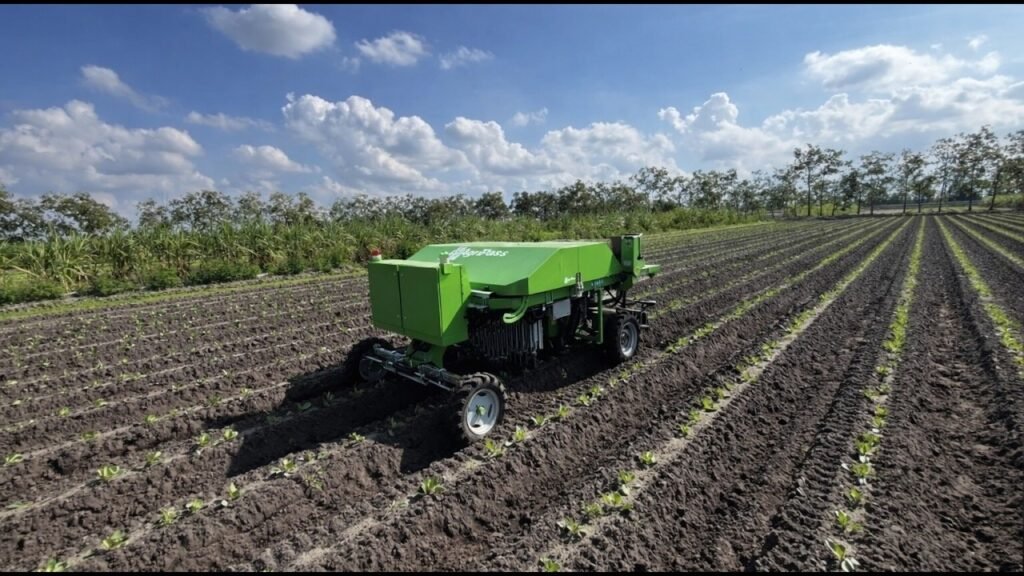
Robotic weeders are evolving quickly. Some zap weeds with lasers, hot oil or electricity, others target them with microscopic sprays. Israeli startup AgriPass, in contrast, pulls weeds out of the ground with what it claims is the precision of a human hand.
While some mechanical weeders lack nuance, AgriPass claims to replicate both the dexterity and judgment of skilled farm laborers, combining AI-driven decision-making with independently operating robotic arms to selectively remove weeds while leaving crops—and surrounding soil structure—intact.
AgFunderNews (AFN) caught up with CEO Liron Cohen Yanay (LCY) at World Agri-Tech in San Francisco to discuss how the technology works, where it fits in the broader robotics landscape, and what it takes to get farmers to adopt it.
AFN: What problem are you solving for growers?
LCY: What we do is human weeding at the farm scale, because there’s a labor shortage and current [chemical] solutions have reached their limit. There is resistance to herbicides, erosion from tillage over time, and people don’t want to come and work in the fields anymore.
We are replicating the human weeding process and making it affordable at scale. AI handles contextual analysis and decision-making to identify which weeds to target and how, in the way an experienced farmer would in real time. Individual robotic actuators then execute these actions in the field.
We’re replicating what humans do and making it easy and affordable to adapt at scale.
AFN: How does AgriPass compare to other mechanical weeders?
LCY: I think that the key question you have to ask is what is the difference between [how] a person [would pull weeds] versus brute force automation? Brute force automation will try to keep a blade in the soil and doesn’t care what it cuts. Whereas a person would say, Okay, this I need to pick, and this I don’t need to. This is the difference.
At AgriPass we have selective action, which is adaptive to the real time situation in the field, which is constantly changing. I can come along one day when the soil is dry. But the second day it’s wet, and that will require a different action. If you just have brute automation [it’s not flexible/responsive] whereas we can do one inch, three inch [interventions], depending on what we find.
We are keeping everything intact and selectively pulling weeds.
AFN: Where does AI come in?
LCY: We use AI for contextual analysis, so we can replicate the way an experienced farmer would analyze a field saying, this is a good weed, I want to keep it. This is a wide leaved [broadleaf] weed, I will cut it this way. This is a grass weed. I need to go deeper.
This is the real time understanding and the real time decision making we’re doing in the field. And then we’re using robotic arms to actuate. It’s actually just like hand hoeing, all the arms work independently, like you’re playing a piano.
AFN: What’s the go-to-market strategy?
LCY: We decided we’d go to small- and medium-sized farms first. We can give them access to technology to solve a real problem and help them improve margins. Second, we’re targeting vegetable crops or high value crops because they have more cycles per acre, they have more weeding per week per year, and they really need a solution for labor working around the crop with crop proximity [ie. the weeds and crops are very close].
Third, we can start by working with regenerative organic farms that cannot use herbicides or cannot till heavily, and then move to the others.
AFN: How widely have you validated the tech across different crops and farming conditions?
LCY: We’re aiming to support multi-crop operation because if you’re regenerative or a farmer of vegetables, you’re likely going to have multiple crops, so the idea is to support as many as we can. We started with brassicas, then tomatoes, then squashes, then melons, and next we’ll move onto beets, onions, carrots, and high density crops.
AFN: Where does autonomy come in? Just in the selection and weeding or also in navigation?
LCY: This [vehicle] could be autonomous, it could be electric, it could be hybrid, but it doesn’t have to be today. I’m focusing on making mechanical hand-weeding at scale. The chassis that I need, I am taking from an OEM off the shelf. Tomorrow we can take something else. I think the world will go for autonomy, I think the world will go for electric. But I don’t think that the farmers can adopt that now fully [yet].
AFN: How much training is required for a new crop?
LCY: We started by taking a few months. Then it went to a few weeks, and now it’s down to a few days, because we use annotation [using AI to mark crops vs weeds] so the model can learn, which is smarter than previously. It will take less and less time to adopt a new one, but we’re relatively efficient with it [already].
AFN: What’s the ROI for a farmer?
LCY: ROI is always about an alternative cost, right? Current cost [savings] if you’re organic, would be around manual labor, mostly. So [using AgriPass] will [pay back in] up to a year on average. If you use inputs and [you are a] conventional [farmer], it will be between two to three years [to get payback].
AFN: What is your business model?
LCY: We sell [rather than use a service model]. And then on top of that, there’s going to be a subscription for an application that will be agentic, where the farmer can check what are the exceptions in the field, if we have new weeds that are telling us a story about what’s going on there, if the crops are fine and so forth. That will be an additional data layer that is connected.
AFN: Where are you on manufacturing and scale up?
LCY: Part of our strategy is to work with regional OEMs. We already signed for Europe with Fyeld Group. They are our partner for the chassis and for AI, and they’re also going to distribute in some countries in Europe. The same [partnership model] we’re going to do for the US, where we currently are having discussions, and the same [approach] for Latin America and other markets. So first we’ll work with farmers directly, but the end game is to manufacture and get to the market through OEMs and strategics.
AFN: What progress have you made to date?
LCY: Just in the second season of trials, we emerged from that with bookings, and that’s a big thing, because we have people that believe in the product. And we keep improving. We’re always in the field. We have three units running in Italy, in Georgia, and in California. We always want to be where the season is. We want to be where the farmers are.
AFN: How much does this cost and what are the biggest barriers to adoption?
LCY: Other solutions cost a lot, that’s a problem, but this is affordable. It’s less than $200,000 for a farmer. That’s something that they can adopt. They just want to know that it’s working from people that they trust and believe.
AFN: Stepping back, what have you learned about agtech adoption in the real world?
LCY: We call it ag robotics 2.0. The idea is to learn from what happened in the past decade… to see what didn’t work and learn from it.
So having something that is completely autonomous, that’s not for us yet. And we don’t have to do everything in-house. I don’t have to develop wheels and engines. We don’t start with big machines [that are] 20 feet [wide]. Let’s prove it on [something that is] six feet and then expand… We are very pragmatic.
The last thing is to decide who is your ideal customer. I’ve done enterprise sales before [to large customers]; it takes 18 months, and you need to come with a proven solution, otherwise stakeholders are not going to sign off, as this is a lot of risk. Whereas smaller buyers have more flexibility. And if you come with a small solution that’s fit for purpose, it’s easier to adapt. They also have fewer decision makers [who have to sign off on a large purchase] so you don’t have to convince so many people.
Further reading:
Frontier AI heads to the farm with Carbon Robotics’ Large Plant Model
Azaneo bets electroporation can outpace herbicides on weed control
RootWave bags $15m to expand its chemical-free weeding platform to Europe, US
Ecorobotix doubles down on AI software for precision spraying after $150m raise
The post 🎥 AgriPass on ag robotics 2.0: ‘We’re replicating the human weeding process but making it affordable at scale’ appeared first on AgFunderNews.