On Udemy, anyone can offer a course. Since the platform launched in 2010, this approach has turned Udemy into the world’s largest catalog of online courses: they now host over 272,000 courses.
In 2025, according to the company, they have 81 million registered users.
In 2020, propelled by the COVID-19 pandemic, they raised $123 million and increased their valuation by over $1 billion. In 2021, the company went public, which gave us a peek at their financials.

In 2025, Udemy’s consumer revenue continued to drop, while B2B (enterprise) revenue climbed again after a fall in Q4, 2024. In Q3 of 2025, Udemy’s revenue of $195.7 million was made up of $132.8 million B2B and $62.9 B2C. Udemy is pushing towards subscriptions at the expense of single course sales and instructor earnings.
Revenue aside, Udemy’s catalog seems to have seldom been analyzed. If you are looking for course suggestions, here is our Udemy’s 250 most popular online courses.
So in this article, we’re going to break down Udemy’s numbers a little further. My colleague @Suparn collected data about the provider’s catalog. And with the Excel skills I (Dhawal) acquired a few years ago (albeit rudimentary), I dug into the data.
This analysis was first published in January 2021. In 2023, my colleague @Archisha re-ran the analysis on the updated Udemy dataset, and in 2024 and 2025, it was @Suparn’s turn again to analyze the data. In 2025, here’s what we found.
Udemy By the Numbers
Course Categories
More than half (53%) of Udemy’s courses belong to the fields of Business (Business, Office Productivity, and Finance) and Technology (Development, IT & Software), but they account for 71% of all enrollments, down slightly from 75% in 2024.

Development courses are the most popular. They have on average 7,527 learners per course, well above the 3,331 average across the platform.
Course Length

The average course length is 3.79 hours in 2025. In 2024 it was 4.69 hours, down from 7.7 hours in early 2023. This will be due to the large number of courses less than 2 hours long. Interestingly, the number of courses over 20 hours in length ballooned from 6,000+ in 2023 to over 11,000+ in 2025. The upshot of this is that the median length is now 2.25 hours, only a slight reduction from 2.3 hours in 2023.
As course lengths increase, average enrollments also increase: learners gravitate towards longer courses.
Courses less than 1 hour long have an average enrollment of 1,724, while courses 15–20 hours long have an average enrollment of 7,130. The average enrollment of courses longer than 20 hours is 11,915.
Course Price

90% of Udemy courses are paid. Course prices range from $19.99 to over $200.00, with 39% costing more than $200.00 (without any discounts or deals). This is a huge increase from only 1% of courses costing over $200 in 2024.
In 2024, 56% of Udemy’s courses were free or cost less than $40, while 3% cost more than $100.
When we analyzed the data back in 2021, around 24% of the courses were more than $100. By 2024, this percentage had decreased to 3%, but in 2025, it has bounced back up to 52%.
The changes in the list price doesn’t mean that the actual price that learners pay has changed. Based on the data in Udemy’s 2021 annual report, the average price a learner paid was $20.40, while the lowest listed price of a course was $19.99. Similarly, in 2023, the average revenue per buyer was $18.60, then by 2025, the average revenue per user dropped from $16 to $13 per month. This is partly due to more emphasis on subscriptions as well as geo-pricing, plus the usual promotions bringing the cost of the courses down, though the frequency of these promotions has been reduced. It also localizes the prices in different markets, bringing the price down by a lot in low-income or emerging economies.
| Monthly Avg Buyers | Avg Revenue per Buyer | |
| 2023 | 1.38M | $18.6 |
| 2022 | 1.336M | $19.7 |
| 2021 | 1.345M | $20.4 |
| 2020 | 1.439M | $18.9 |
| 2019 | 0.962M | $19.5 |
As you can see below, average enrollments increase as the courses’ list prices increase. This doesn’t seem to conform to the traditional supply-demand pattern: higher prices resulting in lower enrollments. This can be because Udemy courses are rarely sold at list price. Some enrollments in more expensive courses may also be from monthly subscribers who can access 12,000+ top-rated courses from $20 per month in America and for lower prices in some other markets.
Course Language
Udemy courses are available in 79 different languages, although more than half of all courses are offered in English. Here are the most common languages on the platform:
- English -> 58.0%.
- Portuguese -> 8.4%.
- Spanish -> 7.9%.
- Japanese -> 4.3%.
- Turkish -> 3.7%.
Course Enrollments
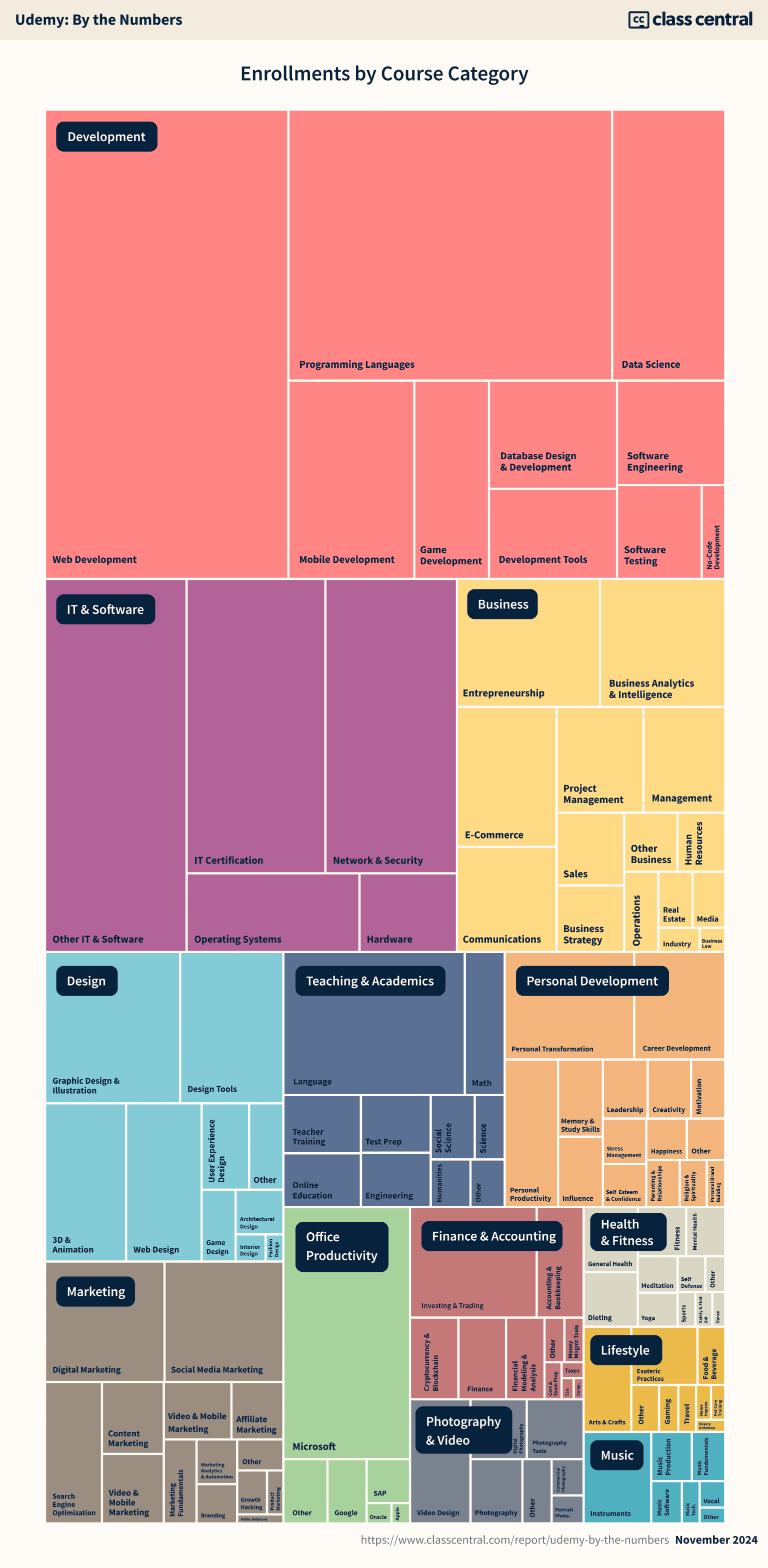
Combined, Udemy’s 272K courses have gathered over 908 million enrollments and average 3331 enrollments per course. What I found most surprising is that the median enrollment is only 243, which means that half of Udemy’s courses don’t reach 243 learners.
Currently, there are 1,016 courses with over 100K enrollments and 11 courses with over a million enrollments.
Do Udemy courses satisfy the Pareto 80/20 principle? I found that Udemy’s top-20% courses by enrollment account for 91.1% of all enrollments.
Course Ratings

In total, Udemy courses have received more than 87.7 million ratings. Class Central’s analysis found that 34.4K of Udemy’s 272K courses (12.6%) have no rating at all.
Ratings tend to be heavily skewed towards the positive side. Over 85% of the ratings are 4–5 stars while 1–2 star ratings represent only ~2.8% of all the ratings.
We also noticed that the rating is correlated with the length of the course. It might be just that the longer courses might be high effort and more polished.
The post 272K Courses, 908M Enrollments: Breaking Down Udemy’s Massive Catalog appeared first on The Report by Class Central.