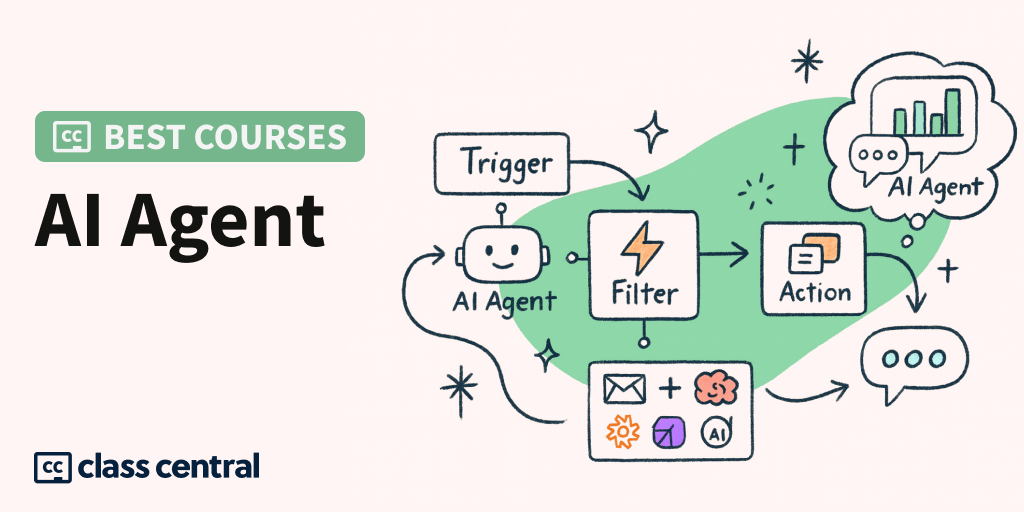

2025 is shaping up to be the year of AI agents. Around 8 in 10 businesses are already exploring them as we speak.
Leaders and hiring managers now value talent who can build, deploy, and manage AI agents to drive OKRs. According to Wang Guanchun, CEO of Laiye:
“I think the valuation metric for a good manager will be: How many digital workers can you manage? That’s a different skill set. It’s about how you can prompt your agents to do the best work they can do.”
So are new-age roles more dependent on learning to build purpose-specific AI agents than rigid software?
I spoke to Pietro Saccomani, too, a no-code enthusiast and founder of MobiLoud:
“AI-powered automation tools like Zapier or Lindy let me work with messy data and turn it into something structured and useful without asking an engineer. Instead of being boxed in by what software allows, I can combine multiple tools, AI steps, LLMs, and automations together. This creates huge leverage in any role.”
In this Best Courses Guide (BCG), I curated the best AI agent courses for beginners and non-coders. For each course, I discuss the learning style, the topics it covers, who should take it, and potential drawbacks.
- Why Trust Us and Our Course Choices
- Best No-Code AI Agent Courses and Certifications for Beginners
- Honorable Mentions: Free AI Agent Building Resources
- Frequently Asked Questions (FAQ)
Why Trust Us and Our Course Choices
Class Central has a catalog of over 250,000 courses and has helped 100 million learners find their next course.
For this guide, I used a multi-layered research process to find the best AI agent course for beginners and non-coders.
- First, I drew on my experience with various AI tools. I’ve tried over 15 no-code AI agent building tools, and I shortlisted the best ones for non-coders.
- Second, I combed through Class Central’s extensive catalog of over 1,100 AI agent and automation courses curated for beginners and advanced learners.
- Next, I engaged with learners on forums like Reddit’s r/AI_Agents and r/nocode to understand their goals and challenges in finding a new course.
Finally, I curated a course guide based on my experience, peer recommendations, and how well these AI agent courses align with real-world applications and learner expectations.
As a result, this AI agent course guide covers an unbiased and deeply researched list of courses focused on your learning goals.
Best No-Code AI Agent Courses and Certifications for Beginners
| Course | Duration | Price |
| Best To Build AI Agents With Zapier (Udemy) | 23 hours | Paid |
| Best for Multi-Platform Mastery (Udemy) | 12 hours | Paid |
| Best for Building Advanced AI Agents (Udemy) | 4.5 hours | Paid |
| Best To Build No-Code AI Agents With Dify (Udemy) | 2.5 hours | Paid |
| Best for Ambitious Beginners With Technical Know-How (Udemy) | 6.5 hours | Paid |
| Best for Academic Excellence (Coursera) | 10 hours | Paid |
| Honorable Mentions | Various | Free |




Best To Build AI Agents With Zapier (Udemy)
- Duration: 23 hours
- Cost: Paid
- Learning style: Practical, with real-world examples and hands-on exercises.
- Suited for: Business professionals, marketers, and anyone looking to automate repetitive tasks across apps.

In January 2025, Zapier rebranded its Central product as Zapier Agents, a more autonomous AI system that works across your tech stack.
This course is an ideal starting point for anyone new to automation. It starts with addressing Zapier’s basic automations and then subtly shifts your mindset to its intricate AI agents.
Krystian Wojtarowicz, the instructor, is an expert in AI and automation and a highly rated instructor on Udemy. His courses involve practical learning through role-plays, which makes learning interactive.
This course focuses on the practical application of agents across 7,000+ apps. You’ll learn to build foundational AI agents that handle tasks like processing form submissions, managing email campaigns, and updating spreadsheets.
Essentially, you’ll move from “if this, then that” workflows to using Zapier’s full suite of tools, including Zapier’s new AI-powered tools like Zapier MCP, Copilot, Canvas, and Interfaces.
Note: The instructor updates the curriculum with every feature launch, so you can always come back here to learn it.
Why take this course:
- Learn Zapier, the industry standard for no-code automation and a foundational skill for modern business and marketing roles.
- Get hands-on experience with Zapier’s newest AI features that make it a true no-code agent builder.
- It has a gentle learning curve, which most students praise. It’s easy to learn if you have a background in marketing or a similar field.
- Includes 13+ real-world automation workflows, 30+ downloadable resources, and a certificate.
Drawbacks:
Focuses exclusively on the Zapier ecosystem and does not cover broader AI concepts.
Best for Multi-Platform Mastery (Udemy)
- Duration: 12 hours
- Cost: Paid
- Learning style: Practical learning, both in creating AI agents and using different AI tools
- Suitable for: Anyone frustrated by scattered tutorials and looking for a complete course

Instead of juggling through scattered tutorials, here’s an all-in-one course that spans multiple no-code tools and applications of AI agents.
Dominik’s teaching style is beginner-friendly and structured, starting with foundational concepts in AI and system design before diving into practical projects.
Speaking of hands-on learning, you’ll design and build AI systems for real-world business scenarios, like automating customer support, content creation, and lead follow-ups.
The course will also introduce you to a range of no-code tools like Relevance AI, n8n, Zapier, and even Voiceflow for agent building, all in one place.
Upon course completion, you’ll have ready-to-use AI agents for different marketing and business processes, suitable for professional use or to showcase your skills.
Why take this course:
- Learn the system design behind AI agents and build them using a diverse toolset, including Relevance AI, n8n, Voiceflow, and Zapier.
- It focuses on the real-world applications of AI agents, especially business-oriented use cases like research, lead generation, sales, and customer support.
- A sweet course exit with over 11 ready-to-use AI agents, downloadable resources, and shareable course certification.
Drawbacks:
- Comprehensive, yet does not dive deep into any single tool as a dedicated, specialized course would.
Best for Building Advanced AI Agents (Udemy)
- Duration: 4.5 hours
- Cost: Paid
- Learning style: Project-based with a focus on open-source frameworks.
- Suitable for: Tech-savvy learners who can trade off a little code for better agent control and customization.

If you find Zapier and Make too restrictive, this course is for you. It teaches you to combine n8n (a low-code platform) with LangChain, a leading open-source framework for building LLM-powered applications.
Taught by Derek Cheung, the 2024 n8n Community Award winner, the course is packed with practical projects. For example, you’ll build intelligent workflows, like a “Chat with Docs” agent that answers questions from a knowledge base and a stock analysis agent that automates financial research.
The course is ideal for the “prosumer,” a non-developer who’s technically adept and wants professional-grade AI agents without code.
You also get $225 worth of paid n8n templates, over 34 downloadable resources, and a super-active Q&A forum to engage with the learner community and Derek himself.
Why take this course:
- You’ll use n8n on top of LangChain to create dynamic, interconnected workflows.
- Learn advanced AI agent concepts for chatbots, RAG, and multi-agent scenarios with guided projects like a travel translator, Slack document bot, and more.
- Build chatbots and an intelligent virtual assistant, like chatbots and complex stock analysis agents.
Drawbacks:
- Some learners report minor difficulties with the initial environment setup for the tools used in the course.
- The curriculum’s longevity is questionable as AI libraries like LangChain evolve quickly, which may cause some course content to become outdated.
I asked Alex, an ML Engineer at ZenML, if longevity is an issue with courses that use an open-source tool stack, and here’s what he said:
“I think there are only a few courses that give real value, and also, since the field changes so often, it’s hard for them to stay up-to-date. It’s probably a better solution to try things out yourself, to build projects and to grow your learning that way, assuming you have the time and interest.”
Best To Build No-Code AI Agents With Dify (Udemy)
- Duration: 4 hours
- Cost: Paid
- Learning style: Step-by-step with hands-on projects.
- Suitable for: Non-programmers wanting to build diverse AI agents via an open-source platform.

Dify is a popular open-source, no-code platform for building AI applications. This Udemy course walks you through using Dify to create AI agents, chatbots, workflows, and text generators. You don’t need to set up servers or deep infrastructure — Dify handles much of that.
You’ll also learn to structure prompts, integrate various LLMs, and manage custom knowledge bases to train agents on your databases and SOPs.
The course covers:
- The fundamentals of LLMs, generative AI, and how they power AI agents.
- Setting up your Dify environment, navigating its interface, and getting familiar with its components.
- Configuring your agent’s behavior by choosing LLMs, parameters, and vision models.
- Managing knowledge bases and memory to provide agents with context.
- Deploying and monitoring agents with detailed logs and observability analytics.
Why take this course:
- Learn Dify, a well-maintained and popular platform with a large community.
- Build your first AI agent: chatbots, text generators, AI agents, and workflows without code.
- Promotes a hands-on approach, applying concepts as you build real applications and workflows.
Drawbacks:
It’s focused on one platform: Dify, which makes the course really subjective as to how you find the platform.
Best for Ambitious Beginners With Technical Know-How (Udemy)
- Duration: 6.5 hours
- Cost: Paid
- Learning style: Hands-on learning with a focus on a single, powerful no-code platform.
- Suitable for: Ambitious beginners willing to tackle more advanced concepts and tools to build powerful AI agents.

If you’re intrigued by LangChain but prefer a visual, no-code approach, this course is for you. It teaches you to use Langflow, a visual, low-code interface built on top of LangChain for creating AI agents without code.
This Udemy course covers an extensive curriculum. That is, you’ll work with different agentic tools and technologies, along with practical tutorials. While it mentions 6.5 hours for completion, if we add implementing time and a couple of trial-and-error attempts, most learners spend roughly 10-12 hours completing projects.
I like the course structure; the learning curve gradually progresses, so it doesn’t overwhelm. You start with the core concepts.
A key technique I learned from this course is: Retrieval-Augmented Generation (RAG), which allows agents to use information from your documents and databases.
The course also covers core AI concepts like the science behind LLMs, prompt engineering, and AI tool integrations. Oh, and it’s updated to 2025 and has thousands of students.
Why take this course:
- It explains AI concepts and core tools in a clear and concise manner. You get to work around many AI agent tools like Langflow, Manus AI, Crew AI, and more.
- You learn to connect your agents to your existing tool stack, like Slack, Discord, and Google Calendar.
- By the end, you’ll build practical agents (chatbots, virtual assistants) and complete a capstone project (an AI assistant named Jarvis).
- It teaches how to integrate agents into your everyday business systems and processes and leverage RAG for on-brand responses.
Drawbacks:
It involves core open-source frameworks and tools. Hence, non-coders and beginners might face a decent learning curve.
Best for Academic Excellence (Coursera)
- Duration: 10 hours
- Cost: Paid
- Learning style: Structured, modular learning with videos, readings, and graded assignments
- Suitable for: Learners who want an academic approach to building LLM apps and earning a certificate.

Coursera (Packt) offers a mini-course on building AI agents with LangChain (code-first), but on top of no-code visual builders like Flowise and Langflow. So while it does involve a code-first framework, you’d probably not require any code. Irony!
Think of this course as a complete round-up. I’ll tell you why. It goes deeper than any other course on this list. You learn about the core components of LangChain (chains, agents, memory), the dominant open-source “stack” behind many modern AI apps.
Also, it’s structured based on Coursera’s proven learning model. It has 9 modules (~10 hours) with videos, quizzes, and 9 hands-on assignments.
This course covers:
- LangChain basics and core functions.
- Installing and using Flowise/Langflow to create AI workflows.
- Build advanced chains such as LLM, conversation, API, and retrieval chains in LangChain.
- Create and optimize prompts within LangChain. You’ll learn to design custom templates, from basic chatbots to complex multi-input scenarios.
- Learn to implement memory and RAG components for contextual awareness.
Why take this course:
- Gain proficiency in both Flowise and Langflow, two popular open-source UI tools for LangChain.
- Benefit from Coursera‘s proven learning model, with a structured syllabus, graded assignments, and discussion forums.
- A fully guided course, with a Coursera Coach chatbot that answers your questions in real-time.
- Receive a formal Coursera certificate upon completion that you can add to your LinkedIn profile to validate your skills.
Drawbacks:
More theoretical and less hands-on compared to quick, project-based courses.
Honorable Mentions: Free AI Agent Building Resources
| Free Resources | Duration | Description |
| Best Crash Course Under 17 Minutes (YouTube) | 17 minutes | A quick, step-by-step tutorial on building customer-facing AI agents using Make.com. |
| How to Build a 24/7 AI Agent with Make – No Code and Free | 19 minutes | Learn to create a round-the-clock AI agent that performs repetitive tasks for you throughout the day. |
| Best Free AI Agent Tutorial for Beginners (YouTube) | 21 minutes | Learn the core concepts and build your first AI agent with n8n. |
Frequently Asked Questions (FAQ)
Are AI agents and Agentic AI different concepts?
Yes, the terms often overlap, but an AI agent generally means any autonomous “bot” built for a specific purpose. For example, a chatbot that books appointments.
Whereas, Agentic AI usually refers to more advanced systems that involve multiple agents working towards a shared goal.
Both can help automate work, but agentic systems tend to be more complex and adaptive.
Which are the best no-code tools for building AI agents?
Based on community feedback, the tools generally fall into three categories :
- For cross-platform workflow automation, Zapier and Make.com are perfect. They are the easiest entry point.
- For power, flexibility, and control, n8n offers more advanced logic and allows you to inject custom code when needed. It is for when you outgrow the simpler tools.
- For building custom AI agents, Flowise, Langflow, MindStudio, and Voiceflow are excellent.
Why are the benefits of learning no-code AI agent building?
Learning how to build AI agents without code offers benefits for founders, marketers, and sales professionals who are low on code.
- You can automate the repetitive, time-consuming parts of your job. This frees you up to focus on strategic, high-value work.
- You no longer have to wait for IT or developer resources to build the tools you need.
- Despite your job profile or position, the ability to build and manage AI agents is a highly valuable and future-proof skill.
Did this guide help? We’ve got 200+ more for you. Check our Best Courses Guides to find your next course!
The post 6 Best AI Agent Courses for Beginners and Non-Coders appeared first on The Report by Class Central.