Ferrari has revealed interior elements of its first-ever all-electric car, and it’s given us the name, too: Luce. That’s Italian for ‘light,’ but is also colloquially used to mean ‘electricity’ (because lightbulbs were many Italians’ first interaction with electricity). It also seems to be a description of the interior design, which was crafted by LoveFrom, a company founded by Sir Jony Ive and Marc Newson. The former was the head of design at Apple responsible for the timeless iMac, iPhone, iPad, and Apple Watch, and you can tell from the Luce’s interior componentry. There are several pieces to discuss, but nothing of the exterior has been revealed besides through spy shots of prototypes. For the full picture, we must wait until May.
Ferrari Luce Steering Wheel
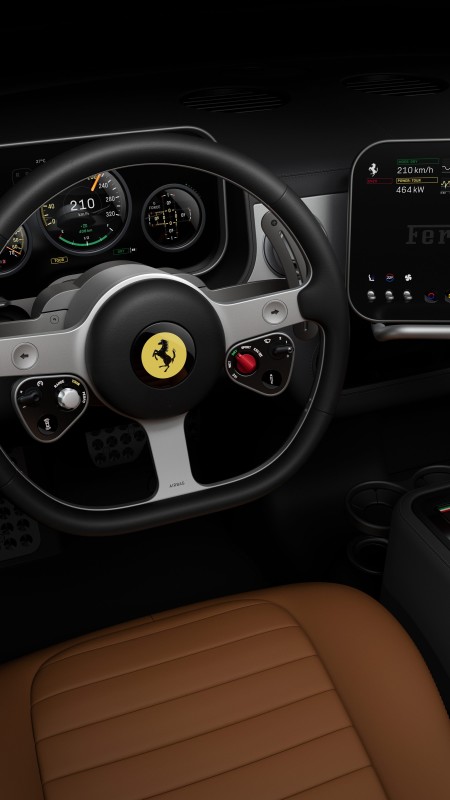
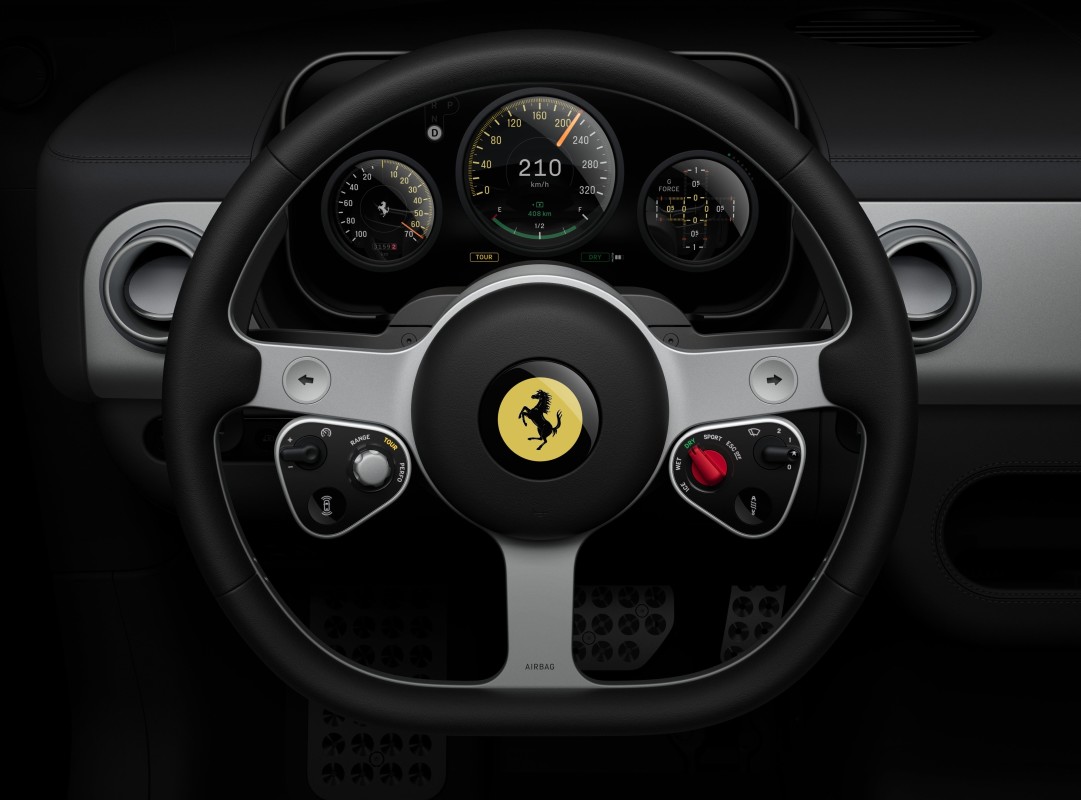
The wheel ahead of a Luce driver will be made of recycled anodized aluminum developed specifically for this application. Its design is inspired by the classic Nardi wooden three-spoke wheel of the 1950s and 60s, and it weighs roughly 14 ounces less than a standard Ferrari steering wheel. Thankfully, its controls are all physical, with a layout Ferrari says is inspired by that of Formula One racers. Indicator buttons reside where the driver’s thumbs will rest, with the button for suspension and dials for windshield wipers and the stability control mannetino on the right side. On the left are similar dials for cruise control and drive modes and a button for park distance control, and in the middle is a classically round airbag cover with the Ferrari logo. Finally, a pair of large column-mounted magnetic paddle shifters sits behind the wheel. These will be used for the EV’s Torque Shift Engagement system, responsible for adjusting the Luce’s torque curve. Essentially, they’re paddles for simulated shifting.
Ferrari Luce Displays and Swiveling Infotainment
The Luce EV will have three interior displays, one of which will be a control panel for rear occupants. Atop the steering column for the first time in any Ferrari is the instrument binnacle, and it moves in tandem with the tiller to ensure the driver has a clear view of all outputs. It boasts two overlapping OLED displays from Samsung, and as crisp as these are sure to be, the real highlight of the interface is how the pair of screens mimics a classic gauge cluster. In a world first, Samsung engineered three cutouts in the display, each of which features a clear convex glass lens and an anodized aluminum surround to enhance the sense of depth. Therein, graphics inspired by aviation, Veglia and Jaeger’s respective clusters, and watchmaking aim to blend old-school analog style with ease-of-use. The center readout even includes an aluminum needle that spins 360 degrees on startup. In the metal, this should make a convincing impression of a traditional gauge cluster. In the negative space above the flanking circular cutouts will be warning lights, turn-by-turn navigation prompts, and other safety info.
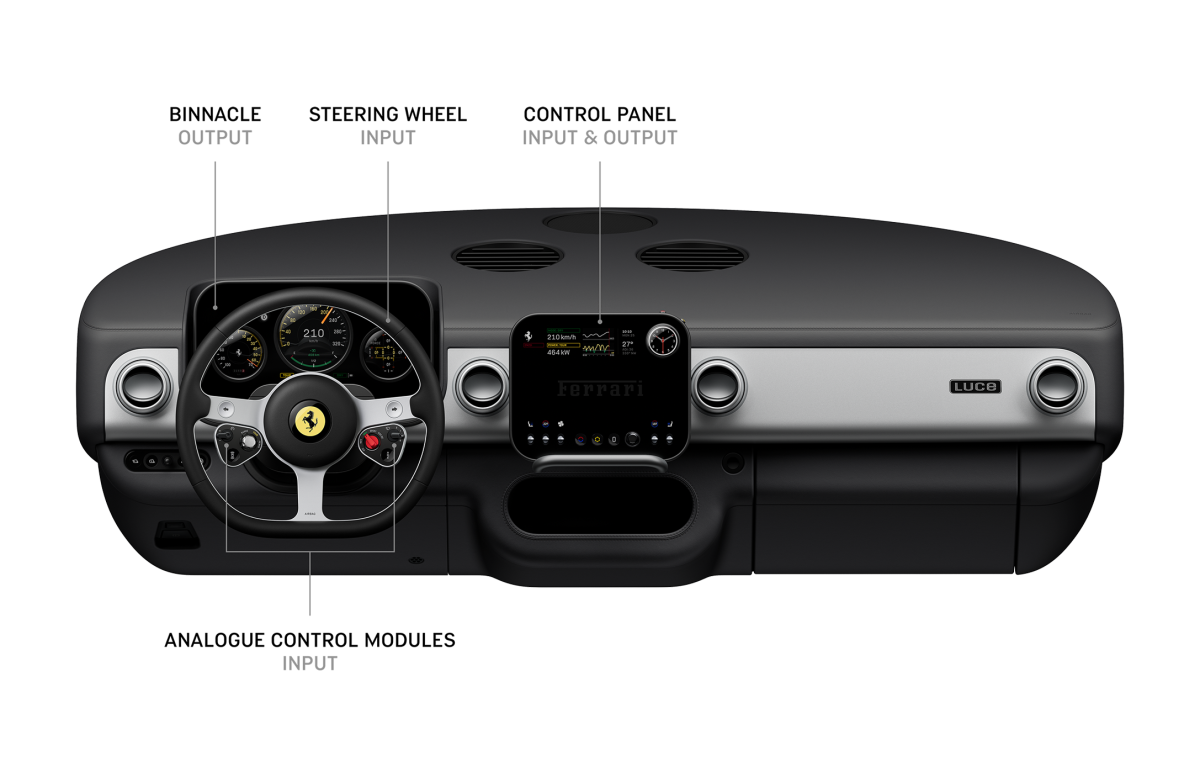
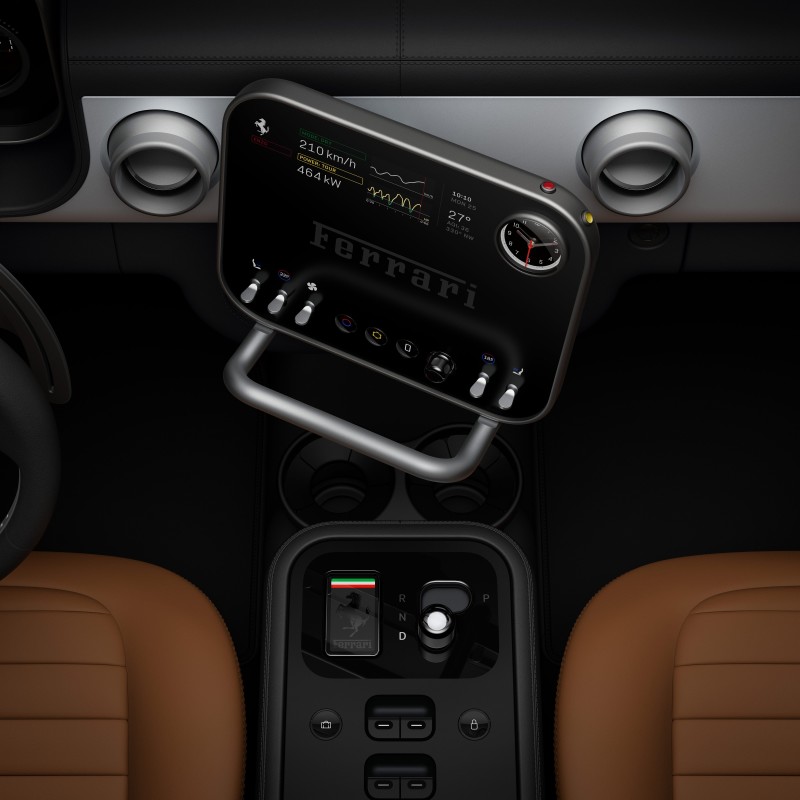
The other important display to note is that which controls the infotainment and other functions like climate control. This control panel sits on a ball-and-socket joint that lets the user angle it towards them, whether they’re sitting in the driver’s seat or are riding shotgun. The handle doubles as a palm rest, making eyes-off operation while the Luce is in motion easier. Along with physical switches for the climate and seat controls (plus a physical volume knob), the display also integrates what Ferrari is calling a micrograph. This sits in the top right of the display and also has physical buttons, allowing it to switch between clock, chronograph, compass, and launch control readouts with animated transitions.
Ferrari Luce Center Console
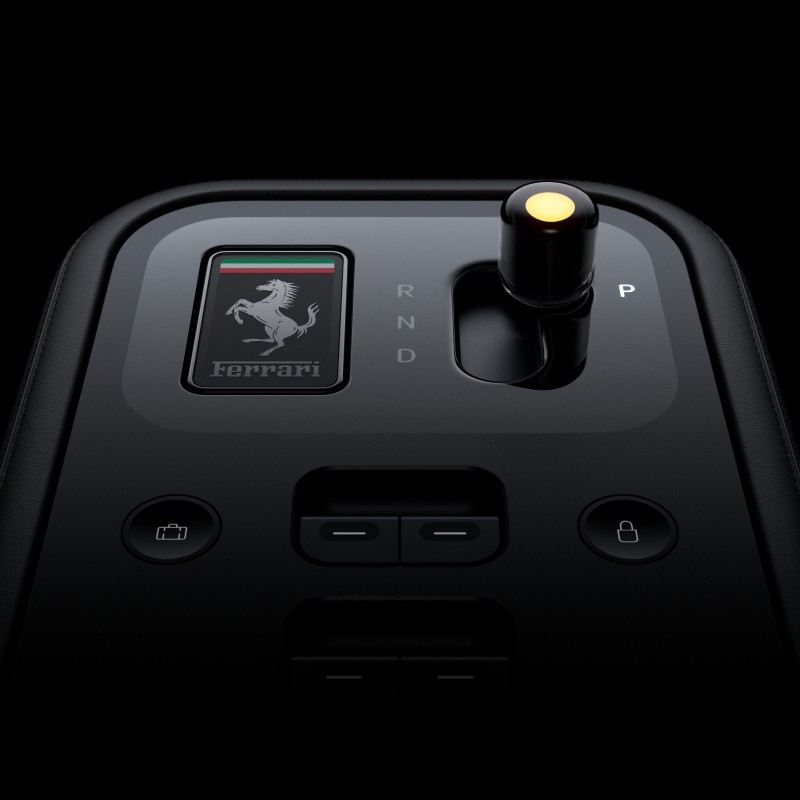
Between the two first-row occupants is a relatively simple center console, in which we find the window switches, door lock and luggage compartment buttons, and a large hazard button. This also has a small shifter, to the left of which is the key fob dock. Ferrari says this is designed to make starting the Luce “theatrical and memorable” by pressing the fob into the console. The fob has an E Ink display, and when it’s depressed in place, the fob’s yellow logo turns black and the control panel and binnacle light up. Naturally, one can keep the fob in their pocket to start the EV, but docking it adds drama to the experience. Ahead of the console are cupholders, though we must say these seem like a bit of an afterthought. On the ceiling, an overhead panel handles exterior lighting and windshield de-misters, as well as housing a launch control switch, which changes the driver display’s power dial to orange and turns the multigraph into a matching five-second stopwatch.
Autoblog’s Take
Ferrari says the Gorilla Glass is strong, fingerprint-proof, and scratch-resistant, and as we can see, there’s minimal use of plastic anywhere in these interior components. All of this is intended to make the Luce’s interior feel substantial yet light and elegant. Extensive use of aluminum and leather is welcome, as is a multitude of physical controls. The minimalist, Apple-like design certainly sets the Luce apart from any other Ferrari, or indeed any other car at all, while the retro-style displays show that Maranello is trying very hard to make its first EV feel like an instant classic. The center console is somewhat disappointing in its blandness, but the use of glass and the promise of animated E Ink tech is sure to make it sparkle a little brighter in real life. We’ll have to wait for the exterior reveal in May to see how well all this integrates, but whatever the end result, we applaud Ferrari for thinking outside the box. Or, at least, for hiring someone outside its box to think for it. Pininfarina must be seething with jealousy.