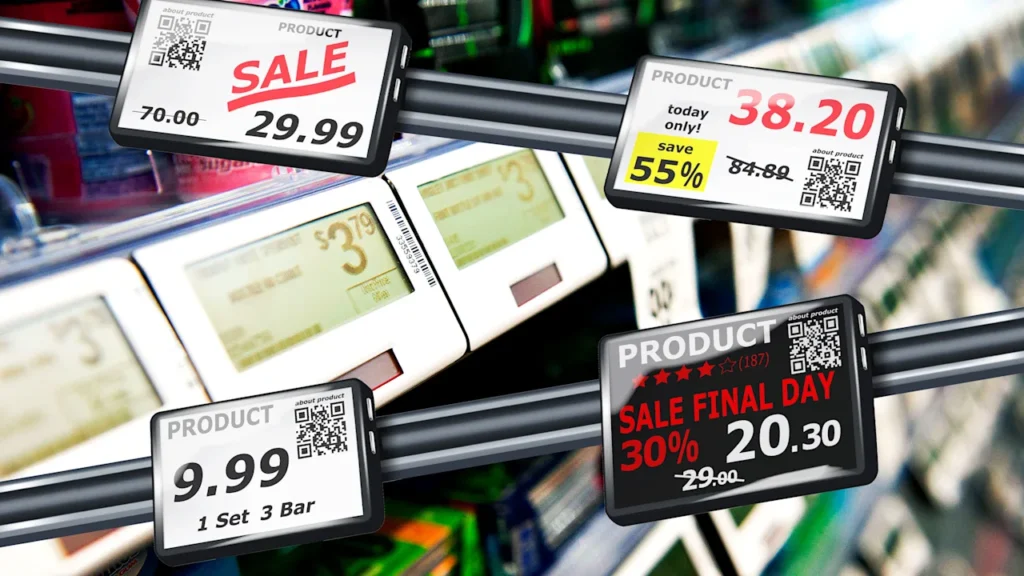
Perusing the grocery aisle in the Westside Market on 23rd Street in Manhattan, you might not even notice the screens. They look just like paper price labels and, alongside a bar code, use a handwriting-style font we’ve come to associate with a certain merchant folksiness. They’re not particularly bright or showy. The only clues that they’re not ordinary sticky shelf labels are a barely distinguishable light bulb and, on some, a small QR code.
These are electronic shelf labels, chip-enabled screens that some stores are now using to display product prices. Unlike their paper predecessors, the prices aren’t printed in ink but rendered in pixels, and they can change instantaneously, at any time. The labels also come with additional features. An LED light can switch on to flag something, perhaps a product that needs restocking, explains Vusion, the company that made the labels Westside Market is now using. The QR codes are designed to help customers find more information about a product, or integrate with a personalized shopping list someone might have.
Of course, these labels aren’t just labels, but end-points of a much larger effort to digitize every way we now interface with products. “You have a network in the store. You send the information that you want to transmit to the labels, and there you go,” says Finn Wikander, the chief product officer at Pricer, another company that’s manufacturing ESLs with the hope of making them a fixture of 21st century shopping.
Unsurprisingly, electronic shelf labels have become a flashpoint for consumer anxiety. The companies selling the devices, and the stores buying them, say the technology isn’t about screwing people over but about making their businesses easier to run. Automating price changes eliminates hours spent replacing labels. It also makes it simpler to respond to new tariffs or account for rising inflation.
But in a world spooked by dynamic pricing, electronic shelf labels can look to some like a goblin of digitization—a symptom of late-stage Silicon Valley campaigns to streamline and optimize seemingly all elements of commerce. Even members of Congress have raised suspicions about the technology, arguing that it enables price gouging and discrimination, particularly as it becomes more common in the United States.
“Historically, when we thought about brick and mortar stores, prices were relatively stable,” Vicki Morwitz, a Columbia Business School professor who focuses on marketing and consumer behavior, tells Fast Company. “These electronic shelf tags break that assumption which makes pricing feel less stable. Even if average prices aren’t necessarily going up, that shelf instability can become a psychological flash point.”
Screenified everything
A handful of companies sell this technology as part of broader enterprise software packages. There’s Pricer, a Swedish firm, and Vusion, headquartered in France. Solum operates out of South Korea, and Opticon, known for barcode scanners, is also in the mix. Electronic shelf labels can also be bought, ahem, off the shelf and integrated into a store’s Bluetooth network—no enterprise startup required.
The pitch for these devices is exactly what unsettles so many shoppers: Electronic shelf labels make it much easier for stores to change prices dynamically and more frequently. The companies that manufacture and deploy these tools say there are legitimate reasons to do so. For example, a store might raise prices if suppliers increase costs, or cut them quickly when a product is nearing its expiration date.
ESLs also allow chains to keep prices consistent across locations and respond more quickly to competitors (especially valuable at a time when shoppers are already carrying smartphones to compare prices between stores). “Most consumers today are used to either doing their own scanning or use ChatGPT or Gemini to find the best offer or use price comparison sites,” says Pricer’s Wikander.
Then there’s labor. Employees might spend hours replacing labels for a price surge or sale. ”The idea is to liberate people from very tedious tasks in a store. Changing prices could be one. Launching promotions could be one,” argues Loïc Oumier, a marketing executive with Vusion. There are also regulatory considerations: France, for instance, passed a law mandating that prices at checkout match advertised prices on aisles, which pushed stores in that country to adopt the technology, says Wikander.
They are now rolling out more broadly in the United States, especially at large chains. Vusion says its labels are in use at Fresh Market, Mattress Firm, and Leon’s in Canada. Walmart, which declined to comment for this story, announced in 2024 that it would begin installing electronic shelf labels, with plans to bring Vusion’s technology to more than 2,000 stores by the end of 2026. Tests or deployments have appeared in Whole Foods, Schnucks, and even smaller retailers like Westside Market.
The reception can be frosty. While there are some scenarios, like from Uber rides and airline tickets, where consumers have come to accept rapidly changing costs, the practice often feels jarring. That tension was evident in 2024, when Wendy’s faced backlash after announcing plans to install digital menu boards and later promised it wouldn’t introduce surge pricing for burgers. Shoppers also worry about price gouging, where retailers spike prices during emergencies. “Exploiting consumers when they have no real alternatives or limited alternatives,” says Columbia’s Morwitz. “The problem is consumers may feel exploited long before an economist would say they are.”
There is also the understandable anxiety that the technology is designed to cut jobs. Some workers, as reported in The Nation, say the labels do not simplify their work but replace one kind of labor with another form of algorithmic babysitting. Unlike paper tags, screens can break, and computer programs fall victim to bugs and internet outages. Employees at one chain store operated by Kroger, which has also deployed the tech, have apparently complained that the labels “heat” up stores. (Kroger did not respond to Fast Company‘s request for comment.)
Concerns reach D.C.
Lawmakers have taken notice. Democratic Senators Elizabeth Warren of Massachusetts and Bob Casey of Pennsylvania wrote to Kroger after the company announced it would introduce the technology, amid accusations that it was using facial recognition to show different customers different prices. In a letter of response obtained by Fast Company, Kroger defended the rollout, saying ESLs helped it manage the 1.3 billion price changes it implements each year and freed up associates to assist customers. Paula Walsh, Kroger’s director of retail operations, denied in the letter that the company was using facial recognition or collecting personal information from customers through the tags.
“Kroger dodged my questions but confirmed my key concerns: It’s using electronic shelf labels to change grocery prices in real-time and collect data that could be used to jack up grocery prices for Americans,” Warren tells Fast Company. ”I’ll keep pushing to make sure consumers aren’t being exploited while they work hard to put food on the table.”
Wikander, for his part, dismisses the idea that retailers would use the technology that way. “Just because you have the possibility of screwing your customers doesn’t mean that retailers will do that,” he says. “I don’t think retailers would typically do it, because the consumers are smarter than that.” Wikander says it takes a typical business around a year or two and that, while the investment upfront is big, the labels last for many years.
Indeed, for all the eeriness surrounding the labels, research shows that it might not be much of a change, price wise, for either consumers or businesses. Ioannis Stamatopoulos, a business professor at the University of Texas at Austin, says there is little evidence that digital shelf labels lead to significant price swings. He pointed to a 2025 study involving an American grocery store that found no evidence of the practice, and another involving an international grocery store that showed that prices tended to decline, particularly for items with short shelf lives.
Much of his research, at least, suggests that the labels are most effective at stopping food waste, since it makes it easier for stores to offer sales on products like bananas and strawberries when they’re about to go bad.
For now, the future of grocery shopping may look almost exactly like the past—except the price tag is oh-so-faintly glowing.