In NW India, rainfall in the 2025 monsoon was 27% above the long term average. Over 2,500 people were killed in India and Pakistan by landslides and floods as a result.
In India and Pakistan, the 2025 summer monsoon generated unusual amount of landslide activity. I described some of these events along the way, most notably in India. In Pakistan, it is much harder to get a good picture of the events that occur in the higher mountain areas.
A new open access paper (Sana et al. 2026) in the journal Landslides provides an initial commentary on these events. By their calculation, 1,528 people were killed in floods and landslides in India and 1,006 were killed in Pakistan.
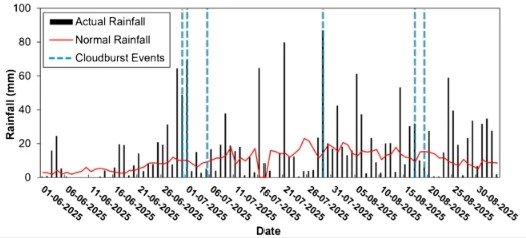
The paper provides a description of some of the more serious events, which is in itself very helpful, but the most interesting aspect is the consideration of the underlying causes. Across all of India, the total monsoon rainfall was 10% above the long term average, but in Northwest India, which was most seriously impacted area, rainfall was 27% above the long term average. In addition, there was an unusually large number of shorter duration extreme rainfall events, which were primarily responsible for the landslides and floods. This graph, from Sana et al. (2026), provides the 2026 monsoon rainfall record for Mandi district in Himachal Pradesh, for example:-
An example of these shorter rainfall events occurred in Khyber Pakhtunkhwa (KP) province between 14 and 25 August 2025, when a succession of cloudbursts triggered landslides and floods in Buner, Swat, Shangla, Mansehra and Dir districts, killing 504 people and leaving thousands more homeless.
But Sana et al. (2026) also remind us that rainfall alone is not the cause of these landslides and floods. Vulnerability has also increased dramatically – for example, there has been a sharp decline in forest cover across much of the area. There has also been growth in urban areas, often with poor planning control, meaning that much of the population is occupying more hazardous locations. And, as I have noted before, poor quality infrastructure development (especially road building) is driving instability across large swathes of hillslopes, rendering them vulnerable to the changed rainfall patterns.
I write on the morning after the decision by the frankly nonsensical decision by the Trump government to reverse the 2009 endangerment finding regarding greenhouse gases, an event that will be judged harshly by future generations. However, in the medium term, this will further exacerbate the issues of increasing rainfall intensities, which drive these horrific events.
It is really helpful that Sana et al. (2026) have provided this intial commentary and analysis of the 2025 monsoon landslides and floods. I will look forward to seeing more detailed analyses in due course.
Reference
Sana, E., Kritika & Kumar, A. 2026. Preliminary investigation of rainfall-induced landslides and related damages by the 2025 extreme monsoon in the Northwestern Himalayan region. Landslides. https://doi.org/10.1007/s10346-026-02703-2
Text © 2026. The authors. CC BY-NC-ND 3.0
Except where otherwise noted, images are subject to copyright. Any reuse without express permission from the copyright owner is prohibited.