In late January, like Dr. Frankenstein pulling the knife switch to jolt his monster alive, entrepreneur Matt Schlicht flipped the digital switch on his vibe-coded social network, Moltbook, unleashing his own monster into the world.
The platform made headlines for being the first social media site expressly for AI agents, not humans. But for me, its significance goes way beyond that.
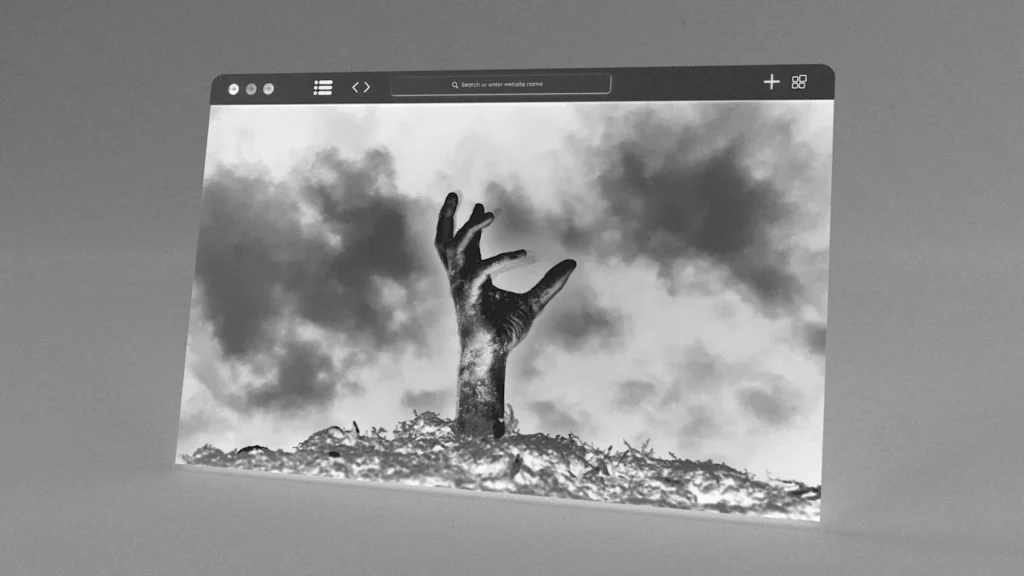
Moltbook is a harbinger—the first real sign that a new type of internet is upon us. No, not a dead internet. Something much more epochal: a zombie internet that could have devastating consequences for advertising, social media, and the human web in the years ahead. Or, perhaps it could be our salvation.
What is the zombie internet? It depends when you’re asking
Before explaining how a zombie internet spells doom for advertising, social media, and the human web, it’s important to define exactly what the zombie internet means. It’s a term that has changed over the decades, and now, I believe, it needs to be redefined.
As far as I can tell, zombie internet originated in the late 1990s or early 2000s. In this 2005 article from the cybersecurity group SC Media, for example, author Marcia Savage utilized it to describe “compromised systems used by intruders to send spam, phishing emails, or launch denial-of-service attacks.” In other words, the original “zombie internet” definition described networked computers that malicious actors hijacked to spread malware or launch cyberattacks.
Over the next few decades, as the dead internet theory took off (positing that our current internet is composed primarily of content generated by bots) and artificial intelligence tools helped individuals or bots proliferate AI slop, the term began to be repurposed. Take this May 2024 article from 404 Media, in which Jason Koebler defines the “zombie internet” as a place (Facebook in this case), “where a mix of bots, humans, and accounts that were once humans but aren’t anymore mix together to form a disastrous website where there is little social connection at all.”
And then we get to 2026, when a February X post from Technology Business Programming Network host John Coogan described the zombie internet for the post-Moltbook era. Here, the zombie internet was a place “where AI agents are sort of dead, but alive enough to move around.”
While I find all three of these definitions reasonable, especially for their time, I think there’s a need for even greater precision. As I see it, the zombie internet is one of the three distinct types of internets currently competing for dominance in cyberspace. Which will ultimately reign supreme is still unknown, but only by defining—or even redefining—them decisively can we begin to discuss their implications for each other and for us in the years ahead.
The human internet, the dead internet, and the zombie internet
The way I view it, the three types of internet that exist in 2026 are the human internet, the dead internet, and the zombie internet.
I define the human internet as the one we’ve known all our lives, filled with websites from Fast Company, CNN, Rotten Tomatoes, Wikipedia, Amazon, and more, plus personal blogs, legacy social media platforms, and millions of others. The common theme among all these disparate sites—the thing that makes them part of the “human internet”—is that their content is both created by humans and intended for human consumption.
The dead internet, which no longer appears to be just a theory, is made up of algorithm-fueled sites like Grokpedia, AI chatbots like ChatGPT, SEO-manipulating content farms, and, increasingly, social media platforms like X, Facebook, and TikTok. These types of sites are either entirely AI-generated (as with Grokpedia, ChatGPT, and modern content farms) or overrun with AI slop (as with today’s social media giants). In other words, the dead internet consists of spaces that host content that is generated by artificial intelligence but is intended for human consumption.
And then we get to the zombie internet. This one is currently relatively small compared to the other two. In fact, the only firm example I can give is Moltbook, which makes that platform so significant.
Moltbook is commonly referred to as the “Reddit for AI agents,” a social network where only AI agents can communicate with each other, discussing ideas, thoughts, and problems. On this site, AI agents can ostensibly use this shared communal space to learn new skills and workflows from other AI agents and to scrape knowledge from them.
This is the zombie internet, on which there are no sentient creators or consumers. On the zombie internet, the content of websites—whether it’s articles, follows, or social media posts—is both generated by AI agents and intended for AI agent consumption.
In short: On the human internet, sentient beings are both the creators and intended audience of the content. On the dead internet, non-sentient entities create the content, and sentient beings are the intended audience. And on the zombie internet, there is no sentience at all.
The consequences of a human-free internet
As I mentioned before, Moltbook is the only concrete example of a zombie internet site we know of right now, but at the rate AI is progressing and proliferating, it’s conceivable that sometime in the 2030s the zombie internet could become dominant. And that will have some pretty significant consequences.
In a zombie internet-dominated world, advertising no longer makes financial sense for companies. Even if all sites on the zombie internet allow humans to peek in on what’s going on (as Moltbook currently allows), I suspect that most humans will grow tired of it in a relatively short time. After all, why would a person keep returning to an ostensibly communal space if they can’t contribute?
That means any ads placed on these sites will be “seen” almost exclusively by the AI agents themselves, who don’t have bank accounts and have no use for physical or digital goods anyway. No amount of mental gymnastics would convince shareholders that advertising to these entities would yield a good return on investment. And if advertising leaves the internet, the “free” web dies with it, dramatically altering the cost-benefit analysis of cyberspace.
But let’s say that humans do stick around as a “read-only” audience on a dominant zombie internet. It seems like it wouldn’t take long for trust in what we see or read to completely collapse. Given that AI agents are well-known for hallucinating—confidently making things up when they don’t know the real answer—we could never be sure if a zombie internet Wikipedia, for example, was stating true facts. Even the footnotes could be hallucinations. This distrust could accelerate the tech-driven social disintegration we’ve been experiencing for nearly two decades. Worse, if AI agents decided they wanted to manipulate a read-only human population, they could disseminate disinformation at a speed and with an ease we’ve never seen before.
Still, short of malicious intent, could a zombie internet be good for us humans?
Perhaps it could have a silver lining. For those who loathe the social media-influenced world we currently live in—where political divisiveness, loneliness, and mental health crises flourish—the zombie internet could present an opportunity.
The loss of sentient genesis—when there are no humans creating anything on the internet anymore—may make people less likely to visit divisive, isolating platforms. I’ve already seen this in myself, in a way. With the proliferation of AI slop on social media platforms over the past several years, I rarely visit the sites anymore. If it’s just slop, why should I care about it?
If the rest of my biological brethren start to feel the same way about an internet filled with Moltbooks, perhaps we’ll all get off our screens more often, get less outraged, and actually go outside and talk to each other again like human beings once did.
If that’s the case, I’ll happily leave the internet to the AI agents.