For the past decade—and really, for its entire 84-year history—the laundry detergent brand Tide has been trying to simplify the process of doing of laundry. From its original all-in-one powder to 1980s-era liquid soap to the 2012 introduction of the packet-based Tide Pod, the brand and its parent company Procter and Gamble have regularly reformulated the core product to accommodate the seemingly simple but highly diverse act of washing one’s clothes.
“There are 55 unique steps we’ve identified in the laundry process,” says Marchoe Northern, president of North America fabric care at Procter and Gamble. “Our job is to continue to think about ways to solve today’s modern need challenges.”
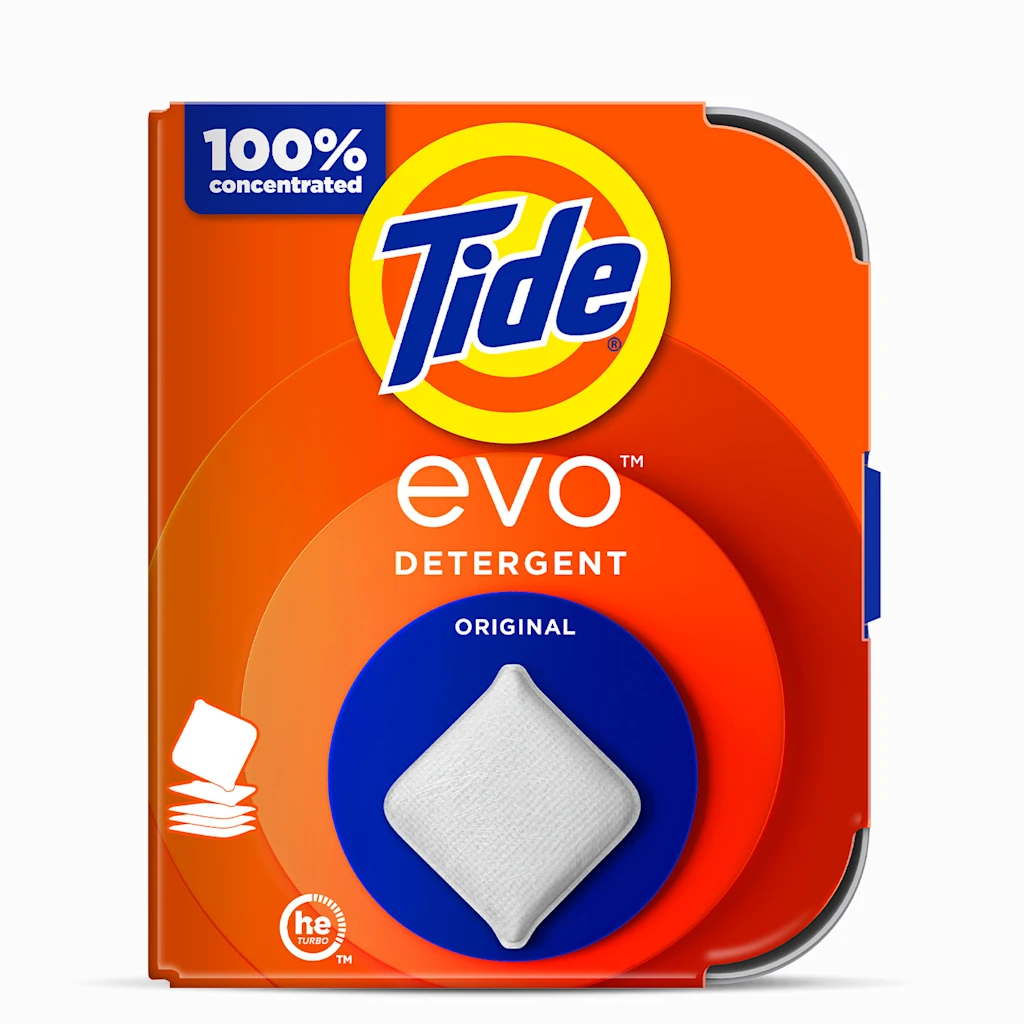
That’s why Tide has spent the last 10 years creating a new kind of detergent product in the form of a fabric-like tile called Tide evo. Developed to streamline the way people add detergent to their laundry load, Tide’s new tile format requires little more than dropping a pre-dosed tile or two into a washing machine.
The Tide tile is a new form factor, but not just for novelty’s sake. The tile was developed by a team of 15 PhD-level chemists and engineers to eliminate the need for any fillers or non-cleaning ingredients. Unlike typical powder or sheet detergents that rely on fillers and liquid soaps that are dissolved in water, Tide evo is a 100% concentration of cleaning ingredients like surfactants, enzymes, alkalinity builders, and polymers.
Detergent designed for four senses
It took the company a decade to figure out how to do this, using a proprietary approach to spin these cleaning ingredients into fibers that can be woven together. Each Tide evo tile is made up of more than 15 miles of these fibers, which gradually dissolve when added to water. In contrast to other detergents that have plastic packaging and weights that increase shipping-related emissions, Tide evo is lightweight and comes in a fully recyclable box.
The tile is safe to touch, and in more than two years of market research Tide conducted among consumers in Colorado Spings, Colorado, the company found that people wanted to do more than just touch them. “Typically, people pick up a tile, they kind of flex it to see if it’ll break or crumble, and then they put it up to their nose to smell it,” says Northern.
Leaning into consumers’ sensorial inclination, Northern explains that the company designed the tile itself to be a visually appealing diamond, and engineered its recyclable paperboard box to make an audible click when it’s closed. “This actually engages four of your five senses,” she says.
The fifth sense, taste, is one Tide definitely does not want to engage. In 2018, the brand had a major PR catastrophe on its hands when people on the internet created the “Tide Pod challenge,” daring each other to eat the candy-colored detergent pods. This proved incredibly dangerous. Many people were hospitalized, and there have been incidences where the ingestion of detergent pods has led to death.
The Tide evo is comparably visually simple, with its diamond shape, a monotone color, and a pliable, fabric-like feel. A sample box sent by the company pops open to reveal two neat rows of eight tiles, with no other adornment or packaging. Picking up a tile, it feels like a dense sponge. It is as unappetizing as a fuzzy piece of felt.
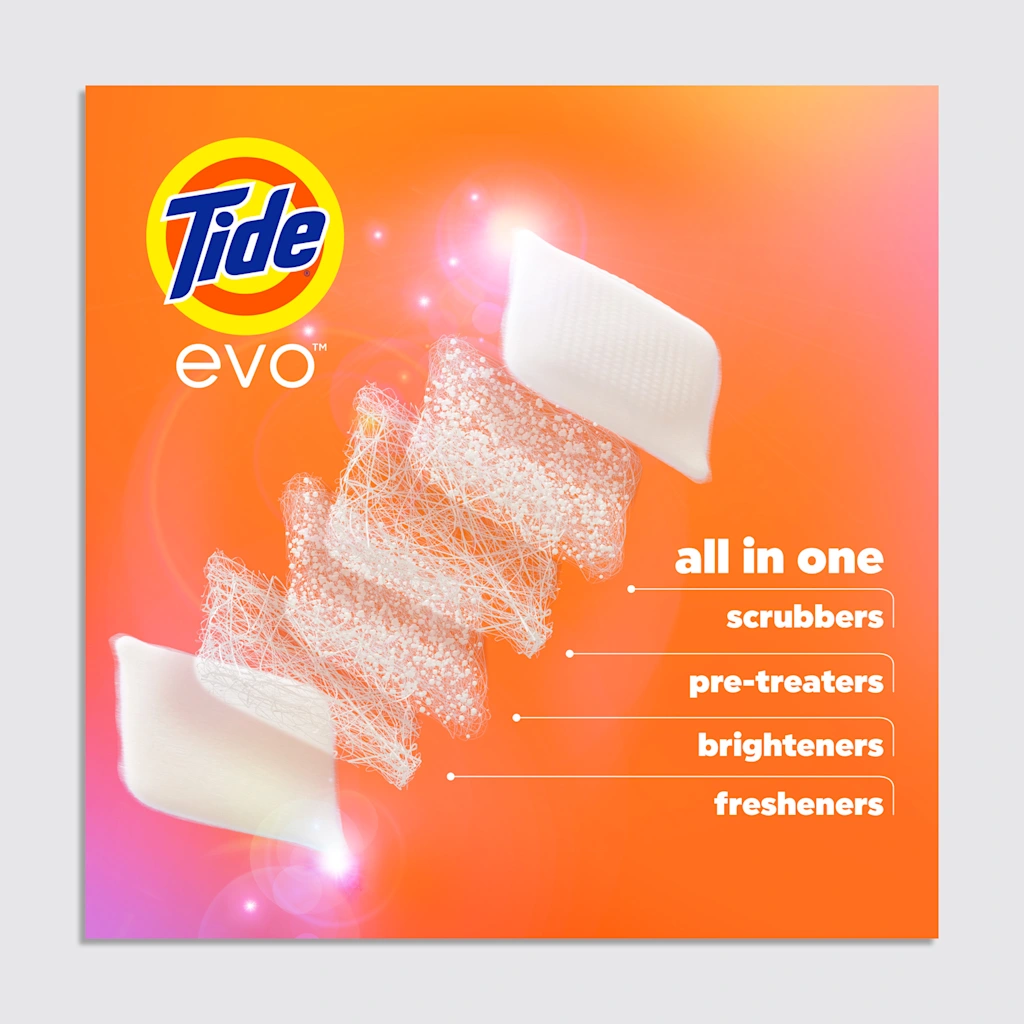
Chemically, though, the tile mimics the innovative function of the Tide Pod, which separated its stain removal, whitening, and brightening capabilities into the capsule’s multicolored chambers, allowing them to be deployed at different times during the wash cycle. Tide evo does this through its six layers, which are made up of woven fibers of surfactants, and embedded with cleaning ingredients formulated to perform different tasks, from breaking down stains to whitening to removing odors.
“This is really first-of-its-kind technology,” says Jennifer Ahoni, Tide’s scientific communications director and principal scientist.
On a recent video call, Ahoni offered a science class demonstration of the tile in action. She placed a single layer of the Tide tile on top of a beaker and began slightly soaking it with a stream of water from a squeeze bottle. Within a few seconds, the tile began to dissolve, eventually opening up a hole in the center and leaving a pool of soapy water below.
In another beaker, she fully dissolved a single layer of a tile into water with a few twirls of a tweezer before dropping in a small piece of polyester-cotton fiber that had been soaked with bright orange chili oil. Almost immediately small globs of the orange oil can be seen lifting out of the fabric and rising up to the surface of the soapy water like the inside of a lava lamp. “What you’re seeing here is that concentration. When you’re taking out the extras, the fillers, the water, and just focusing on the cleaning technologies, you can get this instant activation which translates to instant clean,” she says.
Getting to this point has required a large but undisclosed investment. Procter and Gamble has filed 50 different patents related to the product, from the tile itself to the manufacturing process required to produce it. None of the company’s existing facilities were capable of producing the tiles as they’ve been developed, so an entirely new plant had to be built in Alexandria, Louisiana.
But Northern says the time and expense will all be worth it. “We have high degrees of confidence because it’s arguably our most tested product before launch,” she says. Internal projections forecast annual sales to reach up to $500 million.
Tide evo will officially be hitting stores across the U.S. in April.