The British Museum acknowledged that it had updated certain displays in its Middle East Galleries with “terms such as ‘Canaan,’” the Biblical Hebrew name for the Southern Levant region, amid news reports accusing the institution of erasing Palestinian history.
Canaan refers to an ancient region that encompassed modern-day Palestine, Israel, Syria, and Jordan. According to some academic sources, the term first emerged around 1500 BCE, and the region’s earliest inhabitants settled in Jericho in the modern Occupied West Bank. In the Old Testament, Canaan also refers to the land promised to the Jewish people by God.
“Some labels and maps in the Middle East galleries have been amended to show ancient cultural regions, which is more relevant for the southern Levant in the later second millennium BC,” a British Museum spokesperson said in an email to Hyperallergic.
The museum, however, denied removing the word “Palestine” from its displays altogether, as initially reported by the Telegraph on Saturday.
“It has been reported that the British Museum has removed the term Palestine from displays,” the spokesperson said. “It is simply not true. We continue to use Palestine across a series of galleries, both contemporary and historic.”
“We use the UN terminology on maps that show modern boundaries, for example, Gaza, West Bank, Israel, Jordan, and refer to ‘Palestinian’ as a cultural or ethnographic identifier where appropriate,” the spokesperson continued.
The group UK Lawyers for Israel celebrated the changes in a statement claiming that the revisions were a result of its requests. In a letter to the museum, the group had asked the institution “to describe in some detail the history of Canaan and the Canaanites and the rise of the kingdoms of Judah and Israel using those names.” UK Lawyers for Israel argued that certain labels “retroactively apply the term ‘Palestine’ to periods in which no such entity existed,” thus “obscuring the history of Israel and the Jewish people.”
On its website, the group said that a panel in the museum’s Egypt galleries was subsequently altered to read “Canaanite descent” instead of “Palestinian descent.” The group also claimed that it had flagged an exhibit of ancient dolls that are noted as wearing “Palestinian traditional dress,” and that the museum had vowed to “look again at the use of the term ‘rural Palestine.’”
The British Museum spokesperson told Hyperallergic that the decision to change the labels and maps in its Middle East galleries was made independently and was not influenced by the letter from UK Lawyers for Israel.
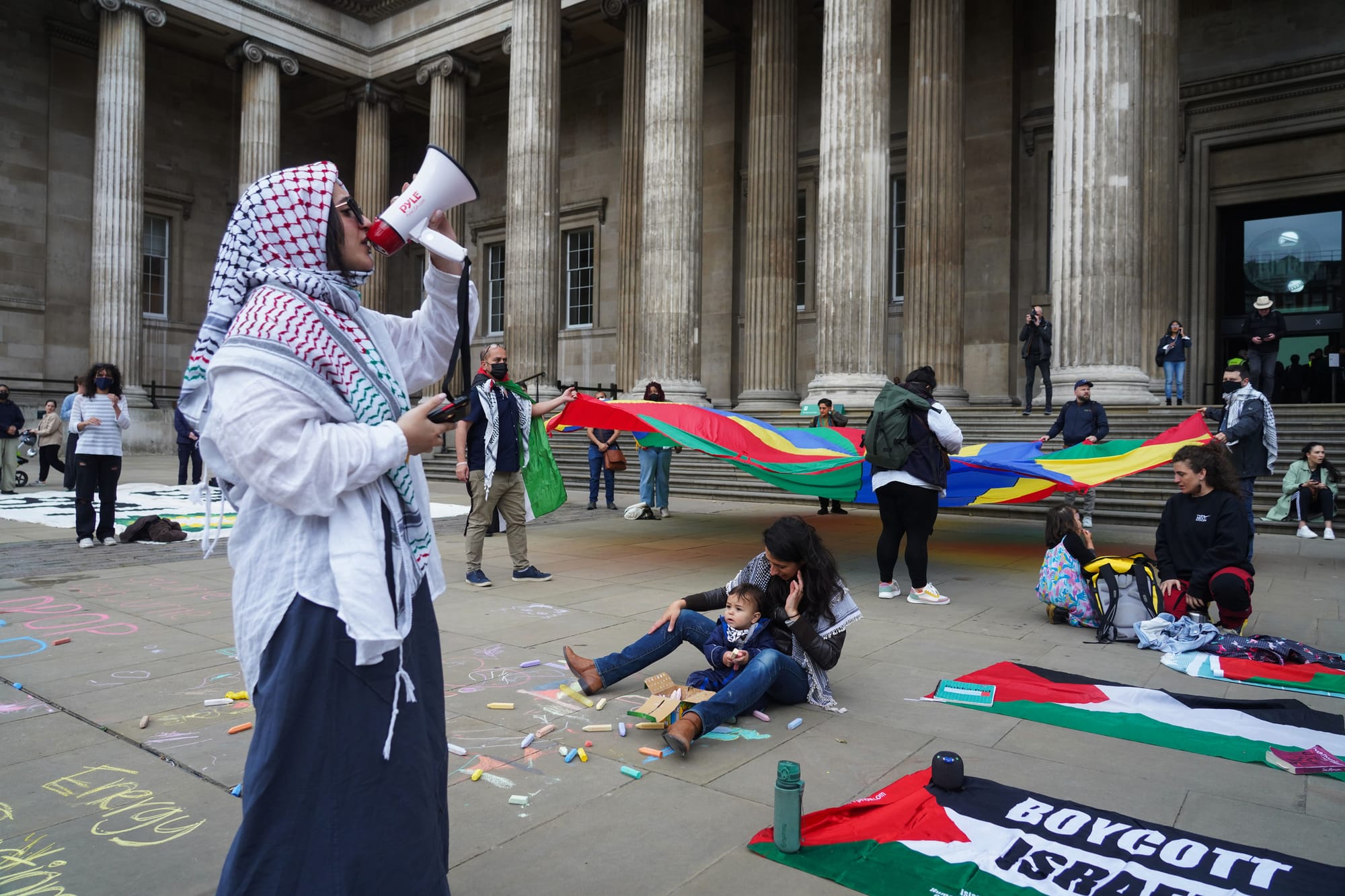
On Monday, the Palestine Forum in Britain published an open letter addressed to the museum’s board of trustees condemning the museum’s efforts to “remove or obscure” the word Palestine.
“We view this as a troubling act of historical erasure that contradicts the museum’s professional and ethical responsibilities,” the group wrote on X.
The Palestinian advocacy group demanded the museum reinstate texts including Palestine, commit to independent scholarship without political influence, and “engage with Palestinians, archaeologists, and cultural experts.”
Scottish art historian William Dalrymple, criticizing reports of the British Museum’s reported label changes on X, said the earliest reference to the word “Palestine” dates back to the Medinet Habu, an ancient Egyptian monument from 1186 BCE.
“Ridiculous of the British Museum to remove the word ‘Palestine’ from its displays, when it has a greater antiquity than the word ‘British,’” Dalrymple wrote.
More than 13,000 people signed a Change.org petition demanding that the British Museum restore the labels to relevant displays and “provide transparency regarding the decision-making process.” The petition also asks the museum to uphold curatorial ethics that are free of “political pressure.”
“This decision is not supported by historical evidence and contributes to a wider pattern of erasing Palestinian presence from public memory,” the petition reads.