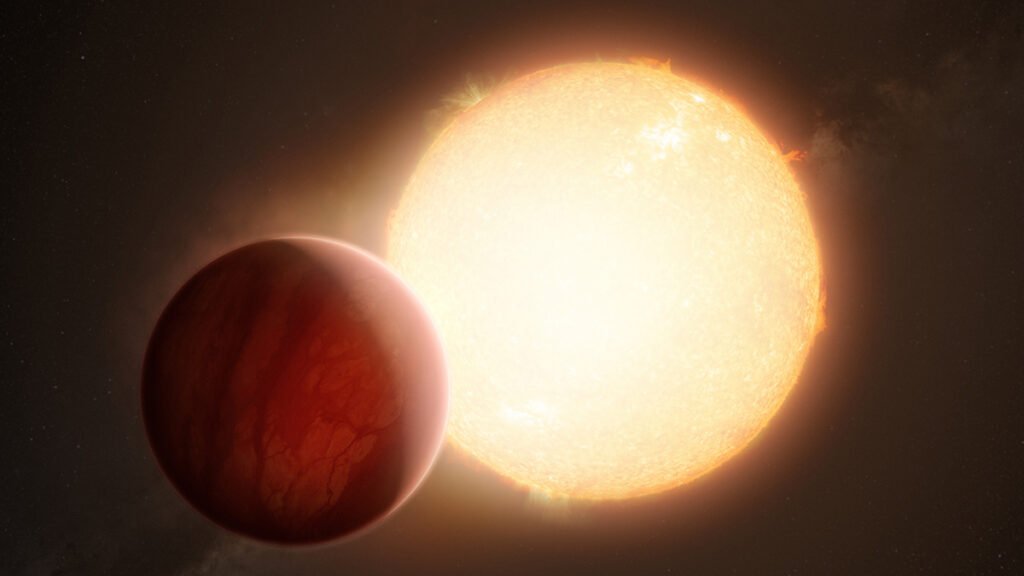
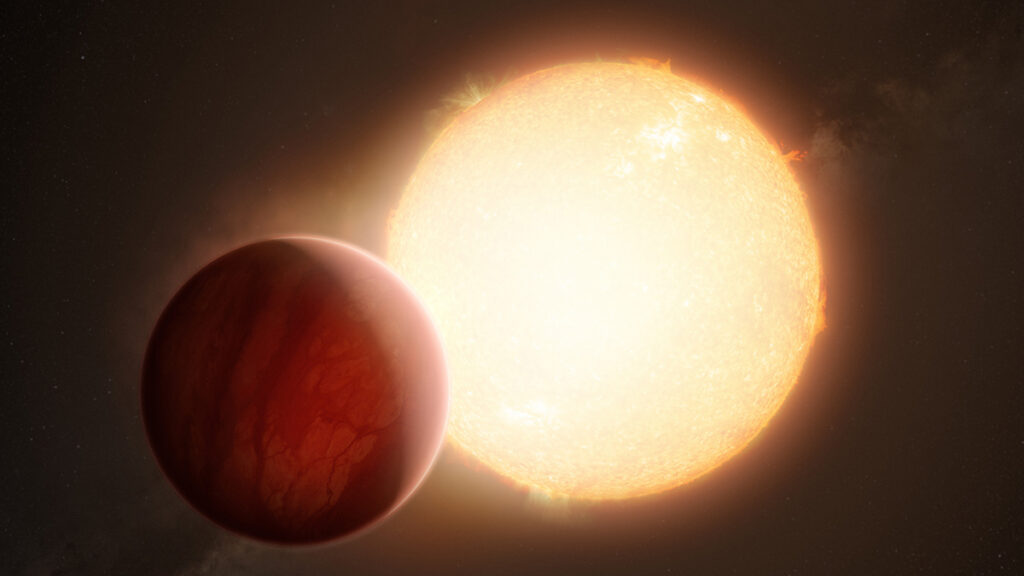
Giant Jupiter-like planets dominate the star systems they inhabit. In our own solar system, Jupiter itself is more massive than all other planets, dwarf planets, asteroids, and comets put together. Current theories suggest it shaped phenomena and features stretching from the size of Mars to the very existence of the asteroid belt.
These effects are even more powerful among the rare exoplanet specimens known as “hot Jupiters”: massive worlds orbiting much closer to their host stars than Mercury does to the Sun. Unlike other known star systems (including our own), most hot Jupiter systems don’t have inner rocky planets.
Now, a new article by Juliette Becker in The Astrophysical Journal provides a possible explanation for why many hot Jupiter and other exoplanet systems look the way they do and might even help elucidate the formation of our own solar system.
“We are approaching the point of a unified giant planet formation model, which is super exciting.”
“One of the biggest open questions in planet formation theories is, Where do hot Jupiters come from?” said Becker, a planetary scientist at the University of Wisconsin–Madison.
In the new paper, she argues that the history of giant planets—and their sibling worlds—is very contingent on specific factors that determine whether the giant planets become hot Jupiters, warm Jupiters (at roughly Mercury’s distance from the Sun), or cold Jupiters (like the one in our solar system). In particular, Becker’s model shows that most hot Jupiters likely formed via an abrupt disturbance caused by a passing star or other massive object, while warm Jupiters move through their star systems via a slower process. The abrupt disturbance scenario also explains why inner planets are missing in hot Jupiter systems; the catastrophic migration of massive planets likely ejects them into interstellar space.
“The first formal question in the field of exoplanets was how hot Jupiters form,” said Brandon Radzom, a planetary scientist working jointly at Indiana University and the California Institute of Technology who was not involved in the research. “Three decades later, it feels like this field is maturing. We are approaching the point of a unified giant planet formation model, which is super exciting.”
Not Like Us
The first exoplanet discovered around an ordinary star was the hot Jupiter 51 Pegasi b, identified in 1995. As of 13 February 2026, astronomers have identified 6,107 exoplanets, of which only a few hundred are hot Jupiters. The precise number isn’t certain, partly because there isn’t a consensus on where the division lies between “hot” and “warm” Jupiters, but data and theory suggest only about 0.5% of exoplanets are hot Jupiters.
“They’re pretty rare, and that’s interesting because it tells us something about planet formation and evolution,” Radzom said.
Despite their rarity, the combination of large mass, large size, and small orbit makes hot Jupiters easier to observe than more common exoplanets. Solar system–like exoplanets (including cold Jupiters) are quite difficult to spot because their size and orbital paths make them much fainter. Instead, a large number of known exoplanets are “super-Earths”: presumably rocky worlds more massive than Earth, orbiting in the same general part of their star systems as our inner planets.
According to current planetary research, super-Earths and other rocky worlds form close to their stars, while gas giants like Jupiter form in the outer parts of a star’s protoplanetary disk of gas and dust. They first form as a dense icy core, then accrete hydrogen and other gases until they reach a large size and mass.
“I think Jupiter could have become a hot Jupiter. Luckily for us, it didn’t.”
However, giant planets don’t eat up every bit of material in the protoplanetary disk. Models show they lose some of their orbital momentum to the remaining gas and dust, which brings them closer to their host star, a slow process known as disk migration. This is one possible way to make hot and warm Jupiters.
Another way to move Jupiter-like planets toward their host stars is tidal migration, which involves gravitational perturbation from a nearby star—because many stars form in clusters—or another giant planet in the same star system. This interference can knock planets into extremely elliptical orbits that carry them close to their host star, the same process that steers comets close to the Sun. However, Jupiter-like worlds are much bigger than comets, and the tidal forces acting on them circularize their orbits over time, resulting in hot Jupiters.
Becker’s model showed that the few hot Jupiters with companion planets probably formed via disk migration, while those without companion planets very likely came about via tidal migration. Using a similar analysis, she found that many warm Jupiters could not have formed via tidal migration within the lifetime of the universe.
“I think Jupiter could have become a hot Jupiter,” Becker said. “Luckily for us, it didn’t. For a Jupiter-mass planet to become a hot Jupiter, it would require an extra-giant planet or a stellar companion or something else that would perturb [its orbit].”
Instead, many researchers think Jupiter formed about 3.5 times as far from the Sun as Earth is, drifted closer to the Sun via disk migration, then was tugged to its current position through a gravitational push and pull between the Sun and Saturn, a hypothesis known as the Grand Tack. While Becker’s paper didn’t address the Grand Tack, she found intriguing patterns that could help scientists understand how every giant planet forms and migrates, which indirectly could reveal something about our own Jupiter—and Earth.
—Matthew R. Francis (@BowlerHatScience.org), Science Writer
Citation: Francis, M. R. (2026), Rare hot Jupiters could reveal how all giant planets form, Eos, 107, https://doi.org/10.1029/2026EO260070. Published on 26 February 2026.
Text © 2026. The authors. CC BY-NC-ND 3.0
Except where otherwise noted, images are subject to copyright. Any reuse without express permission from the copyright owner is prohibited.