Editors’ Highlights are summaries of recent papers by AGU’s journal editors.
Source: AGU Advances
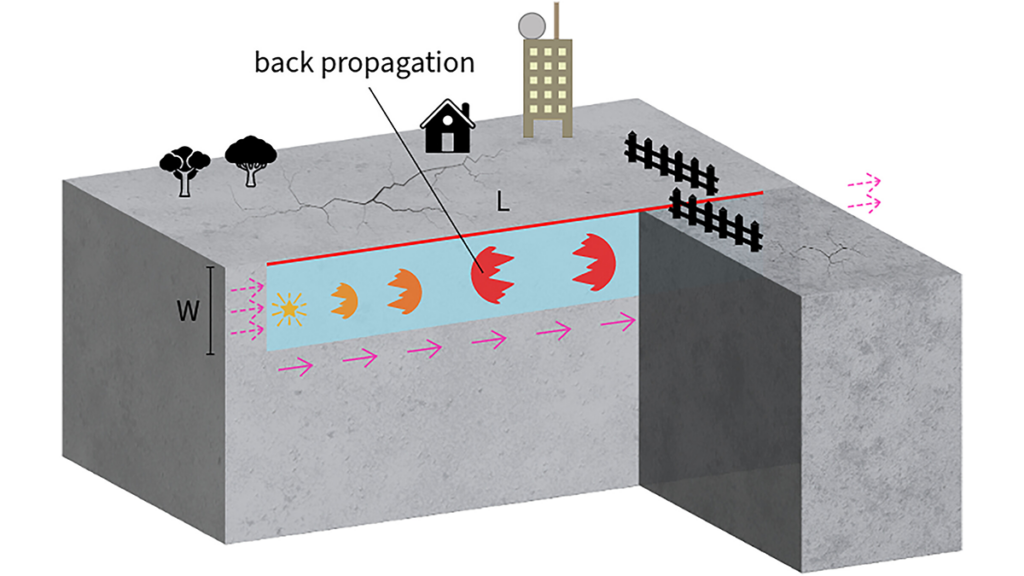
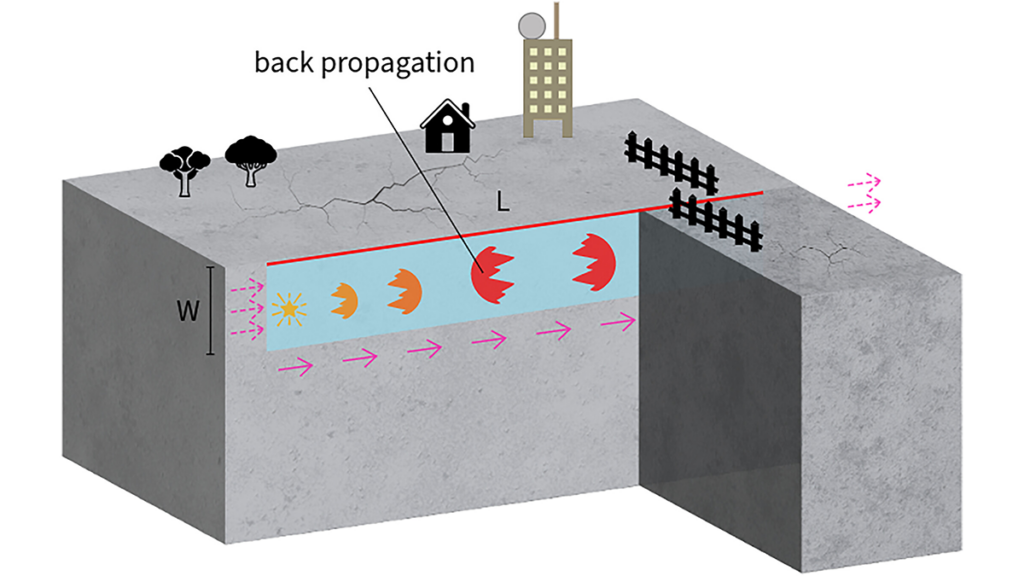
Large earthquakes often release energy in complex ways, and some even produce boomerang ruptures that reverse direction within seconds during the same event. Such reversals can lead to stronger shaking because the fault releases energy in several bursts instead of in one continuous motion. Previously, this behavior was assumed to require geometrically complex faults with bends or branches.
Sun and Cattania [2026] show instead that faults can naturally alternate between continuous sliding and brief, traveling pulses of slip. When a rupture transitions between these modes, it can spontaneously generate a backward-moving front that fills in gaps in the slip. Boomerang earthquakes can occur on simple, straight faults when three common conditions coincide: velocity-weakening friction, rupture starting from one end rather than the center, and faults large enough for the rupture to propagate into regions of lower stress. Their model predicts that earthquakes with slower rupture speeds and lower stress drops are more prone to produce these reversals, consistent with characteristics observed in real events (e.g., the 2016 Moment Magnitude (Mw) 7.1 Romanche and 2021 Mw 7.0 Taitung earthquakes).
Because these conditions are widespread in nature, boomerang earthquakes may be far more common than we can usually detect, and the findings provide physical clues for identifying these hard-to-detect events. Although the study is theoretical, its results offer important insight into why large earthquakes behave in unexpectedly complex ways and how this complexity can influence seismic hazard.
Citation: Sun, Y., & Cattania, C. (2026). Back-propagating earthquakes on simple faults. AGU Advances, 7, e2025AV001649. https://doi.org/10.1029/2025AV001649
—Marcos Moreno, Editor, AGU Advances
Text © 2026. The authors. CC BY-NC-ND 3.0
Except where otherwise noted, images are subject to copyright. Any reuse without express permission from the copyright owner is prohibited.