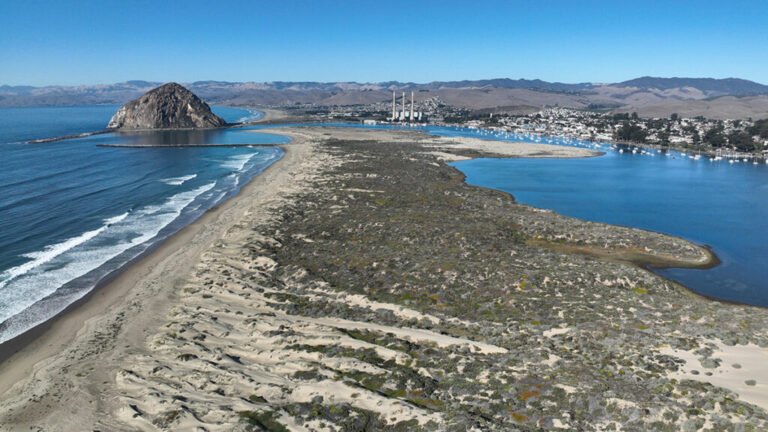

More than 2 billion people live within 50 kilometers of a coastline and are extremely vulnerable to climate hazards such as excessive rainfall and flooding.
A new study in Nature Communications shows how marine heat waves can worsen excess rainfall in coastal areas, potentially exacerbating flooding and its associated losses, including of human lives. Researchers found that from 1982 to 2022, between 5% and 25% of extreme rainfall events in coastal areas occurred downwind of nearby marine heat waves. Compared to events that weren’t downwind of marine heat waves, these rainfall events saw about 20%–30% more rain on average, as well as a 30% increase in fatalities.
“This is a serious concern because marine heatwaves not only intensify general rainfall but also exacerbate extreme rainfall events,” said Zhengguang Zhang, corresponding author of the new study and a climate scientist at the Ocean University of China in Qingdao, via email. Marine heat waves are happening more often and lasting longer, increasing the possibility that coastal rainfall and weather may be affected even more dramatically as the climate changes.
New Insights from Existing Data
In the study, the researchers define marine heat waves as those occurring when the sea surface temperature of an area exceeds 90% of the average value recorded over several decades for a period longer than 5 days. These heat waves can devastate marine ecosystems, and the ecological damage can have knock-on effects, causing massive losses to people and economies that depend on the ocean.
“This study beautifully reframes existing information [such as satellite data] in the context of marine heat waves and shows that coastal rainfall can clearly be impacted by these heat waves.”
The researchers combed through various long-term satellite and climate databases, such as NOAA’s Optimum Interpolation Sea Surface Temperature dataset, to build global maps of sea surface temperatures. They used these sea surface temperature maps to locate marine heat waves and linked them to excessive rainfall events in land areas as far as hundreds of kilometers downwind.
“This study beautifully reframes existing information in the context of marine heat waves and shows that coastal rainfall can clearly be impacted by these heat waves,” said Alex Sen Gupta, a climate scientist at the University of New South Wales in Sydney, Australia, who was not involved in the study.
From Hot Water to Excess Rain
Marine heat waves can vary widely in both their temperature and spatial extent, ranging from roughly 100,000 square kilometers—about the size of Iceland—to several million square kilometers or more. To compare heat waves with such different sizes, shapes, and characteristics, the researchers turned to mathematics.
“Marine heatwaves are characterized by a warm core with temperatures decreasing gradually outward, and Gaussian functions (a common mathematical tool) are often used to describe this kind of heat diffusion,” said Zhang. Using a Gaussian fit allowed the researchers to summarize and extract robust measures of scale and temperature gradients from noisy observational data and compare many marine heat waves and their effects on wind and rainfall.
“We found that marine heatwaves have the ability to influence the atmosphere above them and enhance rainfall downwind,” Zhang said. Areas downwind of marine heat waves experienced more frequent and more intense extreme rainfall, which the study defined as rain events that ranked among the wettest 1% of all rainy days in a particular land area. These extreme rain events peaked within the radius of the heat wave, which could sometimes stretch for hundreds of kilometers, and usually within 1–3 days of the heat wave forming.
The study analyses also yielded clues about how marine heat waves may be causing excess rain in downwind areas. The warm waters of a marine heat wave force the air above to mix violently, increasing atmospheric turbulence and strengthening winds. As these warm, wet winds move through and away from the marine heat wave, they collide with existing air and are forced upward, carrying their extra moisture with them. The rising, moisture-rich air then produces heavy rainfall, often over land downwind of the marine heat waves.
Connections Made, but Uncertainties Remain
Though the study clearly connects marine heat waves and downwind precipitation, the precise physical pathways involved may be more varied than they first appear, according to Sen Gupta.
“I don’t think the analysis necessarily distinguishes between different mechanisms as to how marine heat waves are impacting extreme rainfall events on land,” he said. For example, Sen Gupta noted that the study emphasized the importance of temperature gradients within marine heat waves as a key driver of rainfall downwind. “But temperature maximums within the heat waves may influence downwind rainfall just as much as temperature gradients.”
“Almost all the marine heatwave-related flood events that killed over a hundred people occurred in developing countries.”
Although the study builds a connection between marine heat waves and extreme rainfall, it does not establish a causal link between the heat waves and floods. “Establishing a direct connection is highly challenging due to the complexity of flooding, which is influenced by a lot of factors including topography, surface runoff, and even groundwater,” Zhang said. However, 10%–30% of flood events during the period covered in the study occurred downwind of a marine heat wave.
“Also, what we do not show in the paper is that, almost all the marine heatwave-related flood events that killed over a hundred people occurred in developing countries,” said Zhang. “Coastal communities, especially in developing countries, should incorporate marine conditions into their forecasts of extreme events, which may allow for a more accurate assessment of the severity of extreme rainfall or floods.”
—Adityarup Chakravorty (chakravo@gmail.com), Science Writer
Citation: Chakravorty, A. (2026), Marine heat waves can increase coastal rainfall, Eos, 107, https://doi.org/10.1029/2026EO260068. Published on 27 February 2026.
Text © 2026. The authors. CC BY-NC-ND 3.0
Except where otherwise noted, images are subject to copyright. Any reuse without express permission from the copyright owner is prohibited.