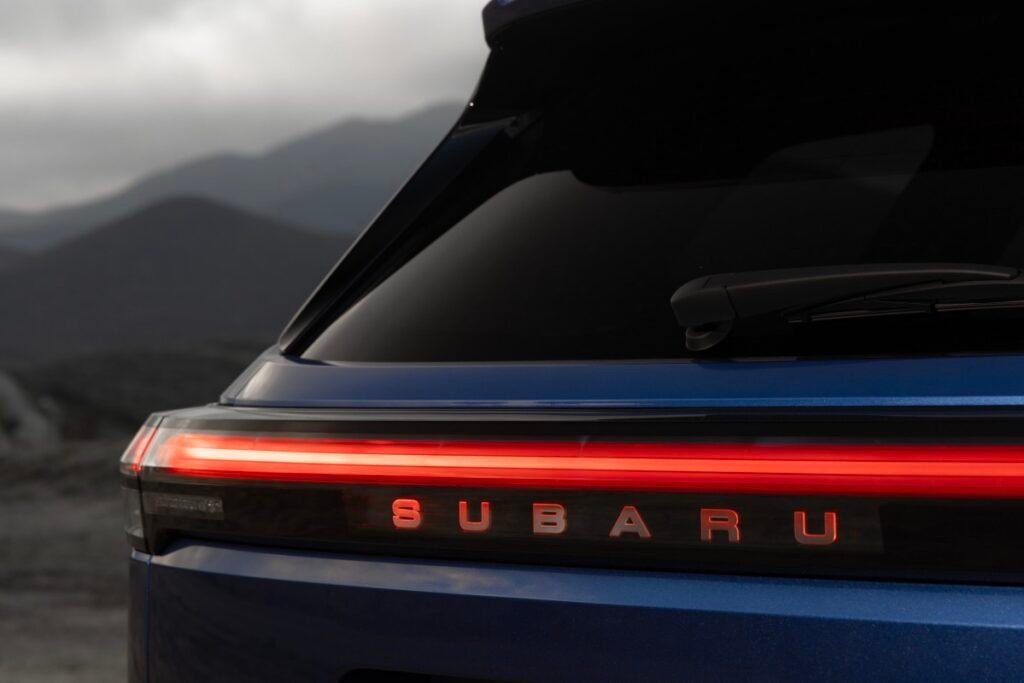
It sounds like something out of science fiction, but the idea of a turbine jet engine in a mainstream production car is not new. In fact, the Wikipedia page for cars powered by aircraft engines has well over a dozen entries, and Subaru may someday soon be its latest entry. According to a publication filed with the World Intellectual Property Office, Subaru has patented an electric power system and startup control method for a turbine engine that could be used in an everyday car. What’s more, this isn’t the first time Subaru has done this, with an earlier patent from last year describing a turbine engine, or jet engine, being used to extend range in an electric vehicle.
Subaru’s Two Jet Engine Patents Are for EVs
Subaru
The first of the two patents, both of which were first brought to wider attention by CarBuzz, indicated that using a turbine as a steady-state generator could be considerably more efficient than what immediately comes to mind when the idea of a jet-powered car is mentioned, a jet engine being used for direct propulsion. In that first patent, Subaru explored how to start the jet engine more quickly to avoid the long spool-up time. Solving that, the turbine could theoretically be used to generate electricity more easily, and the whole purpose of the concept is to feed an extended-range EV (EREV) in a more efficient manner than a traditional gas combustion engine. The second patent addresses a different problem: what happens if the turbine loses power and can’t start up as quickly as desired, but is still necessary for the generation of electricity.
Related: Next Subaru WRX Could Lose What Made It Famous
According to the filing, Subaru’s invention could work in a somewhat symbiotic manner. If the EREV’s high-voltage battery is capable of driving the vehicle at full throttle, that means there’s enough energy to use the electric motor-generator to spin up the turbine quickly, and if not, the turbine would be capable of being started using the regular 12-volt battery without draining it. In a nutshell, when the high-voltage battery is low, the 12V battery could be used to slowly start up the turbine, and when the high-voltage battery has enough juice to run the car at full power, that would start up the turbine fast.
Subaru’s Invention Has Benefits and Drawbacks
Subaru
While aircraft turbines use compressed air to spin up to speed and start running, Subaru’s patent would use the existing electric motor in the EREV, making the package simpler. The turbine would naturally be much smaller and lighter, so the 12V battery could achieve the turbine’s target speed with relative ease, but there are obvious drawbacks, not least of which is yet more weight, albeit a relatively small amount, something EVs of all sorts can do without. And unlike aircraft turbines that can be bump-started if there’s enough air flowing through them to spin the compressor blades, if the hypothetical “jet-powered” Subaru EREV is completely out of juice, the only way to get it going again would be by plugging it in.
There’s also the issue of noise—the patent suggests spinning the turbine at 20,000 rpm when being started by the 12V battery and 25,000 rpm with the HV battery—but given its relatively small size, Subaru would likely be able to insulate it fairly well, and if these drawbacks can be overcome, this could be a highly efficient way of generating electricity for an EREV. As a patent, this idea has a 50/50 chance of reaching production, but it could be a real attention-grabber for the future of the STI nameplate. Either it will or it won’t.
Related: Subaru Wants to Put a Real Clutch Pedal in an Electric Car