Minimalist design—the perpetual hegemony of the midcentury modern style—can feel cold, austere, and in the worst case, bland. Putting a contemporary spin on this cannon, especially in the context of the ever-influential “Danish school,” FRAMA imbues its succinctly conceived, pared back furnishings with the plasticity of idiosyncratic ascription. Standing-out among the crowd of “humble” Danish design classics—replicas and reinterpretations—its precision-engineered designs are often rendered in the slightest of patinated and polished metals; lightly treated woods; and sparingly upholstered textiles. FRAMA isn’t merely a furniture producer, however.


With the best available materials and ingredients, the holistic lifestyle brand develops complementary accessories, self-care solutions, and even fragrances; catering to the considered yet relaxed tastes of today’s shrewdest aesthetes. This expanded offering adds a layer of softness to the essentialized designs and demonstrates how they might be more seamlessly integrated into one’s home.


The overall aim, like with much of Danish mid-century modern design—historic or contemporary—is permanence. It’s an ambition that can only be achieved through the careful, intuitive wielding of aesthetic transcendence and formal adaptability; a holistic strategy that has to root in some degree of familiarity to be successful.


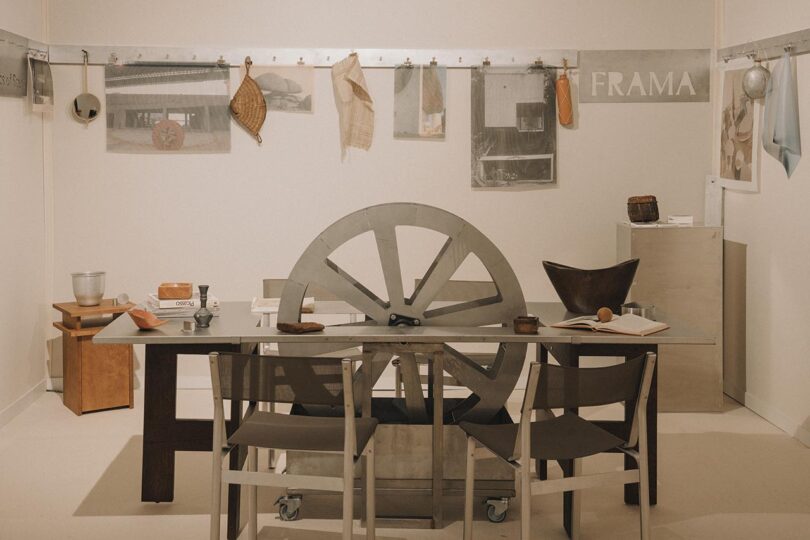
Playing up this duality, ultimate coherence, FRAMA mounted a multi-sensorial display at the Matter & Shape fair, held in Paris early this month. To launch the Union Series—new pared back chairs and tables imagined by Copenhagen-based, British talent Michael Antrobus—the brand staged The Mechanics of Scent showcase. The star of the show: a water wheel spinning from within a recognizable trestle table.

Formalizing the ethereal quality of diffused aroma, the sophisticated but also playful contraption contained water infused with FRAMA’s signature Apothecary scent; available in hand, body, and hair products. The fragrance has notes of sandalwood, cedar, and ylang-ylang. Like the new Union Series collection, it’s intended to a calming effect.


The main mechanical-device—seemingly pulled from the pre-industrial era but refined through a contemporary, late modernist lens—signaled something more fundamental than the overly-functional technological devices of today and perhaps even served to facilitate reprieve from the hurried pace of the fair floor.


Surrounding it were hung photographs and drawings hinting at the scent’s main components. True to form when it comes to FRAMA’s practice of staging frozen-in-time “lived-in” displays, other process and reference materials were scrupulously strewn about. There were stacked books, sculptural catch-alls, and kitchen utensils pulled from the brand’s extended range.


On view as well, of course, were a few “teaser” pieces from the Union Series, offically launched at 3 Days of Design in June. The collection—comprising a chair, easy chair, stool, table, and side table—extrapolated on a new clever use of semi-circular aluminum profiles. The elements were meticulously bent-into-shape and assembled together to embody restraint and accommodate comfort.


In profile, the compositions resemble the divergent lanes of wonderfully uniform and obviously streamlined highway interchanges. Wrapped in taupe and sandstone-colored textile—mesh for outdoor use and linen for the indoors—the settees take on the implicit softening quality that sets FRAMA apart.


The Mechanics of Scent installation will also be presented at 180 The Store this May’s New York Design Week. To learn more about the brand and its ambitions, visit us.framacph.com.
Photography courtesy of FRAMA.