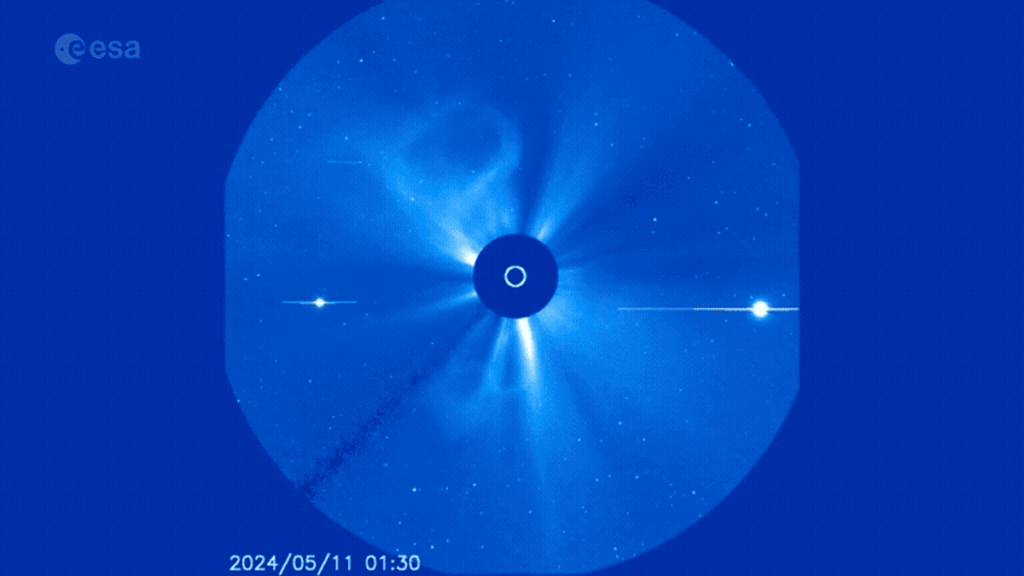
Powerful solar storms that rocked Earth in May 2024 produced similar effects at Mars, including widespread auroras and disruptions in orbiting spacecraft. One of the storms—the most powerful solar flare observed in more than 20 years—turbocharged the Martian ionosphere, an especially poorly understood layer where the density of electrons jumped almost threefold.
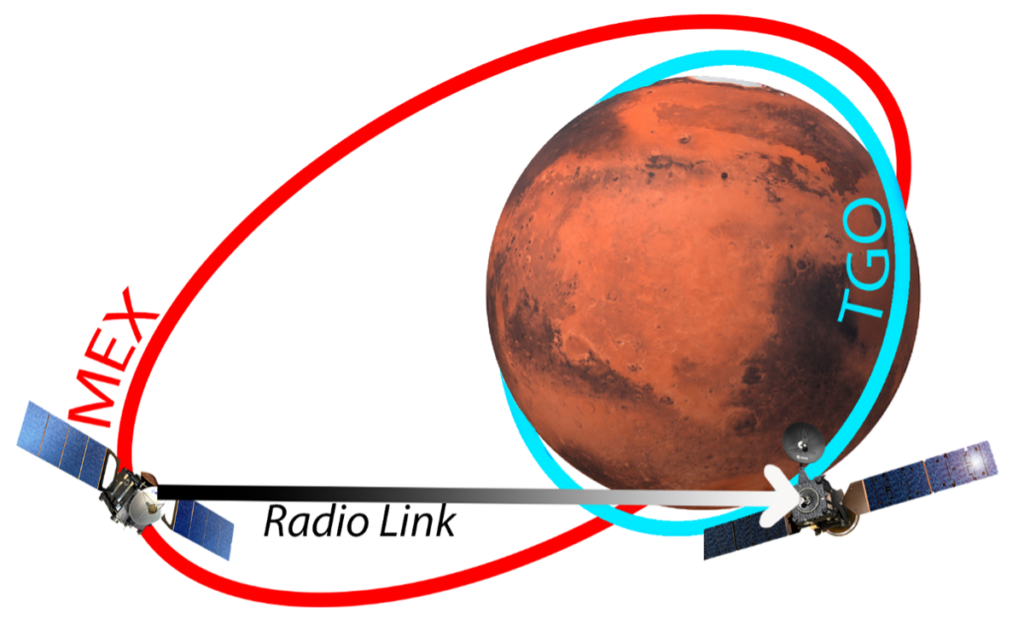
Two European spacecraft, Mars Express and Trace Gas Orbiter (TGO), measured the changes in the ionosphere during a radio linkup just 10 minutes after the flare slammed into Mars. That timing was “incredibly lucky,” wrote Jacob Parrott, a research fellow at the European Space Agency and lead author of the Nature Communications study that reported the findings, in an email interview with Eos. “The planets aligned, so to speak.”
The orbiters provided the first good look at how the Martian ionosphere responds to such a large solar flare, which is an outburst of electromagnetic radiation produced when the Sun’s magnetic field “short-circuits.” A flare produces especially high concentrations of short-wavelength radiation, including extreme ultraviolet (EUV) and X-rays. Those wavelengths penetrate to various depths in Mars’s atmosphere, energizing different layers of the ionosphere.
The Martian ionosphere consists of two main layers. M2, at altitudes of 130 kilometers and higher, is better understood. It contains a denser concentration of electrons, which are knocked from neutral atoms by solar EUV radiation. M1, which stretches from 110 to 130 kilometers above the Martian surface, is less well known. It’s excited primarily by “soft” (lower-energy) X-rays, which are more abundant during flares. The X-rays ionize atoms and molecules, increasing the concentration of electrons in M1. Some of the free electrons smash into other atoms and molecules, further boosting the electron population.
Defying Celestial Mechanics
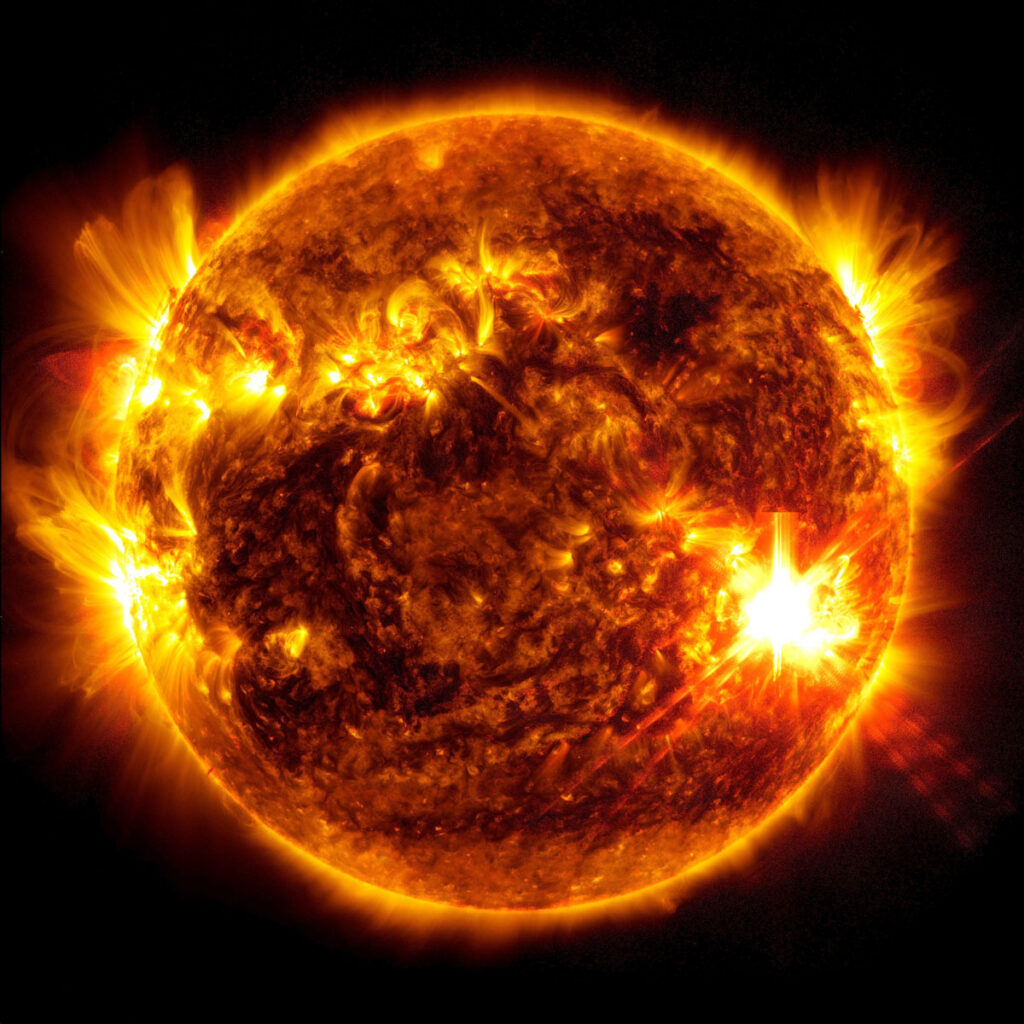
The 2024 flare was part of a days-long solar barrage that produced several intense flares and coronal mass ejections (fast-moving clouds of charged particles). At Earth, these outbursts triggered the most intense geomagnetic storm since March 1989. It caused radio blackouts, damaged orbiting satellites, and created intense auroras. It even pushed some GPS-controlled farm equipment off course.
When an X-class flare (the most powerful category) reached Mars on 15 May, the orbiters just happened to be conducting a radio occultation experiment, with Mars Express beaming a signal to TGO as the latter disappeared below the horizon. The atmosphere refracts the radio waves, revealing details about different layers of the atmosphere, including the density of electrons in the ionosphere.
Scientists have conducted radio occultation experiments since the earliest planetary missions, with a spacecraft aiming its antenna toward Earth as it passes behind a target body. Because of the relative positions of the planets, such observations at Mars are limited to times around Martian dawn and dusk, as well as to a specific range of latitudes, Parrott said.
“The big selling point of mutual radio occultation is that you aren’t constrained by celestial mechanics.”
Spacecraft-to-spacecraft occultations overcome that limitation. “The big selling point of mutual radio occultation is that you aren’t constrained by celestial mechanics,” Parrott said. The observations can probe the atmosphere at any time of the Martian day, providing more details about the ionosphere and how solar energy changes affect it.
The Mars Express–TGO observations began in 2020, but they are limited to two short sessions per week. “This particular occultation was near the subsolar point—local noon—just after the storm hit Mars,” wrote Colin Wilson, the European Space Agency (ESA) project scientist for both spacecraft and a member of the research team, in an email to Eos. “So this was our first chance to see how the never-before-sounded noontime ionosphere responded to [a] solar event.”
The occultation showed that the electron density in the M2 layer increased by 45%, with the peak density at an altitude of 152 kilometers. M1, however, jumped by 278%, peaking at 109 kilometers.
“This is probably the most robust M1 layer ever recorded,” said Robert Lillis, an associate director of the Space Sciences Laboratory at the University of California, Berkeley, who was not involved in the study. “Given what we know about the strength of this flare, I wouldn’t have expected [the layer] to be so prominent…. The flare must have had a lot more energy at shorter wavelengths that could ionize the layer directly or, as the authors suggest, it could have produced more secondary ionization by freeing electrons.”
“This shows that, unless you can measure the spectrum of a flare, you don’t know what to expect,” he said. “So, the lesson—maybe the key lesson—is that there’s a lot more to the ionospheric response than just the strength of the flare itself.”
Looking into Martian History
The study may have important implications for future Mars exploration. The ionosphere “is critical for communications,” Parrott said. “Assets in the future might use ‘over-the-horizon’ communication, in which spacecraft bounce their signals off the underside of the ionosphere to extend beyond the line of sight. So an in-depth understanding of the ionosphere—especially at midday and midnight—is critical.”
“Observing how the Mars ionosphere responds to solar flares will tell us more about how it responded to ambient conditions in the Sun’s early history, which were more like flare conditions today.”
That also may help scientists understand how Mars lost most of its water and atmosphere to space. “The Sun probably was more active in the EUV in its early history,” Lillis said. “Observing how the Mars ionosphere responds to solar flares will tell us more about how it responded to ambient conditions in the Sun’s early history, which were more like flare conditions today.”
The proposed ESA Mars Magnetosphere Atmosphere Ionosphere and Space Weather Science (M-MATISSE) mission, which would consist of two orbiters, would conduct roughly 100 occultation experiments per day, at all hours. “That would be a real game changer,” Lillis said. “We could really understand the structure of the Martian ionosphere if that mission is picked up.”
—Damond Benningfield, Science Writer
Citation: Benningfield, D. (2026), Solar flare spotlights the Martian ionosphere, Eos, 107, https://doi.org/10.1029/2026EO260101. Published on 27 March 2026.
Text © 2026. The authors. CC BY-NC-ND 3.0
Except where otherwise noted, images are subject to copyright. Any reuse without express permission from the copyright owner is prohibited.