Our solar system appears to be very stable. The orbits of planets, moons, comets, and other objects are predictable enough to have provided the basis for theories of gravity, as well as insight into the internal structures of celestial bodies. In the famous final paragraph of On the Origin of Species, Charles Darwin even contrasted the eternal cycles of planets to the chaotic changes driven by evolution.
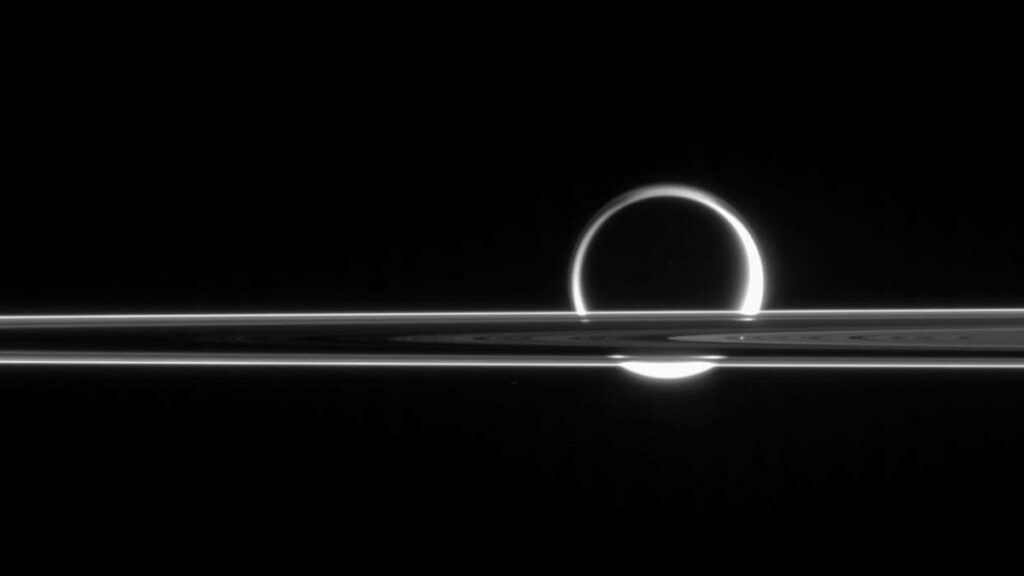
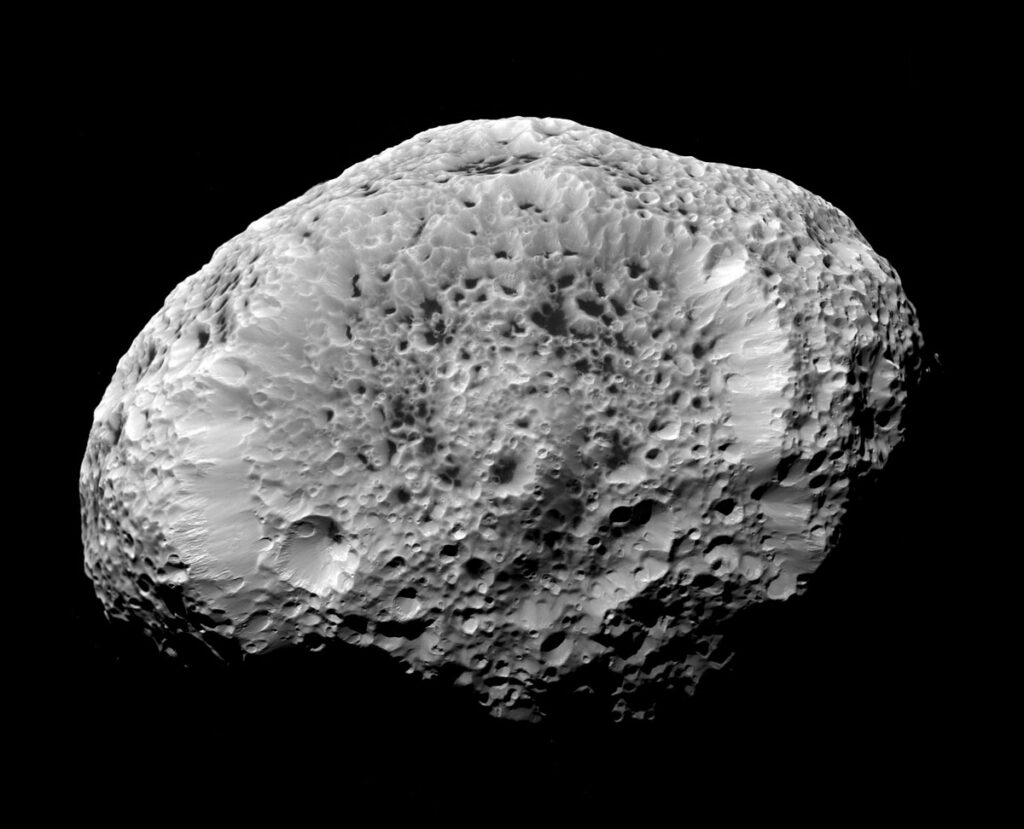
However, a number of small, nagging inconsistencies in the properties of Saturn and its moons have led researchers to suggest maybe something shook things up relatively recently. These odd mysteries include the apparently young age of Saturn’s rings and its oddball moon Hyperion; Titan’s noncircular, growing orbit and thick atmosphere; the highly tilted orbit of the moon Iapetus; Saturn’s large obliquity, or the tilt of its axis; and the way the planet wobbles as it spins. Experts have proposed a number of reasons explaining these individual phenomena, but a recent model published in the Planetary Science Journal by SETI Institute astrophysicist Matija Ćuk and his colleagues provides a unified explanation.
“Everything is driven by the expansion of Titan’s orbit. As it goes around, it plows into other moons and creates trouble.”
“Everything is driven by the expansion of Titan’s orbit,” Ćuk said. “As it goes around, it plows into other moons and creates trouble.”
In the researchers’ model, the biggest trouble came when Titan collided with a large, still-hypothesized moon the researchers call proto-Hyperion. Debris from this impact formed Saturn’s rings as well as the spongy potato-shaped Hyperion itself. The impact may also have stirred up material that formed Titan’s thick atmosphere. Meanwhile, the migration of Titan tweaked the obliquity of Saturn itself.
As the debris settled and the moons finished their shake-up, Iapetus and other moons wound up in their current places. And all of this, the model suggests, happened within the past billion years, possibly only a few hundred million years—recent, in cosmic terms, for such a dramatic reconfiguration.
Expanding Orbit, Wobbling Moons
“We expect giant planets to initially have obliquities close to zero tilt,” said Melaine Saillenfest, an astrophysicist at IMCCE (Institute of Celestial Mechanics and Computation of Ephemerides) at l’Observatoire de Paris who was not involved with this study.
“The most convincing scenario to date is that the observed fast orbital expansion of Titan has pushed Saturn’s spin axis into a kind of resonance with Neptune’s orbit,” Saillenfest said, a concept reflected in his own research.
All the pieces have been proposed by scientists in some form or another over the past decades, but the ambition of putting them together into a single story is what makes this research stand out.
The resulting resonance also affects the moons, including Iapetus. “When you talk about the wobble of the system, it’s not just the planet that wobbles: All the satellites wobble with it,” Ćuk said.
Similarly, many researchers suspect that Saturn’s rings are significantly younger than the rest of the planet based on their low mass and lack of dust. Because of its low density, chaotic spin, and strange—almost spongy—appearance, many think Hyperion also formed fairly recently. All the pieces have been proposed by scientists in some form or another over the past decades, but the ambition of putting them together into a single story is what makes this research stand out.
A Titanic Orbit
Moon orbits change over time thanks to tidal interactions with their host planets. Our Moon, for example, is getting farther away by a few millimeters every year.
This effect is compounded when resonances occur between a moon and other bodies, either with the planet or with other moons in the system. For instance, the orbital period, or the time needed to complete a single orbit, of Jupiter’s moon Io is half the orbital period of Europa, which is half the orbital period of Ganymede, forming a stable resonance. Other types of resonances are unstable, potentially kicking moons out of their orbits.
Resonances can also explain planetary obliquities and how they change. In particular, changes in gravitational torque when an orbit isn’t perfectly circular tweak the rotational axis. Having multiple sources of torque, such as the Sun and Titan, can lead to resonance effects.
“Saturn is being torqued by the Sun to wobble like a top,” said Ćuk. “As Titan’s orbit gets bigger, the [wobble] was getting faster and faster [until it] hit the period of the wobble of the orbit of Neptune. These two periods got locked into resonance, and as Titan’s orbit kept getting bigger, the only way to maintain this lock is for Saturn to tilt to its side.”
Saillenfest noted that none of these ideas are new on their own. Other researchers proposed an additional Saturnian moon they called Chrysalis, of lower mass and farther out than proto-Hyperion, whose orbital resonance with Titan affected the planet’s obliquity. Rather than a collision, the gravitational push-pull destabilized Chrysalis, sending it spiraling toward Saturn to create the rings.
“The idea of Ćuk et al. is to try to reproduce in a single scenario as many aspects as possible in Saturn’s spin and moon system that seemingly call for a ‘recent’ event,” he said. “The scenario that they outline does succeed quite well in this regard.”
Ćuk and his collaborators realized that if proto-Hyperion was bigger and closer in than Chrysalis was hypothesized to be, their team could explain the origin of Hyperion and the orbit of Iapetus.
“Titan’s orbit got big enough that it started messing with proto-Hyperion,” Ćuk said. The gravitational push-pull was strong enough to pull proto-Hyperion into an elliptical orbit, where it crossed Titan’s orbit and the two moons collided. That destroyed the small moon, with its debris forming Hyperion and the planetary rings.
Alternative explanations for some of these phenomena could mean that a unified model such as this one isn’t necessary. And connecting these disparate phenomena is likely to be controversial in the planetary sciences community.
“In my opinion, this approach of trying to solve at once so many a priori unrelated questions is a bit risky,” Saillenfest said, noting that not everyone agrees on the young age of the rings or the explanation for Saturn’s wobble. “The numerous small mysteries that they tackle here all have their own debates in the community.”
—Matthew R. Francis (@BowlerHatScience.org), Science Writer
Citation: Francis, M. R. (2026), Titanic shake-up could explain Saturn’s young rings and strange moons, Eos, 107, https://doi.org/10.1029/2026EO260106. Published on 2 April 2026.
Text © 2026. The authors. CC BY-NC-ND 3.0
Except where otherwise noted, images are subject to copyright. Any reuse without express permission from the copyright owner is prohibited.