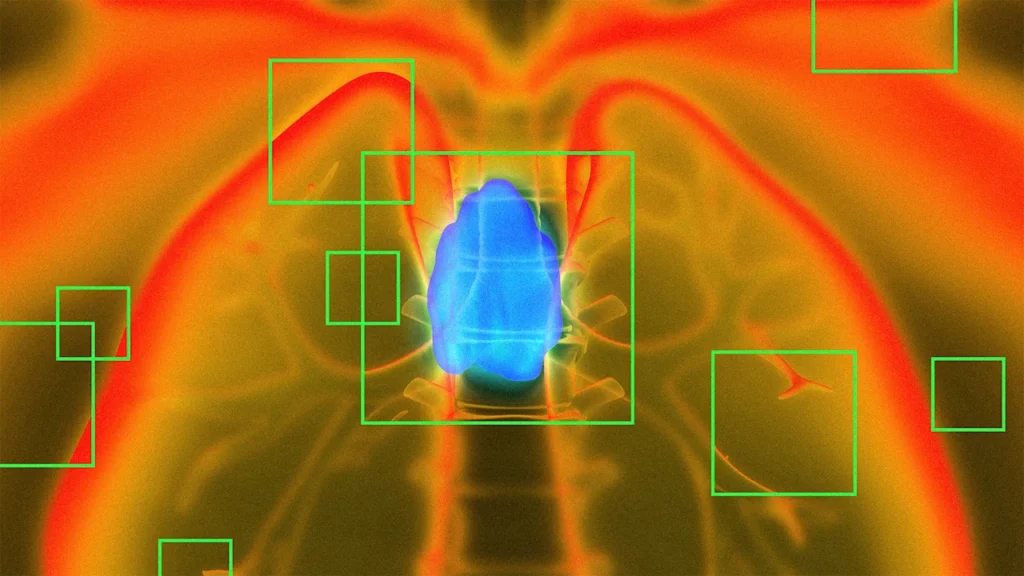
Your upper chest could be the key to your long-term health. A new study found a correlation between the health of a human’s thymus and the likelihood of cardiovascular disease or cancer.
Published on Wednesday in the science journal Nature, researchers detailed the “crucial” effect of the thymus on long-term health and lifespan, reshaping prior assumptions about the organ.
“These findings reposition the thymus as a central regulator of immune‑ mediated aging and disease susceptibility in adulthood,” the report states.
Thymus health a key indicator
Using AI tools, scientists analyzed more than 27,000 patient scans and medical records to evaluate thymus health. According to the journal, people with high thymic health had a mortality rate of 13.4 percent, compared with 25.5 percent among those with low thymic health.
The thymus, a two-lobed gland sitting in the upper chest between the lungs, is responsible for T-lymphocytes, white blood cells that protect the body against pathogens and diseases.
Throughout the years, the thymus “decays with age,” turning a once enlarged organ for health into fatty tissue replacement as it shrinks.
The report added that 5.3 percent of people with low thymic health developed lung cancer, and that 16.7 percent of people with low thymic health developed cardiovascular disease.
Other conditions, such as endocrine, nutritional, and metabolic diseases, including diabetes, were common for those with low thymic health.
“Even practical approaches, such as lifestyle changes including exercise and sleep, as well as healthy food choices and supplement intake, are likely to notably impact thymic health,” notes the report.
AI and health care
To further analyze their original hypothesis, scientists conducted two major cohort studies, the Framingham Heart Study and the National Lung Screening Trial. Researchers and scientific contributors Simon Bernatz and Vasco Prudente established an emphasis in using AI to more accurately measure thymic health.
The duo stated in the report that manual assessment can oftentimes be unreliable: “Previous studies did not find any associations between thymic imaging characteristics and outcomes … indicating insufficient thymic quantification using a visual scoring system.”
Instead of leaning on an external AI platform, the study relied on an in-house deep learning system to better evaluate the patients. Primarily by quantifying the thymic health on computed tomography (CT) scans and extracting a thymic health score with it.
The study highlights the model’s consistency, particularly when tested on independent data sets.
“These results demonstrate that the performance of the thymic health model is robust against input variations, and that it captures contextual information directly from the anatomical region of the thymus,” the report states.
AI and deep learning systems have continued to shape research and health care. A recent collaboration between Nvidia and Roche created one of the largest hybrid‑cloud AI factories in the pharmaceutical sector.
The ongoing momentum of AI in the biopharma sector is fueled by an interest to speed up research and discovery in order to save lives.
—Moses Jeanfrancois
This article originally appeared on Fast Company’s sister website, Inc.com.
Inc. is the voice of the American entrepreneur. We inspire, inform, and document the most fascinating people in business: the risk-takers, the innovators, and the ultra-driven go-getters that represent the most dynamic force in the American economy.