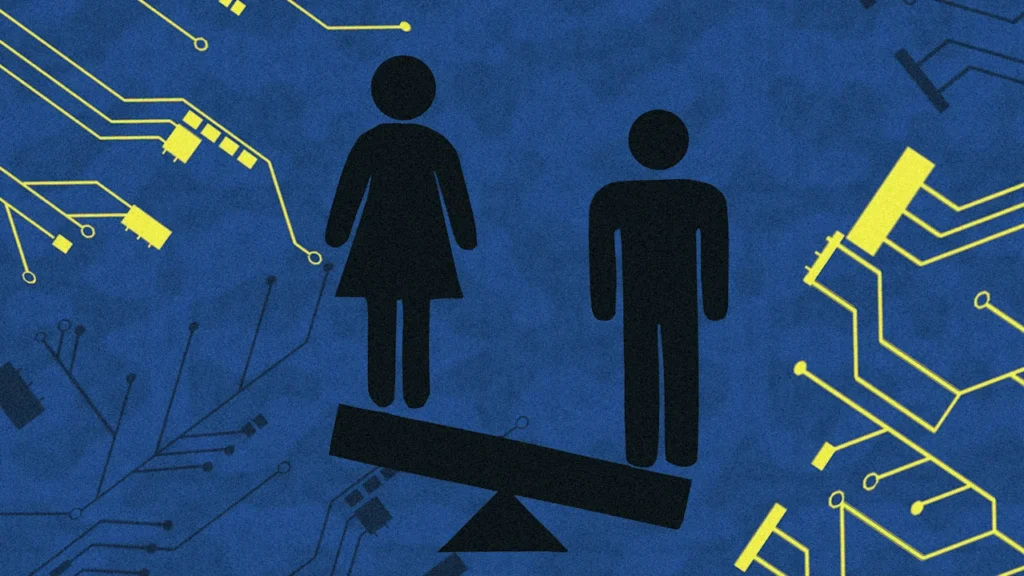
Lean In, the feminist organization founded by Sheryl Sandberg, has a new focus: fighting the gender gap in AI adoption.
The nonprofit has put out new research that digs into how women use AI in the workplace relative to their male counterparts, which captures an adoption gap that has surfaced in previous surveys. In a survey of over 1,000 adults, Lean In found that 78% of men had used AI in the workplace, when compared to 73% of women. Men also reported using AI more regularly: About a third of men used AI daily, while only 27% of women did the same.
This might not seem like a major difference at the moment. But Sandberg argues that this gap is likely to grow over time if it goes unaddressed. “These differences—which are not that small, but are smallish now—will compound over time, which is why we think it’s so important for people to understand them and acknowledge them,” she told Fast Company.
Part of the reason for this gap, according to Lean In’s findings, is that many women are more cautious about the ethical implications of using AI at work. Women were 32% more likely to feel concerned that they would be perceived as cheating by using AI—and they also tended to steer clear of AI over concerns about accuracy and ethics. Some of them were also worried about the disproportionate impact that AI-related layoffs could have on women.
“Don’t get us wrong. It is great that women have ethical concerns and care about cheating,” says Bridget Griswold, Lean In’s recently appointed CEO. “But we really worry that’s going to inadvertently cause women to use AI less.”
Lean In’s research suggests that this is already happening—in part because the very gender biases that have impacted career progression for many women are now influencing how AI is being adopted in the workplace.
“We also found that women feel differently about AI because they are treated differently in regards to AI, and [are] spoken to differently,” Griswold says. Women are encouraged to use AI less than their male colleagues, for example: Only 30% of women surveyed by Lean In said that their managers urged them to use AI, as compared to 37% of men. And when women do use AI at work, they are not nearly as likely to be recognized for it or get credit for doing so; men were 27% more likely to be praised for using AI on the job.
“The biases exist, and then they will get internalized,” Sandberg says. “I bet a lot of the people doing this—and it’s got to be both male and female managers—don’t even know they’re doing it, which is why we think research like this is so critically important.”
Previous research has signaled a broader gender gap in AI adoption. A recent analysis conducted by researchers at Harvard, Stanford, and the University of California, Berkeley, drew on 18 studies that surveyed over 140,000 people globally and found that women were 20% less likely overall to use generative AI. In the workplace, however, women face particular challenges as it relates to AI. While women tend to be more skeptical of AI on the whole, the slower rate of adoption in the workplace seems driven more by gender dynamics. Women are also both overrepresented in some of the industries most vulnerable to AI disruption—clerical work, for example—while also being underrepresented in some of the roles across engineering that are being augmented by AI.
While there are signs that the AI adoption gap is narrowing, Lean In’s research indicates that it’s not happening fast enough—and that employers have a crucial role to play in bridging that gap.
“I think we’re in a place where we’ve got new technology [and] old patterns, and they are old patterns that we at Lean In are committed to overcoming,” Sandberg says. “We are worried—and we should be worried—that in a world of the revolution of AI, women shouldn’t get left behind.”