The stone houses of Westchester’s early 20th-century neighborhoods carry a particular material candor – their masonry is pulled from the same geological bed as the landscape around them, their permanence a direct expression of the region’s character. Ravi Raj’s renovation of a Mount Airy house in Croton-on-Hudson treats that original fabric as the project’s main thesis, organizing every intervention around it while carefully reconciling past and present into a cohesive whole.


Local flagstone sourced to match the existing masonry extends and reinforces the base of the house, preserving its historic texture while subtly expanding its footprint. In contrast, white lap siding wraps the upper floors, introducing a lighter, more contemporary expression that distinguishes new from old without disrupting their dialogue. A 1980s addition that had previously fragmented the roofline was reworked entirely—its massing clarified through a new upper level, steeply pitched roof, and dormers that restore a sense of formal continuity while nodding to the region’s vernacular traditions.


Entry at the below-grade level establishes the interior palette immediately. A foyer and adjacent mudroom unfold in textured limestone flooring and wood-paneled walls, grounding the experience in materials that echo the surrounding terrain. From here, circulation rises toward the main level, where a sculptural staircase—Raj’s reinterpretation of a former spiral—acts as both connective tissue and spatial anchor. Its presence is less about movement alone and more about orientation, framing calibrated views of the stone boulders behind the house and reinforcing a continuous dialogue between interior and landscape.


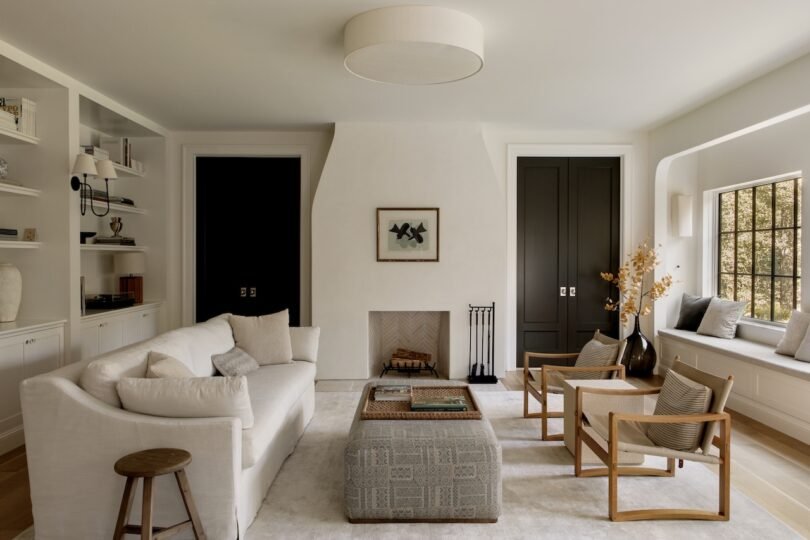
Curved thresholds carry this spatial logic through the plan, softening transitions and introducing a measured rhythm between rooms. The main level unfolds from the stair into a sequence of living spaces—a galley kitchen, great room, and primary suite—each tied together through this language of subtle curvature. In the great room, a gently sloped fireplace and an arched portal over built-in seating extend the motif, balancing formal restraint with moments of permeability that open outward to the wooded site beyond.


The primary suite holds the residence’s temporal layering within two adjacent rooms. In the bedroom, exposed original rafters—painted a deep green—retain the weight and memory of the earliest structure, paired with a restored fireplace clad in dark soapstone. The material’s matte density reinforces a sense of historical grounding. This is set in deliberate contrast to the adjoining bathroom, where marble hex tile and white lacquered wood wainscoting introduce brightness and refinement, articulating a quieter, more contemporary sensibility.


Beyond the interior, the project extends its architectural language into the landscape through a series of outdoor interventions. An elevated deck off the great room, anchored by a burnished metal firepit, and a bluestone patio off the kitchen with a built-in barbecue create multiple points of occupation, allowing the house to engage the site across seasons.


Throughout, a restrained palette of natural finishes—lacquered wood, honed marble, soft textiles, and custom built-ins—contributes to an atmosphere that feels both timeless and deliberate. A once-disparate structure becomes unified through material continuity, calibrated interventions, and a clear architectural narrative that bridges inheritance and inhabitation.


To see this and other projects by the studio, visit ravirajarchitect.com.
Photography courtesy of Sarah Elliott.