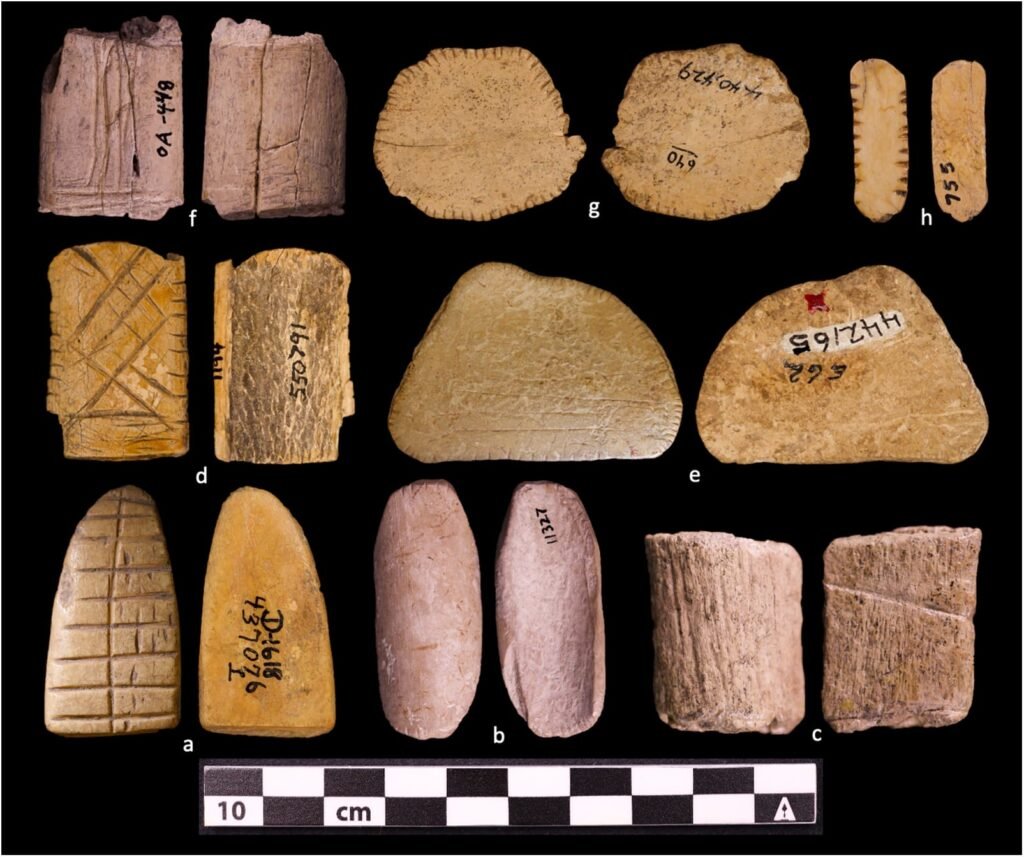

Archaeologists have long known that the ancient peoples of North America—not unlike us—played a lot of games. Going back millennia, cultures around the world developed myriad ways to keep entertained, and for a long time, it was thought that the first dice ever used could be traced to the ancient Eastern European and Near East cultures of Mesopotamia, the Indus Valley, and the Caucasus. But according to a new paper by Robert Madden, published by Cambridge University Press, games of chance developed much, much earlier than originally thought—halfway around the world.
Researchers previously believed that the earliest dice originated about 5,500 years ago, but Madden shares that examples excavated in North America date back as far as the Late Pleistocene—the Ice Age. Among the oldest reported examples are a few found in modern-day Wyoming, Colorado, and New Mexico. The rich archaeological sites in these places are associated with the Folsom Culture, representing a dispersed hunter-gatherer lifeway that extended across the North American West, Southwest, and Great Plains around 12,000 years ago.

“The dice tend to show up in liminal spaces where you have a lot of high mobility,” Madden told Live Science. “It might have something to do with how separated these people are and the need to relate to people you don’t see very often.”
In the report, Madden also says that “the making and using of dice represent humans’ first known efforts to intentionally generate, observe, and record streams of controlled, random events…” He adds that, possibly for the first time, people were comprehending patterns or regularities in probability—a kind of precursor to understanding what we now call the law of large numbers. Anthropologists consider this to be “a crucial early step in humanity’s evolving discovery and understanding of randomness and the probabilistic nature of the universe.”
Madden compared hundreds of examples found across the American West with a comprehensive, several-hundred-page publication called Games of the North American Indians, published in 1907 as part of an annual report by the Bureau of American Ethnology. It’s currently available in a two-volume edition from Bison Books.
You might also enjoy seeing what may be the world’s oldest crayon.


Do stories and artists like this matter to you? Become a Colossal Member today and support independent arts publishing for as little as $7 per month. The article 12,000 Years Ago, Native Americans Were Playing Games of Chance with Handmade Dice appeared first on Colossal.