Editors’ Highlights are summaries of recent papers by AGU’s journal editors.
Source: Journal of Advances in Modeling Earth Systems
The purpose of atmospheric data assimilation is to obtain a 3-dimensional gridded representation of the fields of the atmospheric state variables (temperature, wind, pressure, etc.) for a specific time based on atmospheric observations. The product of data assimilation, called analysis, can be used to prepare weather maps and to start model-based weather forecasts. Analyses collected over a long period of time can also be used for research and to monitor variability and changes in the climate.
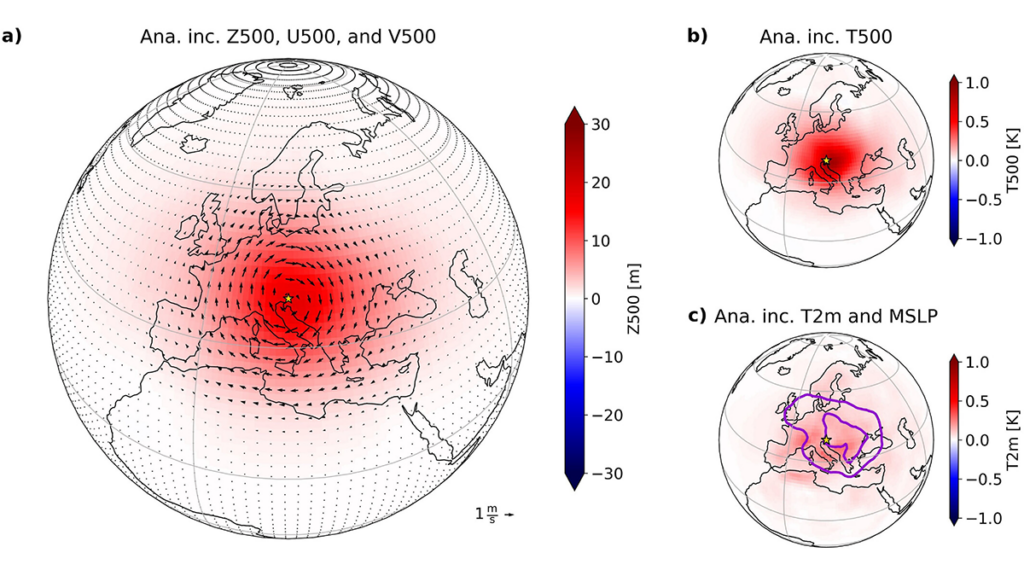
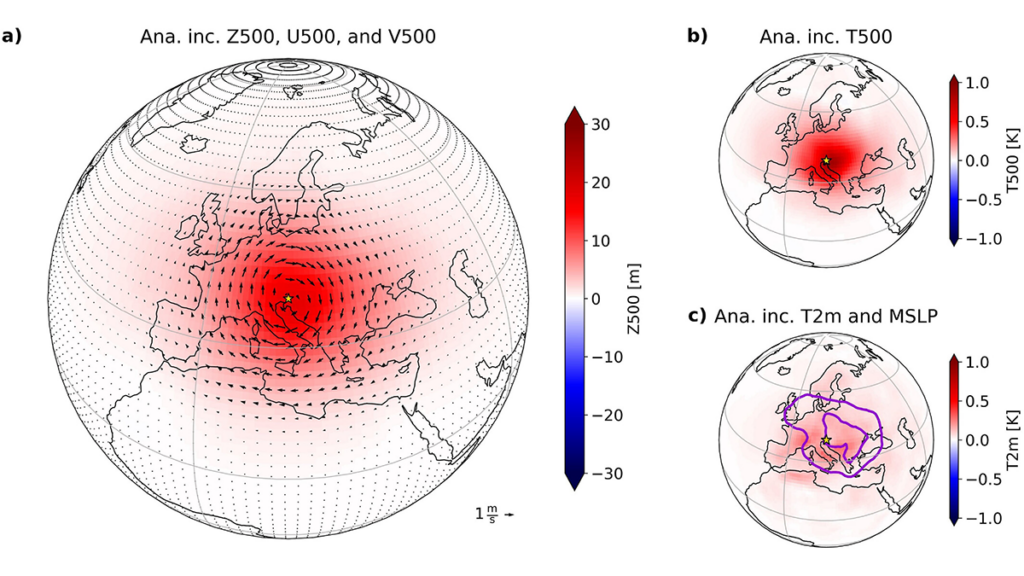
The main challenges of data assimilation are that observations are not collocated with the grid-points of the analysis, and most observations do not observe the variables of interest directly and have errors. For example, satellite-based observations, which form the bulk of the operationally assimilated observations, measure the intensity of electro-magnetic waves at the top of the atmosphere; a physical quantity that depends on the atmospheric state in highly complicated ways. The background-error covariance matrix is a key component of a data assimilation system, responsible for spreading information from observations to the unobserved locations and state variables. A good estimate of this matrix is essential to produce analyses in which the fields of the state variables are realistic and consistent with each other. Obtaining such an estimate is particularly challenging for tropical locations, where physics-based knowledge does not lead to a straightforward practical formulation.
In a new study, Melinc et al. [2026] propose a novel machine learning-based (ML-based) approach to define a background-error matrix that is equally effective in the midlatitudes and tropics. This approach takes advantage of the power of ML to learn quantitative relationships between different state variables at different locations-relationships that are either not known, or cannot be easily used for the formulation of a background-error matrix based on physics-based knowledge.
Citation: Melinc, B., Perkan, U., & Zaplotnik, Ž. (2026). A unified neural background-error covariance model for midlatitude and tropical atmospheric data assimilation. Journal of Advances in Modeling Earth Systems, 18, e2025MS005360. https://doi.org/10.1029/2025MS005360
—Istvan Szunyogh, Associate Editor, JAMES
Text © 2026. The authors. CC BY-NC-ND 3.0
Except where otherwise noted, images are subject to copyright. Any reuse without express permission from the copyright owner is prohibited.