“This story was originally published by Grist. Sign up for Grist’s weekly newsletter here.”
The day’s forecast called for high winds, but around midday in downtown Manhattan, it felt like a perfect spring day. The sun shone high in the sky last Tuesday as people gathered on the sidewalk around the corner from City Hall. Municipal employees mingled about, chatting excitedly. The cause for celebration wasn’t the weather—but a sleek, modernist-looking shed on the sidewalk where there had once stood a vacant newsstand.
The structure may not have looked like much, but it had been years in the making. Since 2021, Los Deliveristas Unidos—a union of app-based delivery workers—have been campaigning for the city to build outdoor structures where they can safely rest on the job, charge their e-bike batteries, and escape the elements. The crowd had gathered for the opening of the first “deliverista hub,” which had been a long-discussed idea, until recently—when Mayor Zohran Mamdani decided to expedite the building process following years of permitting delays and red tape.
By the time several delivery workers dressed in jeans, tactical-looking jackets, and bike helmets showed up, the atmosphere was buzzing with excitement.
“This is what the public realm is made for,” New York City Parks Commissioner Tricia Shimamura said from behind a podium, standing next to the hub with its clear glass windows and tall metallic columns. “This is what it means for our city to serve the people who keep it running.”
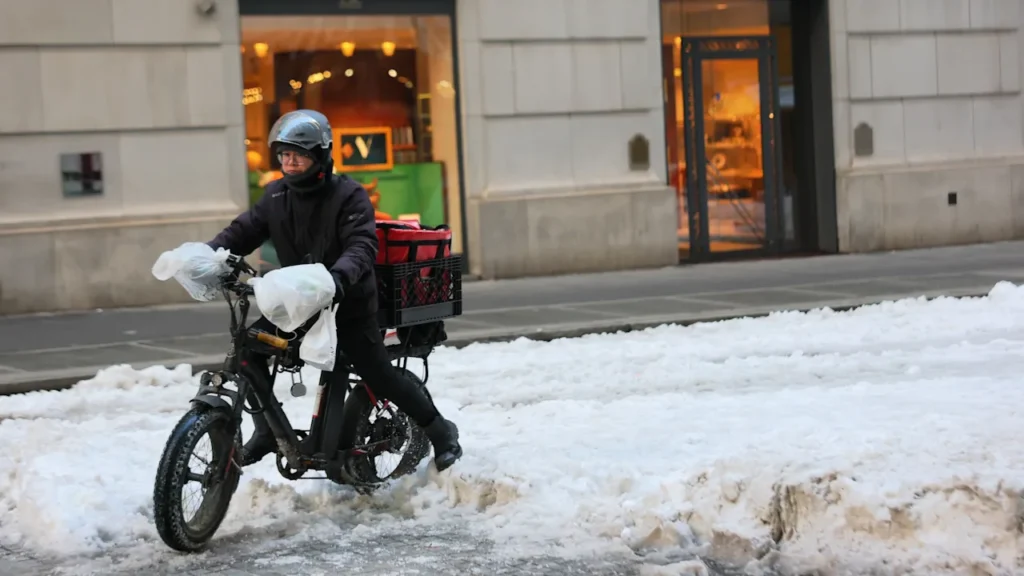
In New York City, more than 80,000 men and women board their vehicle of choice every day and shepherd everything from burrito bowls to groceries to many people’s front doors. Many of these deliveristas travel on two wheels: opting for e-bikes, scooters, and mopeds over cars. That means this workforce is more vulnerable to extreme weather events like heat waves and flash flooding—which are becoming more frequent and more severe due to climate change.
The idea for deliverista hubs sits at the intersection of workers rights and climate justice. If the city opens more of these facilities throughout the five boroughs, they will offer respite through all kinds of inclement weather, as well as provide a space for workers to talk to one another. Soon, the Lower Manhattan hub will also be staffed five days a week by a member of the Worker’s Justice Project, the worker center that helps organize Los Deliveristas Unidos. Delivery workers who are interested in learning more about joining the union can stop by the hub as a starting point.
At the grand opening, representatives from the New York City Parks Departments, the delivery workers union, Worker’s Justice Project, and the Department of Transportation were present and gave speeches. New York Senator Chuck Schumer—who secured $1 million in federal funding for this hub—as well as New York City Public Advocate Jumaane Williams and City Council Member Shaun Abreu also spoke.
Throughout the ceremony, a fine mist fell over the attendees. But it hardly dampened the mood of the ceremony, with the crowd frequently breaking out into cheers.
Ligia Guallpa, the executive director of the Worker’s Justice Project, proudly claimed this week’s opening as a victory for the working class. By pushing this project through, she said, deliveristas are “redefining what’s possible” in cities like New York City, where “public spaces have historically been built for cars, for the wealthy, and for the privileged.”
Gustavo Ajche, the co-founder of Los Deliveristas Unidos, said he got the idea of repurposing city infrastructure to create places of rest for delivery workers during the height of the Covid-19 pandemic.
“We were really isolated,” Ajche told Grist, speaking in Spanish, “with nowhere to go. During the pandemic, everything was closed and things got very complicated—I saw my colleagues [working outside] struggling to find places to shelter from cold, rain, and wind.” But he noticed that there were pieces of urban infrastructure throughout the city that had sat abandoned for years—like vacant newsstands—that could easily help them escape the elements.
Still, the road from that moment to last week’s opening ceremony was anything but straightforward. Ajche lamented that New York City’s previous mayoral administration, led by Eric Adams, took its time when it came to approving permits required to construct the city’s first deliverista hub.
Under Mayor Zohran Mamdani, said Ajche, things have gone differently; the New York Times reported that the mayor pushed to open the hub within his first 100 days in office.
After years of delays, the physical construction of the deliverista hub only took about a month, said Ajche. Asked directly about the lengthy timeline by a reporter after speeches ended, Parks Commissioner Shimamura said, “Unfortunately, I can’t really speak [to that], I’ve only been the commissioner for the last eight weeks.”
Ajche acknowledged that just having one hub isn’t sufficient to provide for the tens of thousands of delivery workers who stream through the city every day. Both he and Shimamura demurred when asked about the possibility of opening more hubs throughout the five boroughs. It’ll depend on financing, they said. But establishing partnerships with other city agencies is also part of the challenge; Shimamura noted that not every viable spot for a deliverista hub is owned by the Parks Department.
While it’s formally open, the hub itself sat largely empty—no charging stations, no HVAC system. Those will come later, according to a representative from the Worker’s Justice Project. The mist that was still falling on the attendees, it turns out, wasn’t rain—just a drizzle from window-washers working on a building across the street. Nevertheless, some of the deliveristas posed for photos beside the shed. Standing with Guallpa, who had been handed a bouquet of flowers, the group sang out chants of “Deliverista! Power!” as many flashed grins for the cameras and lifted fists to the sky.
This article originally appeared in Grist at https://grist.org/labor/new-york-city-unveils-its-first-rest-stop-for-delivery-workers/.
Grist is a nonprofit, independent media organization dedicated to telling stories of climate solutions and a just future. Learn more at Grist.org