Elon Musk wants to execute the largest initial public offering in history, chasing a staggering $1.75 trillion to $2 trillion valuation for SpaceX. To justify this unprecedented price tag, he is aggressively hyping a cosmic vision: launching 1 million artificial intelligence servers into orbit to create a 100-gigawatt space data center in the next decade. He plans to one day build a factory on the moon to catapult these servers to Earth’s orbit.
If that sounds like the background plot of a boring space movie, it’s because it is science fiction.
The TL;DR: here is that Musk’s blueprint is fundamentally broken, according to experts in physics, aerospace engineering, and chip design. It ignores basic thermodynamics and the logistical impossibility of extraterrestrial manufacturing. Even if the talented SpaceX engineers perform multiple miracles to make their CEO’s plan work, the real timeline spans decades, not years, as Musk has proposed.
This sci-fi narrative masks a vulnerable core business that, despite being the current leader by a wide margin, could lose its launch monopoly to cheaper Chinese rockets and face a fatal technological disadvantage in the upcoming space cellular war.
Sound familiar?
Yes, SpaceX 1.0 could quickly become Tesla 2.0.
And yet Musk—who, remember, has a long history of delays in his enterprises—boldly claims that SpaceX can build the required lunar infrastructure for his million-satellite plan in less than a decade, and that his orbital AI computing idea can reach cost parity with terrestrial AI farms in just two to three years.
According to the experts I’ve spoken to, this timeline is unlikely to play out. And if you’re planning to spend your money on Musk’s latest pipe dream, you should pay attention to what the experts are saying.
Those pesky physics
Down on Earth, when a computer processor gets hot, a fan blows ambient air across it (it can be liquid-cooled, but that radiator also needs to radiate out the heat through air). The air absorbs the thermal energy and carries it away through a fluid motion called convection.
In space, it’s a different story. Space is a vacuum, so there’s no air to carry the heat away. Electronics must shed their thermal energy by glowing, radiating it away as infrared light.
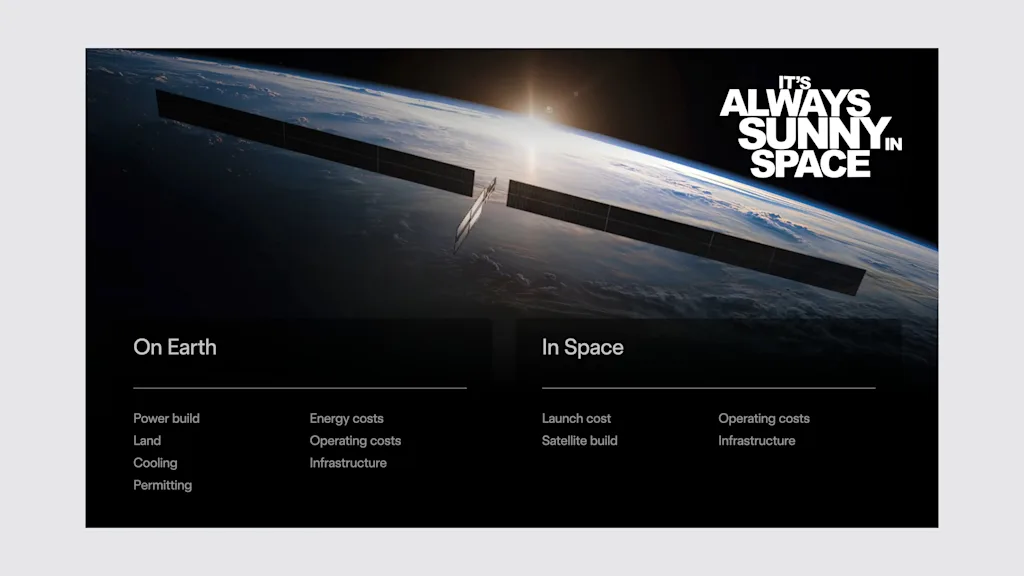
“Refrigeration in space is more challenging than on Earth because standard systems rely on gravity to manage liquids and gases,” Harvard astrophysicist Avi Loeb tells me in an email interview. He says that without gravity pinning it to the bottom of the server, “the oil used to lubricate traditional compressors can clog the system.” Furthermore, Loeb points out, “heat cannot rise away from components through natural convection.”
Damien Dumestier is an engineer who analyzed orbital data centers for the ASCEND project, which examined the feasibility of launching orbital servers. He agrees with Loeb and adds that new technologies will need to be developed to make it happen.
“In space you need to refrigerate IT hardware. The main difference is that on Earth you have the ambient air, which is roughly around 20 degrees Celsius,” Dumestier tells me in an email interview. In space you have minus 270°C temperatures, but heat must radiate out of components due to the lack of air, which is a very inefficient way to keep things cool.
“You cannot use convection or airflow to collect the thermal power from the dissipative elements,” Dumestier says. “Therefore the only way to dissipate the thermal power outside of the data center is to use radiative elements.”
Ryan McClelland, a research engineer at NASA Goddard Space Flight Center, puts the real issue in one clean sentence: “Cooling things in space is well understood. It is the scale required that is mind-boggling.” Indeed. It’s not that cooling things in space is impossible. It’s the scale of what Musk is proposing that makes it extremely hard.
Right now, a standard modern telecom satellite generates roughly 20 kilowatts of heat, which is low enough that the flat metal body of the spacecraft itself can act as a passive radiator, or a surface that slowly bleeds heat into the cold of space. That is a solved aerospace problem.
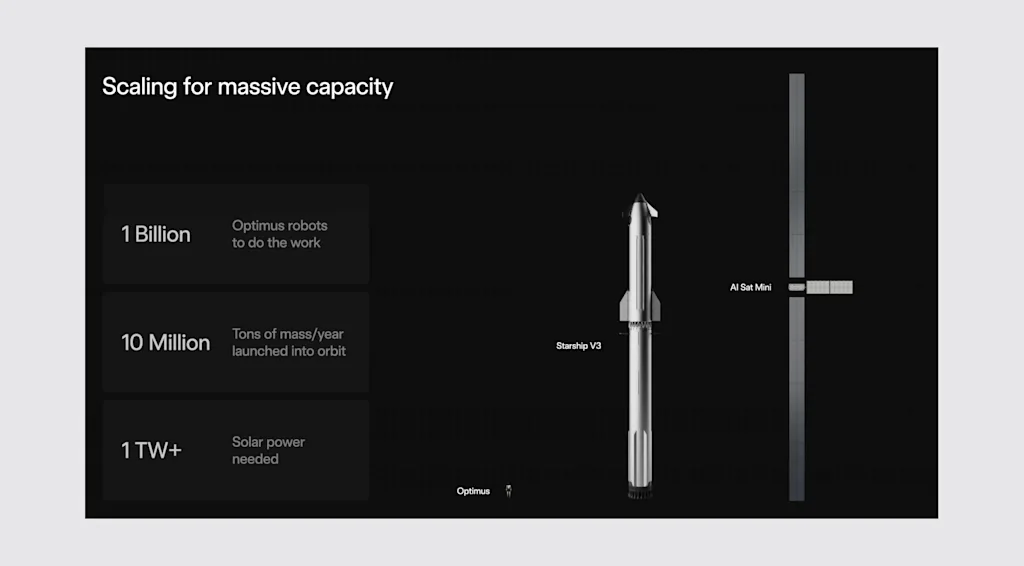
But Musk wants to build a 100-gigawatt network with 1 million satellites. Simple division dictates that each individual spacecraft must continuously process 100 kilowatts of power (100,000,000 kilowatts divided by 1,000,000 satellites). That is an entirely different thermal beast, as astrophysicist and science communicator Scott Manley points out.
Manley says that at 100 kilowatts per ship, a satellite’s natural surface area is nowhere near large enough to shed the heat. SpaceX will be forced to equip each satellite with massive, fragile, deployable radiators that unfold into space. Furthermore, the heat doesn’t magically jump from the melting silicon processors to those external wings; it must be physically carried there. This requires pumping tons of pressurized cooling fluid every minute through a complex labyrinth of narrow pipes. When you multiply that zero-gravity plumbing nightmare by 1 million satellites, the sheer mechanical absurdity of Musk’s data center becomes impossible to hide.
“Basically, all the energy collected (either by direct illumination and heating, or via the solar panels) must be radiated,” European Southern Observatory astronomer Olivier Hainaut says. “And yes, the radiation is not efficient, so large radiators are needed. That said, looking at the current version of their satellites, their radiators are significantly smaller than their solar panels. Still, they will be large.”
Dumestier calculates that the ratio of power generation to heat dissipation is roughly 4.5 to 1. To cool 100 gigawatts of computing power, SpaceX will need an astronomically massive physical footprint of radiators.
A silicon Dyson sphere
Then there’s the issue of feeding those AI processors. SpaceX will use solar panels to power them, but generating the power envisioned by Musk is a mathematical nightmare. Loeb tells me that capturing 100 gigawatts of solar flux requires an effective panel area of 1.07 billion square feet. Even if you chop that massive array into a million separate satellites, each unit requires a 32.8-foot solar panel.
“A linear alignment of just 10 components stretches across roughly the full height of the Artemis II Space Launch System rocket,” Loeb explains.
He compares the sheer scale of this million-server constellation to a “miniature version of a Dyson sphere,” referring to the theoretical megastructure first proposed by physicist Freeman Dyson in 1960 that entirely encompasses a star to capture its power. In a 2023 paper, Loeb suggests that as stars evolve, they might break these Dyson spheres apart, turning them into “thin interstellar objects which are pushed around by radiation pressure.”
You can’t just bolt a standard off-the-shelf server into this environment. A top expert in the chip industry who requested anonymity tells me that “cooling and solar energy production will require a huge footprint.” He stresses that the industry must invent entirely new hardware, noting, “We need to reimagine how chips are designed for space (heterogeneous compute, integrated Peltier coolers, integrated photonic chips) etc.”
A Peltier cooler acts like a microscopic electronic refrigerator glued directly to the silicon to force heat out, while photonic chips use beams of light instead of electrical currents to transmit data, eliminating much of the heat entirely. While basic photonic integrated circuits are just now reaching commercial mass production for Earth-based data centers, fully integrating microscopic Peltier cooling directly into the silicon die remains largely confined to experimental research. Mass-manufacturing these exotic processors, let alone engineering hundreds of millions of them to survive the radioactive vacuum of space, pushes this timeline decades into the future.
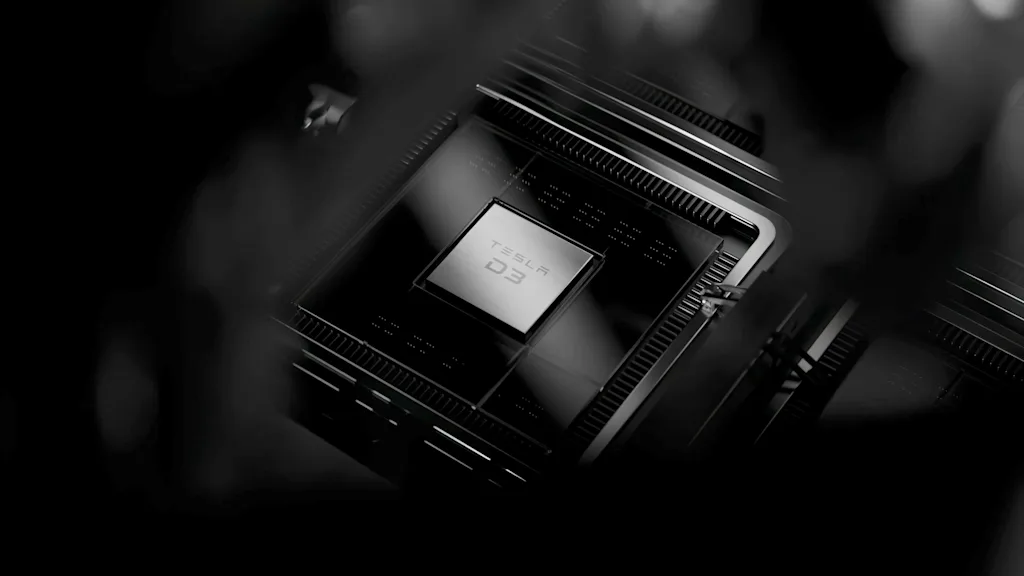
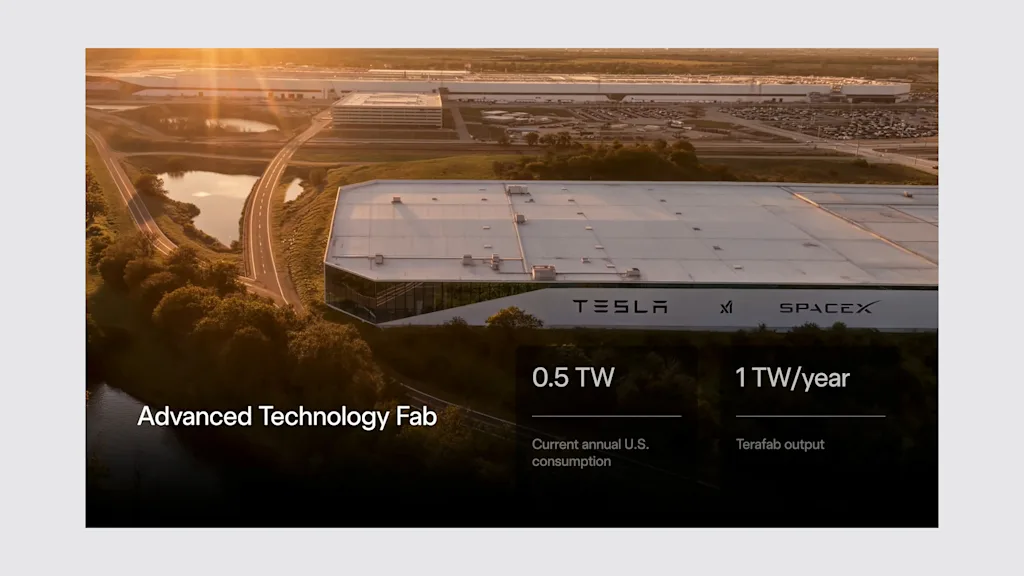
Hainaut speculates that SpaceX may already be working on solving the chip problem, since the rocket company and Tesla recently announced Terafab, a joint $25 billion chip factory in Texas. Nobody outside the company knows exactly what’s being built there, and this chip company may actually be for the Starlink mobile plans.
But even if they manage to solve this problem and come up with amazing new hardware, the timeline alone keeps ruining the investment pitch. “I still think we can have small-scale data centers (with specific objectives) in space within 10 years for sure. . . . We cannot underestimate Musk,” the chip expert says. The key phrase here is small-scale.
The Kessler lottery and lunar latency
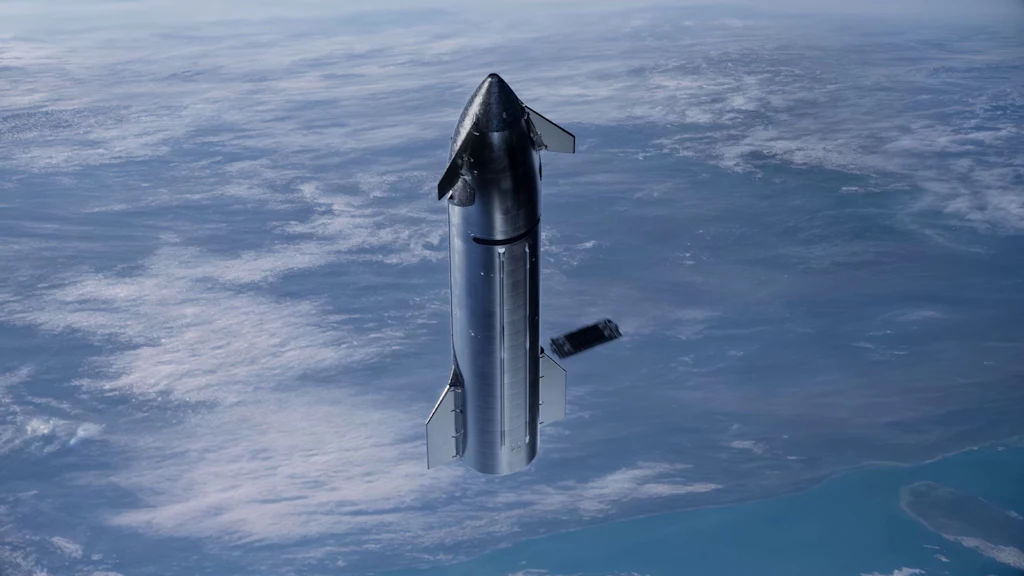
The problems with this plan don’t end with hardware. Placing a million massive structures into low Earth orbit—just 250 to 370 miles above our heads—invites a planetary disaster. Loeb warns that this density would “pose a serious risk for collisions, where the debris would catastrophically trigger a cascade chain reaction” known as the Kessler effect.
Debris from crowded orbits is already wreaking havoc. In late 2025, the return of three Chinese astronauts aboard the Shenzhou-20 was delayed because orbital debris struck their spacecraft, causing cracks in a window. In a 2023 report the Federal Aviation Administration issued a stark warning that falling space debris could cause human casualties by 2035.
Dumestier notes that 100 megawatts is completely unmanageable in low Earth orbit, which is why Europe’s ASCEND study proposed a far safer alternative: deploying just 1,000 satellites—each producing 1 megawatt—at a much higher altitude of 870 miles (for comparison, low Earth orbit is 250 to 260 miles)—to avoid the Kessler effect. But that comes short on the 100-gigawatt promise Musk is making by a factor of 100.
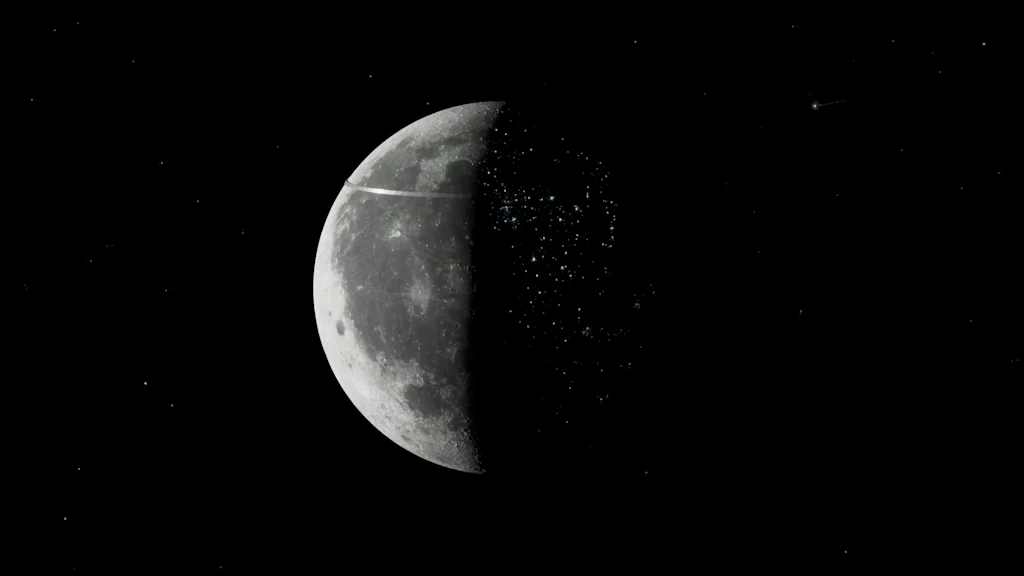
Furthermore, to avoid the crushing cost of launching all this heavy hardware from Earth, Musk’s master plan is to build a factory on the moon and use an electromagnetic mass driver to hurl the servers into orbit.
“Building a suitable factory on the moon will probably take many decades,” Loeb tells me. “The use of an electromagnetic catapult to launch satellites is an unproven technology. The entire project sounds more like a speculative science fantasy than a believable technological project.”
Musk wants to have a lunar factory up and running in just a decade, which is a wildly ambitious timeline, but Hainaut tells me that we shouldn’t underestimate SpaceX engineers. “They are good, and they control the whole stack,” he says, reminding me of the early days of Starlink, when astronomers complained about brightness in January and SpaceX launched modified spacecraft in March. “That kind of turnaround time is completely unheard of in the space industry,” Hainaut points out. “I suspect they can (eventually) do it,” though it will be “later than they claim.”
Under pressure
Let’s assume that SpaceX engineers manage to pull everything off in two or three decades. Cool. There’s another big elephant in the room: money. As Dumestier points out, that’s the real problem. How can they pull it off, even with that massive valuation, soon enough to actually make money and survive? Even if SpaceX manages to magically conquer these unprecedented engineering challenges, the timeline would span decades.
Musk is mainly going to use the massive influx of capital from the IPO to bankroll his decades-long science fiction dreams of lunar factories and mass drivers. But the company still needs to generate lots of money to keep going. Right now, SpaceX is running on two massive cash engines that Musk is desperately trying to leverage into his $1.75 trillion IPO: its workhorse Falcon 9 commercial rocket and Starlink’s 9 million subscribers. Without the commercial launches and continuous, dramatic Starlink growth, the card castle starts to fall apart.
And it just so happens that those two SpaceX revenue engines are under heavy fire.
Each Falcon 9 rocket launch prints money for the company, with a staggering operating profit margin as high as 77%. But state-backed Chinese aerospace companies are already aggressively undercutting Musk’s prices, with plans to sink them even more by building enormous factories to produce thousands of rockets.
You don’t even have to wait a year or two for that. As of March 2026, a commercial firm established by the Chinese Academy of Sciences, CAS Space, successfully launched its Kinetica-2 rocket at a cost of roughly $1,970 per pound. For context, SpaceX’s most recent Falcon 9 launch prices charge customers roughly $3,100 per pound. Now, keep in mind CAS’s price tag is for a ride in an expendable rocket. They are testing reusable technology this year and, according to the company, they’re aiming to halve the cost when that happens.
Domestically, the monopoly is also breaking, with rivals like Rocket Lab and Blue Origin bringing their own cheaper, reusable rockets to market to steal SpaceX’s lucrative commercial and government launch contracts.
Adding to the financial pressure that may crush Musk’s plan is Starlink, which he wants to turn into a global phone provider. Currently the source of up to 80% of SpaceX’s gross revenue, the division may lose the space cellular wars to multiple competitors, like Amazon Leo, multiple constellations from Chinese companies, and a small Texas-based company called AST SpaceMobile, which is backed by telecom giants like AT&T.
While SpaceX plans an environmentally reckless, brute-force constellation of 34,000 disposable Starlink V3 satellites—operating on weak, high-frequency signals that bounce off buildings and require users to buy an entirely new phone equipped with a proprietary SpaceX modem chip—AST has vastly superior technology that will allegedly allow it to cover the world with just 90 massive unfolding satellites. The latter also owns key “gold spectrum,” the low-band radio waves that penetrate walls and connect directly to the standard 5G smartphones already in consumers’ pockets.
To further complicate SpaceX’s immediate future, its Starlink V3 is so heavy that the Falcon 9 cannot launch it in economically viable numbers. The entire broadband business model hinges on Starship, a super-heavy rocket that remains in the testing phase. Even Musk admitted that because the Falcon 9 lacks the volume for next-generation satellites, SpaceX faces a “genuine risk of bankruptcy” without Starship.
Of course, SpaceX may be able to fend off competitors and solve all the huge engineering problems ahead. After all, SpaceX succeeded in making reusable rockets happen at the 11th hour, just when Musk thought the company was about to go under.
Still, with all the external forces aligning against the company and a sci-fi plan that may require decades to come to fruition, it’s hard to imagine investors getting any significant profits for an extremely long time. The current situation feels all too familiar to me. It’s as if we’re watching SpaceX walk the exact same path as Tesla: an industry that Musk started, scaled to incredible heights, only to fall, wrecked by his own hubris and the unstoppable rise of better technology, better design, and the overpowering Chinese supply chain and manufacturing muscle.
Musk’s astronomical valuation relies on investors looking at the moon, a tall tale seemingly designed to obscure his company’s breaking points right here on Earth.