From the Cool Cat Teacher Blog by Vicki Davis
Subscribe to the 10 Minute Teacher Podcast anywhere you listen to podcasts.
Everyone is talking about AI. How do we start? I started my journey into teaching coding with amazing resources, with Hour of Code and Code.org. Now, we have “Hour of AI” resources and other tools collected by Code.org that we can use anytime. In this episode, Karim Meghji, President and CEO at Code.org, shares how AI literacy belongs in every classroom for all ages. In addition to Hour of AI, you’ll hear about unplugged resources that teach kids about AI without a single computer.
A 2025 RAND Corporation study found that AI use in schools is rising rapidly — but guidance and teacher training are lagging behind, with a concerning equity gap between low-poverty and high-poverty districts. They said that the proliferation of generative artificial intelligence has created a “fast-moving, real-time social experiment at scale.” This is so concerning to me and should be to all of us!
Please don’t assume that kids just “know” how to use AI tools. When I taught an AI literacy lesson recently, several eighth graders were genuinely stunned to learn that AI doesn’t actually “think.” Wow!
This episode is sponsored by the VAI Educators Studio from Van Andel Institute for Education. If you’re a K-8 STEM teacher looking for classroom-tested lessons, hands-on projects, and time-saving resources, you can get 50% off an annual membership using the promo code COOLCAT. Head to coolcatteacher.com/vai to learn more.
Key Takeaways for Teachers from Karim Meghji
- AI Literacy applies beyond computer science class. Students need to know how to use AI tools responsibly and ethically, as well as how they work. As Karim says in the show, you don’t have to be a mechanic to drive a car, but understanding the basics of how it functions matters.
- Code.org’s Hour of AI brings together hundreds of partners who offer one-hour activities across grade levels and subject areas. Whether you want to fit an AI activity into an English class or a math class, you’ll find a resource. The key message: just start by doing.
- AI 101 for teachers. We need to build our confidence with AI. This course from Code.org can get us teachers started with the foundation to guide our students.
- Unplugged AI lessons give options for teaching content to students without a computer needed. Whether a school is concerned about screen time or doesn’t have computers, unplugged lessons are a great place to start.
- Computational thinking is the foundation. Skills like sequencing, algorithms, and pattern matching are used every day. Students with a foundation in thinking in these ways will have an advantage when describing the apps and programs they can easily create with a good prompt.
Resources, Links & Research Mentioned in This Episode
Code.org Resources
- Hour of AI — Code.org’s free collection of one-hour AI activities from hundreds of partners, organized by grade level and subject area.
- Code.org — The nonprofit dedicated to ensuring every student has the opportunity to learn computer science and AI.
- Code.org AI 101 — Free professional learning curriculum for teachers to build their own AI literacy in just a few hours.
- Computer Science Discoveries — Code.org’s middle school curriculum, which includes AI education and is being expanded.
- Code.org Unplugged Activities — Hands-on, no-computer-needed lessons that teach computer science and AI concepts through discussion and collaboration.
Other Tools Mentioned
- CodeCombat — Game-based coding platform Vicki found through Code.org many years ago and still uses with students.
- MIT RAISE AI Curriculum — MIT’s initiative for Responsible AI for Social Empowerment and Education, offering K-12 AI curriculum resources.
Research & Studies
- AI Use in Schools Is Quickly Increasing but Guidance Lags Behind (RAND, 2025) — RAND Corporation research showing AI adoption is outpacing teacher training and district guidance, with a significant equity gap between low- and high-poverty districts.
- More Teachers Than Ever Before Are Trained on AI (EdWeek, 2025) — Reports that nearly three-quarters of districts plan to provide AI training by fall 2025, but access remains uneven across school communities.
Sponsor
- VAI Educators Studio — Classroom-tested lessons, hands-on projects, and professional development for K-8 teachers. Use promo code COOLCAT for 50% off.
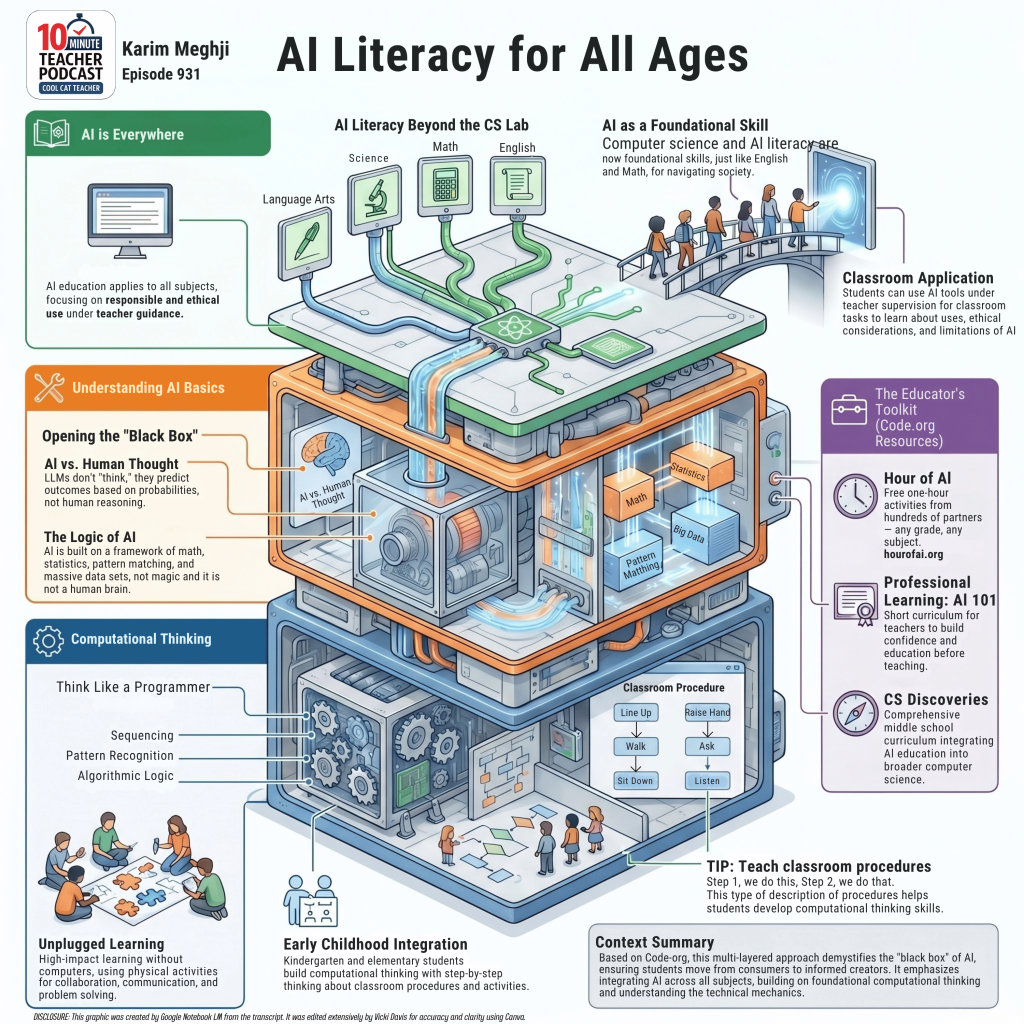
Visual Summary
This infographic highlights the key AI literacy takeaways from Karim Meghji’s interview on the 10 Minute Teacher Podcast.

Disclosure: This graphic was created by Google Notebook LM from the transcript. There were quite a few issues so I used Text Magic Grab in Canva to edit. I performed several fact checks between the infographic and the transcript using Claude Cowork to ensure it reflects our guest’s opinions. I hope this disclosure helps those who would like transparency to understand the use of AI. – Vicki Davis, your host
Listen to the Show
Free AI Resources for Teachers: Hour of AI and Beyond

Watch this video on YouTube.Subscribe to the Cool Cat Teacher Channel on YouTube
Watch on YouTube | Subscribe to Cool Cat Teacher on YouTube
About Karim Meghji

Karim Meghji is the President and CEO at Code.org, the nonprofit dedicated to ensuring every student in every school has the opportunity to learn computer science and AI. Code.org is known worldwide for Hour of Code and the new Hour of AI. Karim previously served as the CPO at Code.org, leading the global effort to bring CS and AI into K-12 classrooms. His path was shaped in high school, when a teacher inspired a lifelong passion for technical problem-solving — a “lightbulb moment” that now fuels his mission to empower students everywhere. A seasoned executive with experience in scaling high-growth companies, he has served in leadership roles at Remitly, Booking.com and RealNetworks. He is dedicated to the vision that teaching students how technology works gives them the agency to build the future.
Website: code.org
Other Shows You’ll Love
- STEAM Classroom Ideas That Work: 9 Experts Share What’s Real — Hear Karim’s segment on AI literacy as part of our STEAM Super Series on Cool Cat Teacher Talk (S5E8)
- Preparing AI-Ready Graduates for Future Challenges with Richard Culatta — Episode 912
- 3 Easy AI Prompts I Teach My Students on the First Day — Episode 907
- Computational Thinking and Math for Elementary Grades
Love Cool Cat Teacher Talk? Browse all episodes here for deeper dives into the topics you care about most.
Listen and Subscribe
If you enjoy the 10 Minute Teacher Podcast, please leave a rating on YouTube! It helps other educators find the show.
Episode Transcript
This transcript was generated using AI and has been reviewed by humans for accuracy. Minor errors or artifacts may remain.
Click to read the full transcript
Vicki Davis (00:05)
Today’s episode is brought to you by the Educators Studio from Van Andel Institute for Education. If you’re a K through eight STEM teacher looking for classroom tested lessons, hands-on projects, and time-saving resources, you can get an annual membership for only $9.99 using the promo code COOLCAT. More on this after the show.
Vicki Davis (00:32)
Karim Meghji is the President and CEO at Code.org. It is the nonprofit dedicated to ensuring every student in every school has the opportunity to learn computer science and AI. Of course, Code.org has been known for Hour of Code. Now it’s Hour of AI. And Karim, as we talk about artificial intelligence, does it have to be taught just in a computer science class or is this something that could be for all ages and stages of students?
Karim Meghji (01:05)
I love to start with this kind of a question. The answer is no. At the end of the day, AI literacy applicable in the understanding of how to use AI responsibly, ethically — they apply well beyond computer science. So whether it’s in language arts, math, science, there are a lot of applications where using AI done with good guidance from teachers, done well because students understand how and when to use AI, I think is important.
I’ll add the one thing though, and that is that AI literacy should go broader than just how these tools work across subjects. At Code.org, we’ve spent a decade with the mission that computer science is foundational, that every student, just like they learn English, math, and science, should be learning computer science. And so when we think about computer science and AI together, we believe students should not only learn how to use the tools, but how do the tools work? And that does fit within the context of a technical sciences curriculum or course.
Vicki Davis (01:58)
So I love all the content you have. As we were talking before the show, I teach AP Computer Science Principles and some of my favorite tools I found through Code.org many years ago, whether it was Code Combat, the MIT AI curriculum, a lot of different things like that. You have resources that beginning teachers who are just like, hey, I know I need to teach this, but I don’t know where to start — where does a beginner know where to go and what to do?
Karim Meghji (02:25)
You touched on actually probably one of the best places for a teacher who’s dipping their toes in the water of teaching AI to students at all grade levels, by the way. And that is the Hour of AI. We started the Hour of Code years ago and we brought together hundreds of partners across the computer science community, bringing together their expertise and their experience of teaching students computer science in just one hour. And that’s what we did for a decade.
This past year in December 2025, we launched the Hour of AI and have done the same thing. We brought together hundreds of partners who in one hour teach students a variety of aspects of AI. So that would be a great starting point. Go to hourofai.org and see the resources we have there. We have activities by lots of partners that target different age groups, different areas, depending upon what you want to fit it in. Maybe you want to do something in an English class. You’ll be able to find a really good resource for that. That’s the first thing. Just start by doing, and that’s the place to do it.
The other thing that I would say for those who are just starting out is, you know, to be confident at teaching any subject with students, you yourself have to be confident at some level with the subject itself. That’s another area that I would really encourage teachers to engage in, which is the professional learning and development that they need to do. We offer resources — we have an AI 101 curriculum. It’s just a few hours for teachers to start their own journey. So use our resources or there are a lot of other organizations that have these professional learning resources just to get you started. Don’t forget to take care of your own education before you start that next step with students.
Vicki Davis (03:59)
And your computational thinking, which of course is part of the computer science area, is so important. I teach our kindergarten teachers that how you describe your classroom procedures can help your students foster that computational thinking that they need. Thinking in algorithms and steps, being able to break down topics — like these are all things that do impact every area. Okay, we need to maybe shift how we teach those classroom procedures so that we’re incorporating computational thinking. While AI is important and it’s part of what’s going on, also understanding we don’t want all this technology to be a black box to our students. We want them to understand that there’s algorithms and what’s going on behind the scenes, right?
Karim Meghji (04:47)
I completely agree. Computational thinking is a really interesting topic to discuss. Something that I say quite a bit is computational thinking isn’t just about computers. It’s about learning how to solve problems with lots of things. We use computational thinking every day without knowing it or calling it that. It just happens that when we try and structure our instructions for a computer, we speak in computational thinking terms to get that computer to do some of the things we want to do.
So learning things like sequencing and algorithms and pattern matching are important for young learners as they not only engage with the world around them, but with computers directly. Now as we move into this world of AI, this idea of learning what’s happening under the hood gets even more important as these systems interact with us in human-like ways, but they’re not human. And so what’s happening? Probabilities, statistics, pattern matching, data. We want to start teaching about those concepts to students so as their world evolves, they are able to navigate it both as good consumers, but also as creators of a society that can shape those technologies.
Vicki Davis (05:54)
So Karim, one thing I’ve always loved about the Code.org content is that you have all these unplugged activities for teaching computer science. Do you have unplugged activities for teaching about artificial intelligence also? And unplugged means you don’t need a computer. Like you could teach this stuff without a computer. And in many ways, I actually pull a lot of your unplugged content to even use in my AP class because you can get hands-on, you can go lids down with the computers and you can really understand how these things work.
Karim Meghji (06:24)
Love this question, Vicki. Young learners need to be away from devices to be interacting with each other and doing some learning in addition to just the core subject. So yes, we do have unplugged activities for AI. We’ve just begun to develop curriculum around AI unplugged, exploring generative AI as a specific unit that we built for middle school students.
It has two parts. The first part is just unplugged, getting away from the computer, having conversations, having discussions within the classroom itself. Then teachers can choose to take that next step and put them on computers and start to actually make it practical for them, the things that they’ve just learned. Yes, and we expect to do more — especially as we get to K-5, you’ll see more from Code.org in the many months ahead, developing in both high school and elementary school, and middle school actually. But unplugged will be an important component of that for the reasons you described. It’s an important modality because it teaches things like collaboration, communication, all the other skills that we’re also trying to incorporate in the classroom, especially around problem solving and technology.
Vicki Davis (07:31)
I was teaching an AI literacy lesson to my eighth graders today. AI used to come at the end of the semester. It now has to be at the beginning because it’s the elephant in the room and they all want to understand about it — the first wrongful death suit against ChatGPT. And a lot of these concerns, the kids are like, well, how could this happen? You know, and you talk about the Eliza effect.
I think the moment that shocked me was I had a couple of kids when we got through how LLMs work, who looked at me and said, you mean AI doesn’t think and it doesn’t have a brain? They were literally stunned. And I think some of it’s the metaphors maybe used in advertising — we always see the electronic brain or whatever. I had a teacher one time say, I just explained it to my students that it’s just like an electronic brain. And it’s shocking to me sometimes how hungry kids are to actually understand how it works.
Karim Meghji (08:21)
Learning, to your point, about what’s actually happening under the hood is so important, right? I don’t have to be a mechanic to drive a car, but it is good to understand how the car functions and how it works and what the basic physical properties are. And I would argue that the analog applies here in a world with AI where we’re driving AI — we have to understand what it is. It’s a tool that is made up of algorithms, data, math.
Vicki Davis (08:44)
So Karim, let’s talk to educators about where they can start with all of your resources — maybe a few pointers to some of your favorite things that are out there. Let’s just get some starting points for folks as we finish.
Karim Meghji (08:57)
I think elementary school is a great place. We have a lot of really fun activities for students. They learn to use AI. They get exposed to it. It’s a way to dip your toe, both for the teacher and for the students. So that would be my one thought there.
Middle school curriculum — there’s a lot of curriculum that’s developing out there. We’re in the middle of developing our own curriculum. If you go to code.org, you can see some of the stuff that we already have today that does include AI education. We’re making it better. It’s called Computer Science Discoveries. So stay tuned for more there, but it’s also a really good starting point.
On our site, we have resources for a lot of partners, so that’s the last thing I’ll leave you with. Just about any domain of work you want to explore — if you’re teaching English and you want to bring some AI into that, you can find partners and curriculum. So just go to code.org under Teach, you’ll find all of our resources.
Vicki Davis (09:49)
Before you go, I want to tell you about today’s sponsor, the VAI Educators Studio from Van Andel Institute for Education. Do you know how it feels when you just find that perfect lesson that works? The VAI Educators Studio is packed with classroom-tested lessons, hands-on projects, and skill-building activities designed specifically for K through eight teachers. Plus you get on-demand professional development and a community of educators who get it. I’ve been exploring their resources and love how they’re built to save you time while sparking real creativity in your classroom. You can get 50% off membership to the Educators Studio by using the promo code COOLCAT when you sign up. So head over to coolcatteacher.com/vai. The VAI Educators Studio — because great teaching should not mean endless prep. And remember, use the promo code COOLCAT.
Disclosure of Material Connection: This episode includes some affiliate links. This means that if you choose to buy I will be paid a commission on the affiliate program. However, this is at no additional cost to you. Regardless, I only recommend products or services I believe will be good for my readers and are from companies I can recommend. I am disclosing this in accordance with the Federal Trade Commission’s 16 CFR, Part 255: “Guides Concerning the Use of Endorsements and Testimonials in Advertising.” This company has no impact on the editorial content of the show.
The post Free AI Resources for Teachers: Hour of AI and Beyond appeared first on Cool Cat Teacher Blog by Vicki Davis @coolcatteacher helping educators be excellent every day. Meow!
If you’re seeing this on another site, they are “scraping” my feed and taking my content to present it to you so be aware of this.