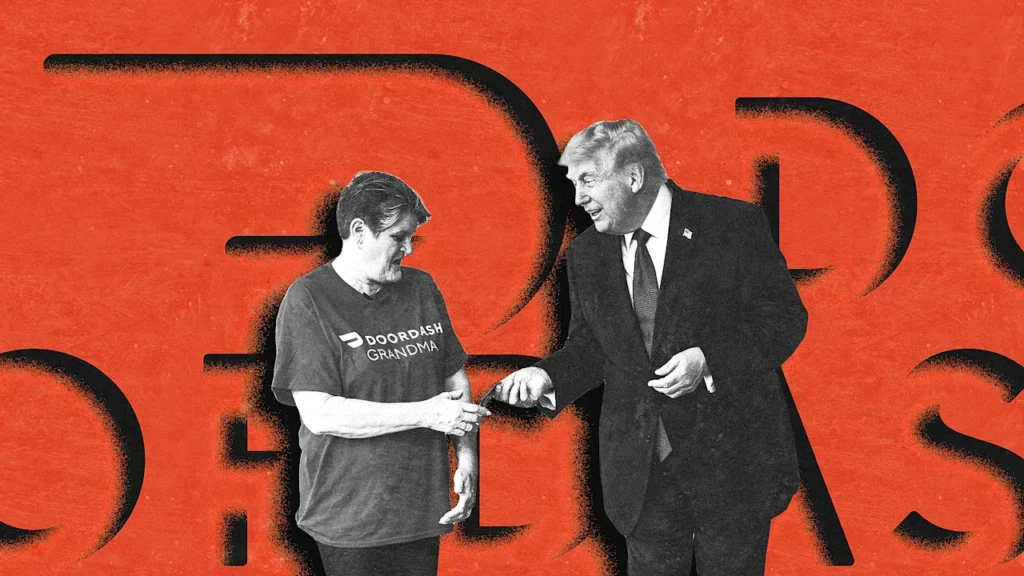
It must have seemed like a slam dunk PR opportunity for all concerned: A “DoorDash Grandma” making a (staged) delivery to the White House, affording President Trump a chance to tout his “No Tax on Tips” policy, and DoorDash a prompt to praise that policy for letting “workers keep more of what they earn, including hundreds of millions of dollars for Dashers.”
As press looked on and cameras rolled, Sharon Simmons, sporting a “DoorDash Grandma” T-shirt and handing a couple of McDonald’s bags to Trump, praised the policy for saving her thousands of dollars on taxes, which she says she’s using to help pay for her husband’s Stage 3 cancer treatment. “It has helped my family out immensely,” she said.
But it wasn’t a slam dunk. In fact, Simmon’s appearance turned into an absolute disaster, as the PR stunt devolved into an argument over whether Simmons, the 58-year-old grandmother (of 10) in question, was actually a MAGA shill. That debate, as neatly chronicled by Fast Company’s Joe Berkowitz, drew attention to the forced nature of the stunt, and helped thoroughly undermine the episode’s effectiveness for the policy or the brand.
But the squabble over whether Simmons is fully legit or some kind of ringer has obscured a deeper point: Either way, she’s a dreadful symbol for the DoorDash brand and for the state of the economy in general.
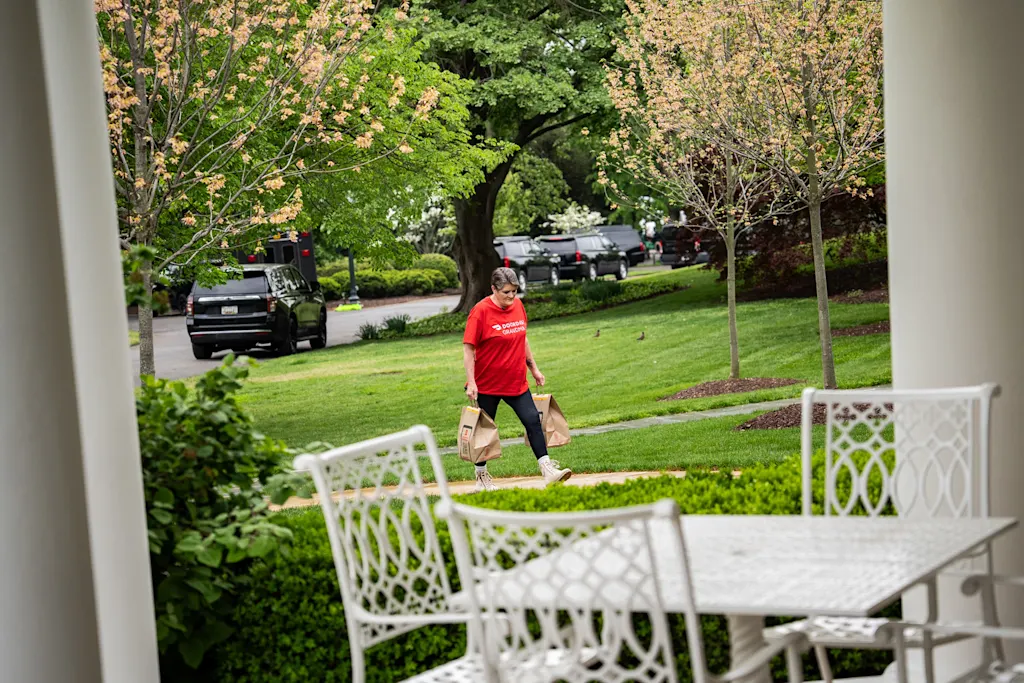
At an age when a worker should command comfortable earning power and be counting down to retirement, Simmons is grinding for tips at a no-benefits gig job to cover healthcare costs. Frankly, she’s lucky the rise of driverless vehicles—long a goal of the rideshare and delivery sectors—hasn’t yet taken even this not-so-reassuring option away. (Yet.) This sounds more like a cautionary tale than a heartwarming policy success. When you think about your golden years, does your vision involve hustling to cover your spouse’s vital medical care?
Admittedly, the cozy and carefree retirement dream of security and dignity after decades of work has never been universally realized. Yet it remains culturally potent—even as many workers today (including many comfortably in the middle class) expect they’ll need to keep finding ways to earn money well past traditional retirement age.
If DoorDash Grandma was intended to function as an anecdote polished up for political optics, the real message seems different. What’s authentic is that there are countless older Americans in similar positions, navigating a patchwork of Social Security, savings, and supplemental income streams that increasingly include gig work. (In Simmons’s case, there’s reportedly a GoFundMe as well.)
Businesses that rely on tip-dependent labor are naturally in favor of no tax on tips, because it benefits their workforce without the business sacrificing a dime or making any particular effort. And there’s nothing unusual about that; it’s just capitalism. Gig-economy companies have spent years positioning themselves as a source of opportunity: flexible work, entrepreneurial autonomy, a platform that empowers individuals to earn on their own terms. DoorDash Grandma seems like a variation on this standard gig-economy pitch: the scrappy side-hustler, the student paying tuition, the creative professional bridging income gaps.
But in reality, a 58-year-old grandmother delivering food to a rich guy (Trump apparently tipped her $100) to offset healthcare costs is not exactly an aspirational image. To the contrary, it’s vaguely alarming. The dominant implication isn’t flexibility—it’s necessity.
That’s why the episode highlights a brand-narrative problem for the entire gig economy, and, by extension, for policymakers eager to highlight its positive impacts. The gig economy has always occupied an ambiguous space between innovation and erosion, expanding access to income in innovative ways while redefining (and often reducing) the protections and stability associated with traditional employment.
And on a policy level, no tax on tips is hardly a replacement for, say, comprehensive healthcare benefits. Trump’s healthcare policies and proposals are projected to reduce enrollment in the marketplace created by the Affordable Care Act by 750,000 to 2 million people in 2026. And some experts believe broader Medicaid/ACA cuts will strip coverage from millions more over time. The administration has promised to fix all this, but any specific plan, or concepts thereof, has yet to materialize (and lately seems to be deprioritized in favor of spending on defense and deportation efforts).
Which is part of what makes DoorDash Grandma, genuine or not, so complicated. Her story is compelling and memorable—but it’s also just kind of a bummer. Here is an older American, engaged, contributing, not sidelined. But beneath that is a nagging question: Why does she need to? As a symbol, she’s basically a question mark. And neither business nor institutions seem entirely equipped to provide a comforting answer.
Perhaps, in the end, this is a simple case of brand-narrative tension. A (true) story of flexibility, empowerment, and opportunity is contradicted or at least complicated by another (true) story of difficult lived experience. Most of the time, those tensions remain abstract. Occasionally, they crystallize in a single image or anecdote that’s too vivid to ignore. Maybe this is one of those times. And maybe actually contending with those tensions would not be such a bad thing.