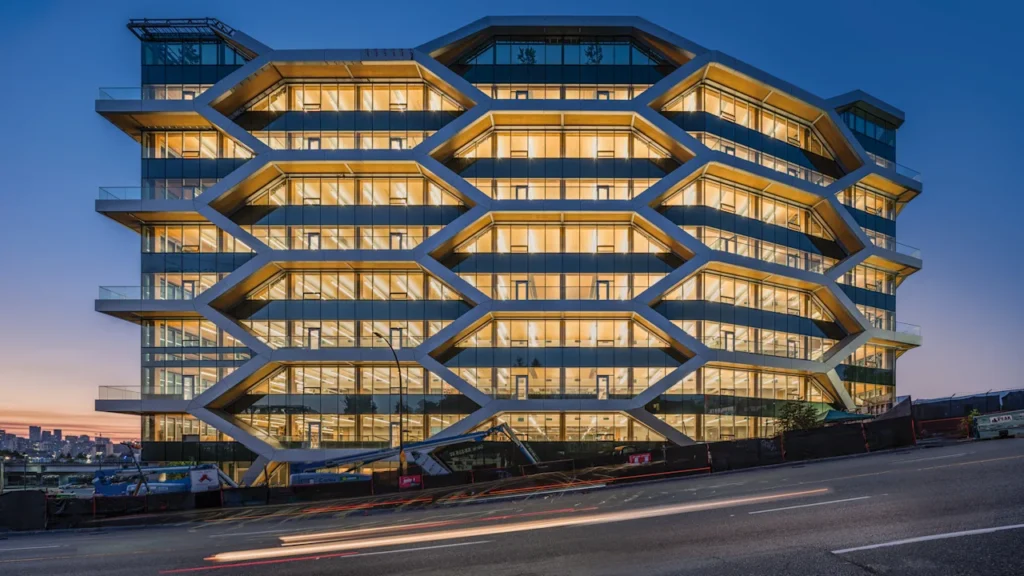
As visitors head into downtown Vancouver through the city’s False Creek Flats neighborhood, the first thing they’ll see is the Hive: a 10-story office building built out of wood and shaped like a giant honeycomb. Beneath its webbed exterior, the building is hiding a clever design system that keeps it safe from earthquakes by allowing it to wiggle, shake, and settle.
The Hive, designed by the Toronto-based architecture studio Dialog, is the tallest seismic-force-resisting building made from mass timber in North America. By substituting mass timber for typical steel-and-concrete construction, the building is sequestering a total of 4,403 metric tons of CO2; equivalent to taking 1,300 cars off the road for a year. And, according to Martin Nielsen, a partner at Dialog, mass timber is naturally more resilient to seismic activity than steel and concrete.
Despite these advantages, tall mass timber buildings like the Hive are rare. Whereas wood construction was the norm pre-20th century, the mass production of steel and concrete made those materials the dominant building resources over the last century. Recently, though, interest in mass timber construction has resurfaced in cities like New York, Milwaukee, and Vancouver, among others, as a way to reduce greenhouse gas emissions. As of now, there are around 2,700 mass timber buildings either constructed or in the works in the U.S.—more than double than back in 2022.
In earthquake-prone regions like western Canada, this renewed interest means that architecture firms like Dialog are beginning to experiment with strategies that can make mass timber buildings both more common and more safe. With the Hive, their solution is a system of joints that take a key design cue from tectonic plates.
“Concrete is the worst”
The concept for the Hive started around a decade ago when an organic farming company looking for a new headquarters approached Nielsen. While that client ultimately couldn’t use the space (the building will now serve as offices for the Insurance Company of British Columbia), the initial mandate remained in place: a sustainable, wood-based building that would help pave the way for future mass timber developments in Canada.
Using timber to build at scale certainly isn’t unheard of. Other examples do exist, like Milwaukee’s 25-story Ascent MKE Building, Norway’s 18-story Mjøstårnet tower, and the University of British Columbia’s 18-story Brock Commons Tallwood House, but they’re largely the exception to the rule. The issue, Nielsen says, is that building codes and policies have been structured around steel and concrete construction since the Industrial Revolution. The cost efficiency of concrete, as well as timber’s potential fire risk factors, are two key factors that have become baked into those policies over time.
Even after a developer goes through the arduous task of gaining approvals for a mass timber building, they then have to contend with much higher insurance premiums. And, in the case of the Hive, which is located in a region with strict building requirements because of potential seismic activity, Dialog was facing the added stipulation of designing an ultra-earthquake-safe wooden structure.
However, according to Nielsen, while steel and concrete have been the default building materials for decades, wood actually has a natural ability to resist seismic force. In fact, it’s been used in earthquake-prone regions for centuries, including in ancient Japan, where wood pagodas and pavilions were designed to move with seismic activity rather than resist it.
“Concrete is the worst,” Nielsen says. “It’s really stiff, brittle, and it breaks.” Once it breaks, he adds, “it’s garbage.” In the case of a severe earthquake, rigid steel and concrete buildings may remain standing, but they’re often structurally compromised. But “wood has a bit of a bend,” Nielsen continues. “Clearly, in the case of a big earthquake, the glass might pop out, but the structure will remain sound.”
How a special joint makes the Hive safer in earthquakes
Most post-industrialization buildings rely on a concrete core (where the elevator shaft and stairs are located on nearly every skyscraper) as their main stabilizing support. The Hive has no core at all—instead, its seismic force-resisting properties are hidden inside its facade.
During initial testing phases, Nielsen’s team decided to use a perimeter-braced structural system to avoid excess concrete use. Without the usual core keeping the building stable, its outer walls needed to be both sturdy and capable of absorbing the movement of an earthquake.
To start, the designers mocked up a structure that used diagonal wood beams to evenly distribute force across all 10 stories of the building. During testing they found that this diagonal-based shell wasn’t enough to prevent potential breaks in the case of an earthquake. So the engineers returned to the drawing board and came back with something called a “tectonic joint.”
The tectonic joint was invented in the wake of the deadly Christchurch, New Zealand, earthquake in 2011, when dozens of people were killed inside collapsing buildings. It’s a component that allows the joints of stabilizing beams to ever-so-slightly slide together in the case of an earthquake, letting the whole building flex to absorb the impact.
“It always recenters to vertical, so the structure can be reused,” Nielsen says. “Typically, in a seismic event, you have to take the building down. It’s trying to dissipate those forces, and whether it’s concrete or steel, it is going to either yield or fail completely. So [tectonic joints] were an exciting development.”
Dialog added these joints throughout their design and then headed to the University of Alberta, where they subjected a full-scale mockup of an entire story of the building to a seismic force simulation. Those tiny, imperceptible joint wiggles proved effective: The Hive passed its earthquake-readiness test, and was approved for construction.
A wooden revolution
When it came time to actually build the Hive, Dialog worked with a local business to source lumber from a sustainably managed forest. The amount of wood used to make the building, Nielsen says, takes just 42 minutes to naturally regenerate across British Columbia.
In the meantime, the timber’s processing requires minimal greenhouse gas emissions and ensures that each beam’s CO2 remains sequestered—in other words, out of the atmosphere—for the building’s lifespan. In case of a fire emergency, the Hive is equipped with a sprinkler system and an on-site water cistern. Each wooden beam has nearly four inches of additional width so that if they were to burn, the beams would remain structurally sound for several hours.
“Supply of lumber is not the issue,” Nielsen says. “We’ve talked to foresters, loggers, and forest ecologists, and we could build all our buildings out of wood.”
Nielsen believes that buildings like the Hive are a first step toward securing more support for mass timber construction. In fact, after Dialog published an initial rendering of the project, the firm received $3.5 million CAD in funding (about $2.5 million USD) from National Resources Canada, a federal organization dedicated to driving wood innovation, as well as $500,000 CAD (about $366,000 USD) from the province of British Columbia.
Already, the firm is looking ahead to taking its mass timber ambitions even higher. Right now, Nielsen says, he has a design ready to go for a 90-story mass timber building—he just needs a client to take it on.
“We’re incredibly optimistic about the future,” Nielsen says. “The federal government of Canada has committed 13 billion to building more housing, and we think that every bit of that should be made out of wood.”