For a lot of parents right now, one of the hardest parts of raising kids is the questions. Our kids are seeing and hearing and experiencing things that are practically unprecedented in our lifetime. So, the questions come. Big ones. Unexpected ones. Ones about fairness, rules, why things work the way they do (or don’t). I can’t even tell you how many times just this year I’ve found myself mid-conversation thinking, How do I even explain this in an age-appropriate way?
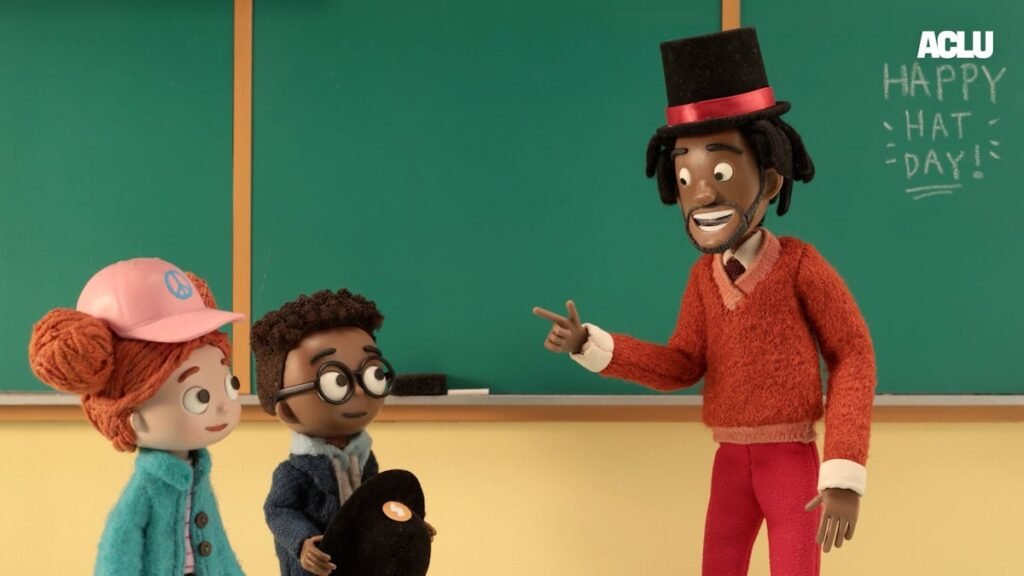
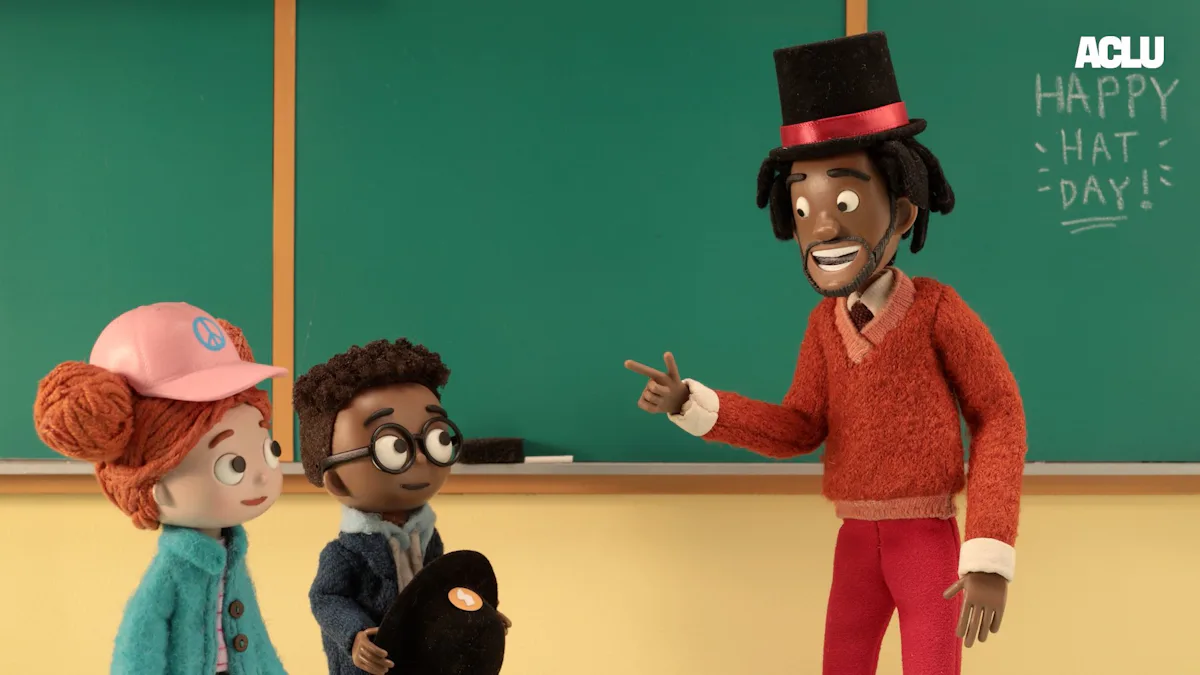
And that’s part of what inspired the American Civil Liberties Union (ACLU) to step into kids’ programming with their new animated series, Know Your Rights University. Designed to help kids understand everything from free speech to how laws are made, the stop-motion YouTube Kids show gives parents a much-needed assist in starting those complex and oh-so-important conversations at home.
Scary Mommy spoke with Brandon Lake, who conceptualized and directed the series, and Emily Patterson, Head of Marketing Channels at the ACLU, about why this show feels especially urgent right now… and what it looks like to teach kids about their rights in a way that feels engaging, not overwhelming.
Scary Mommy: For people who might not expect the ACLU to create a kids’ show, what made now the right time to step into children’s media?
Brandon: Feeling that kind of void in education, especially for civics right now, really made us want to use our own voice as an organization, to use our 100-year history and our vault of knowledge and lawyers, to try to help with the education of our country. I myself am a parent, educator, and animator. So, to me, it was very close to my heart to try to do something and create something positive for the world as well.
Emily: I feel like now is the perfect moment, and we really wanted the show to meet the moment — and it does. These kids feel like kids you know, they’re asking questions that you hope that your kids are going to ask. And the teacher, Mr. Charles, he’s answering the way that you hope you’ll be able to when those questions are brought up.
Right now, one of the worst effects actually of the spate of attempts to ban books and censor what we’re teaching in classrooms is the way that it chills other speech … it’s convinced people, parents know well, that every facet of life is so highly politicized. But it’s not controversial at all to teach kids about the power of their own voices, or how a bill becomes a law.
SM: What age group is this really best for, and how should parents watch it with their kids?
Brandon: We were thinking about the age range of about 8 to 11, but in the world of animation, you always still capture older and younger than that. That’s the beauty of animation. It’s such a visually interesting medium that younger kids can watch and still find things funny and playful. They might not get all of the content, but they can still enjoy what they’re looking at.
Then, for adults, you kind of get to under-the-radar still watch content that’s also maybe been distilled down a little bit. So you’re like, ‘Oh, that is what that means. I did not think about that.’ If you were to watch the old school Schoolhouse Rocks, they still have value in them, and I think that’s important, that it can capture all mediums and still be a playful thing.
SM: The episodes contain cultural touchstones like Tinker v. Des Moines, but also James and the Giant Peach. How did you decide which specific real-world things to pull?
Brandon: When we were coming up with the ideas, part of it was trying to think of what is foundational to what we are at the ACLU. What do we think is important to convey to our audience, to kids, especially at times when people might be looking for answers? And having a kid myself, I can’t answer every question he asks. There are so many questions. But I can try to at least build a base that he can then hopefully infer other ideas from, or come up with his own conclusion. He’s only 3. So I mean, that’s a stretch, but at its core, that’s I think what we were striving for here.
Emily: We wanted to make sure that Know Your Rights University taught kids the power they already have and the way they have a role in the world around them and in the systems they’re starting to figure out and make connections about. And these felt like topics that are timeless. They’re showing up no matter where in the country you live, no matter what grownup is watching this with you. It could be your educator, it could be a caregiver who’s not a parent, it could be your parent. It feels like something that there are real-world examples, if a child were to especially light up and have a lot of follow-up questions from there.
These just felt like a really good entry point for showing kids that the things they’re paying attention to don’t happen accidentally. They happen through systems and choices that people make, and that kids are powerful enough to affect.
SM: We’re talking about reaching kids who maybe aren’t getting a strong civic education in school, and maybe even at home. There’s a gap there. What does knowing your rights look like for a kid in their everyday life?
Emily: One of the things we talk a lot about at the ACLU is the way that once you know this information, it’s not a magical solution. It doesn’t mean that violations of those rights never occur. It means that you recognize that when it happens to you, you know that you might have recourse and what you can do next.
So to us, a child knowing their rights after watching this program would have follow-up questions if they’re told that the book they would like to get at their public school library is not available to them. Or if a unit that has been taught in their social studies course for many years is suddenly removed after a school board vote. What we would like is for kids to raise their hand and ask to know more about that, and know that they’re not just showing up to school — especially as public school students — beholden to what adults have decided for them without any sort of friction in that conversation.
That’s something adults have to grapple with as well. Knowing my rights does not necessarily mean that all systems will do what they should do. It means that I can recognize and advocate for myself.
Brandon: Just that idea of feeling confident enough to ask a question. In school sometimes you might be wondering whether or not something’s right or wrong, but you don’t know if you heard it somewhere before, so then you might keep quiet. Ask questions; there’s no end to what you can ask.
Just ask more questions. Yes, as parents, we get tired of questions, but still those questions are really what help us grow, and I think it’s so important.
SM: What else should we be doing? What can I do that’s attainable and actionable as a regular parent who, like everybody else, feels very overwhelmed right now?
Brandon: We have already started creating a bunch of supplementary materials on our website, so KYRU will have a page dedicated to it that can hopefully assist parents, kind of as an informational jumping-off point. The general ACLU website has a bunch of extra information too … that’s one thing we want parents to also look into. And obviously not just us, the world exists, the internet exists, but parents also finding out more helps all of us in the end.
Emily: Go to the ACLU Know Your Rights landing page, and look at other things that are relevant for your child, or family, or for your community. There are immigrant rights, protestors’ rights. If you are going to vote this fall, talk to your kid about what’s on the ballot, and how it’s going to impact their life, what money that a politician gets to decide to spend on their behalf, and laws that will be passed, and how it will impact their life.
Showing kids the friction and the uncertainty of existing in our democracy is one of the best ways to prepare them for an adulthood where, I think we can all agree, we don’t have all of the answers. We’re still also trying to assert our autonomy and power in the world.
You can watch Know Your Rights University here, and check out supplemental materials on the ACLU’s companion page.
This conversation has been edited and condensed for clarity.