While one unfolds across water and the other over pavement, surfing and skateboarding share an almost meditative relationship to rhythm, balance, and flow. Boards become extensions of the body–conduits not only for movement, but for memory itself; each carved line and worn surface holding traces of experience long after the ride ends. For designer Mary Ratcliffe, that connection between maker, athlete, and material forms the conceptual backbone of the CARVER Collection, which distills the technical silhouettes and fluid geometries of surfboards and skate decks into sculptural furnishings that recall the child-like joy of movement and experimentation. More than a stylistic departure, the collection reads as a kind of material recollection within Ratcliffe’s broader practice–one where craft, intuition, and a rediscovered sense of play converge.


Texture is something that can be felt with touch, of course, but it can also be felt in the mind: synapses habitually relive a related sensation of the material, quickly determining what it might feel like. This instinctive reading of surface once helped our ancestors discern whether something was trustworthy, durable, or even safe. Mary Ratcliffe Studio’s (MRS) latest pieces do just that.


Presented by the Toronto-based studio during New York Design Week with Afternoon Light, the collection marks a notable evolution for Ratcliffe. Softer curves, translucent color washes, and a freer, more playful sensibility depart from the sharper geometries and raw natural finishes that have previously defined the studio’s work. Inspired by the “flow state” Ratcliffe rediscovered while surfing in Malibu earlier this year, CARVER reimagines youthful activities often left behind in adulthood as refined, handcrafted furnishings.


Wood is often prized for consistency, categorized and selected for matching grain patterns that create cohesion. Here, Ratcliffe instead celebrates the natural confluence of fibers and the shifting directionality of the grain itself. Thick solid-wood forms intersect with a satisfying sense of weight and permanence, visually signifying sturdiness and, therefore, trust.


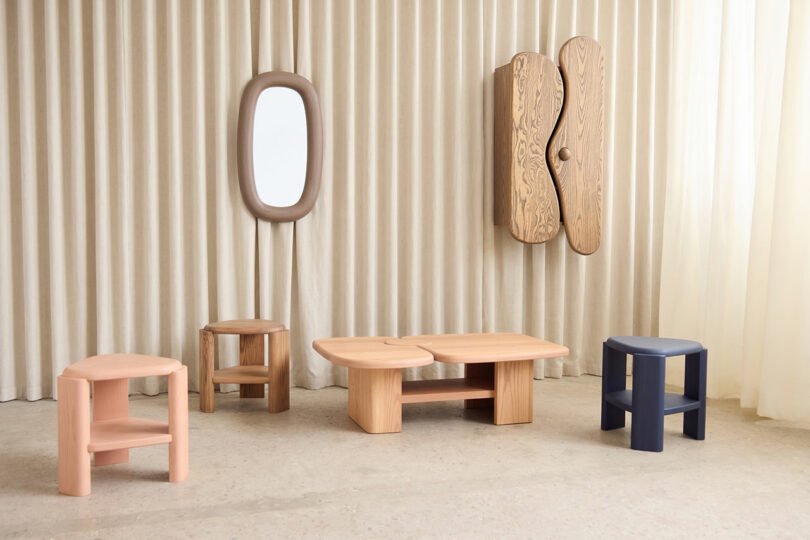
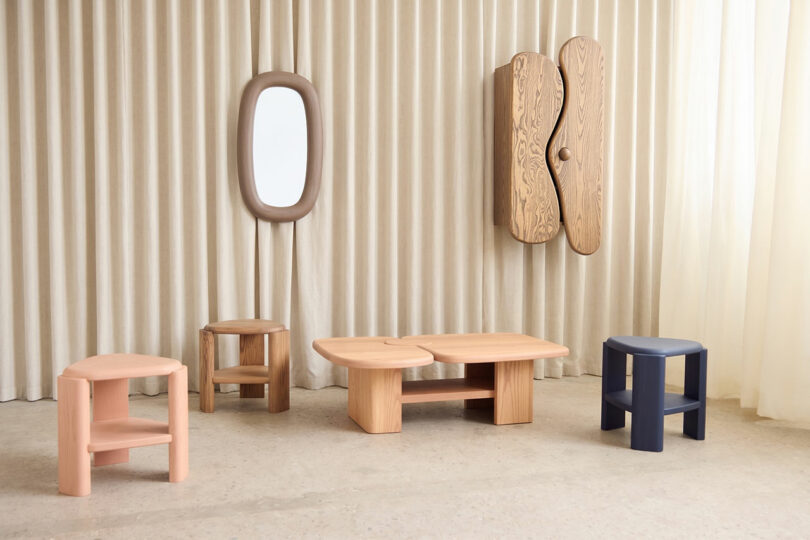
The Decker Side Table captures that feeling of momentum through tightly radiused corners and a compact, rounded triangular footprint that easily nestles into a variety of spaces. Finished in translucent tones like Wet Clay and Dust Rose, the satin surfaces amplify the character of the white ash beneath rather than concealing it. The lower shelf not only offers visual balance and structural solidity, but also provides a practical perch for books, objects, or keepsakes. There is an agility to the piece that makes it feel somewhere between functional furniture and sculptural object.


The Dume Mirror is a study in both materiality and introspection. Crafted from a singular solid wood glue-up with a substantial nearly three-inch profile, the piece projects confidently from the wall, grounding the viewer in space. As its soft perimeter curves and bends, the grain rotates and shifts direction, revealing the lifecycle of the material itself. Ratcliffe frames this transition as a quiet parallel to self-rediscovery – an acknowledgment of growth, movement, and evolution embedded directly into the wood.

The Corral Cabinet features broad, undulating doors intentionally offset to reveal glimpses of the metallic backing within, a subtle nod to the carved path left by a board in motion. Its sweeping continuous radii reference both longboards and the curling line of a wave. Finished with a translucent wipe-on stain, the cabinet allows the organic patterning of the ash to remain visible beneath the surface, reminiscent of the weathered underside of a well-loved skateboard deck. Inside, a full-color application and reflective metal backing introduce a silvery flash of energy that contrasts with the warmth of the exterior.


The Solstice Coffee Table pulls from the tactile experience of experimentation and learning itself. Three distinct organic forms appear to ‘click’ naturally into place, like the moment scattered lessons suddenly cohere into instinct. Soft beveled edges and elongated curves echo the hydrodynamic contours of surfboards, while setback C-shaped legs and a connecting shelf create the impression that the table is almost floating within the room. Its translucent surfaces interact dynamically with the grain below, reinforcing the collection’s broader meditation on movement, intuition, and play.


There is an ease running throughout CARVER that feels intentional. Ratcliffe is not simply referencing surfing or skateboarding aesthetically, but channeling the mindset they cultivate: looseness, experimentation, and immersion in the present moment. In a culture that often demands efficiency and seriousness, the collection argues for something softer and perhaps more necessary – a return to flow, tactile awareness, and the value of play itself.

To learn more about the CARVER Collection and shop the drop, visit maryratcliffe.studio.
Photography by Ryan McCoy.