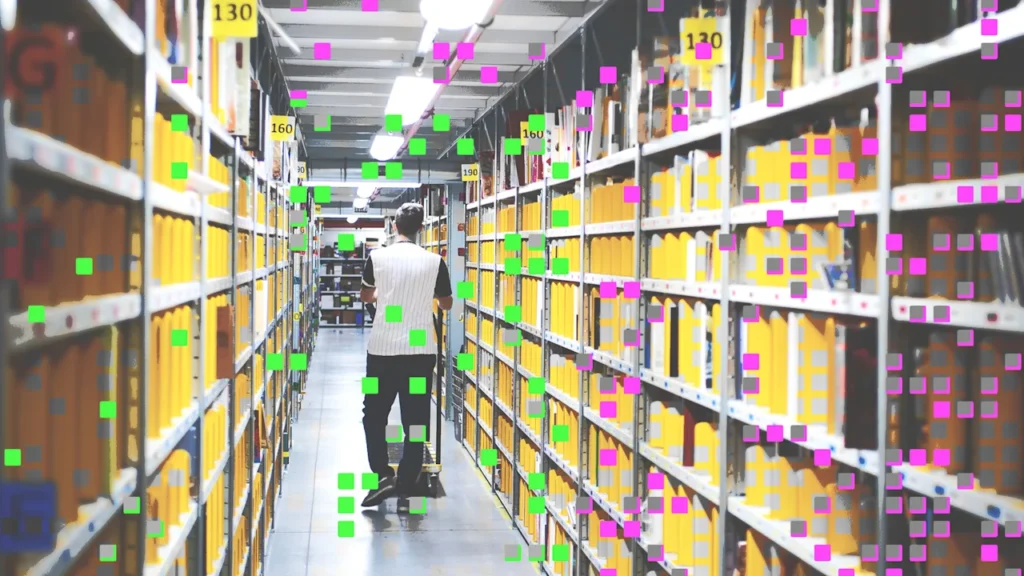
In February, April Watson hit her head while stowing products at an Amazon warehouse outside of Atlanta, Georgia. The injury gave her a concussion, and she was told by a neurologist that she would have to go on restricted duty and work at a slower pace than was typically expected of her.
Despite having paperwork from the doctor that clearly stated that she had to work more slowly, however, it took Watson over a month to get the necessary accommodations on the job—all because she couldn’t get the correct medical form from Amazon’s internal AI assistant or easily connect with an HR employee.
In the meantime, Watson was flagged for making errors on the job, and had to sit down with her manager for what Amazon calls a “documented coaching session.” Just weeks later, she was reprimanded again—but this time for working too slowly, which her doctor had said was necessary after her injury.
“I told my operations manager: This doesn’t make any sense,” Watson recounted. “I thought that everyone thought I should go more slowly because I’m recovering. And he was like, this is not our choice. This is Amazon.”
Over the last four years, Watson says automation has slowly changed how workers like her communicate with the HR department and raise issues on the job. In December, the worker advocacy nonprofit United for Respect surveyed Amazon and Walmart workers to better understand how AI and automation was changing the nature of their work. The findings were not entirely unexpected: Job displacement was, as always, a major source of stress for retail and warehouse workers at both companies. Out of over 200 respondents, 60% said they were worried about AI eliminating their jobs within the next year or two, and 49% cited losing their job to a robot as one of their top three fears amid growing AI usage in the workplace.
But a surprising number of workers—62%—were most concerned with how HR decisions were increasingly being outsourced to automated systems.
“I think it really does speak to the nature of how technology is getting implemented in the retail setting, and specifically how Amazon and Walmart are deploying AI in their workplaces,” says Bianca Agustin, co-executive director of United for Respect.
Amazon has not been shy about its investments in robotics technology, which are already transforming its warehouses; as the company continues adding robots and automation, Amazon will reportedly be able to cut back on hiring hundreds of thousands of workers in just the next few years. (Amazon has previously disputed these claims to Fast Company, arguing they do not “accurately reflect” the company’s hiring plans.) Walmart, on the other hand, has talked about its strategy to streamline its AI agents, deploying “super agents” focused on four areas: customers, employees, engineers, and suppliers. Walmart has reportedly even changed its approach to compensation for retail staff and frontline workers, no longer offering standardized raises based on years of service. Instead, Walmart now looks at a number of performance-related factors, from attendance to overall store performance—and, according to Agustin, the company is using algorithms to determine those raises.
When reached by Fast Company, Amazon did not comment on the record. Walmart referred to its proxy statement and noted that the company had been “open and proactive in discussing how AI and automation are transforming our business, including our workforce.”
United for Respect’s survey reveals that both companies have started automating their HR functions in ways that are already being felt by employees. At Amazon, for example, workers like Watson now largely communicate with HR through an AI assistant, rather than speaking directly with HR managers who are on site at the warehouse.
As this shift has taken place, many workers seem to long for more human connection—even if it’s with their manager. In fact, 56% of the Amazon and Walmart workers surveyed said they were worried the uptick in AI usage had resulted in less contact with managers and coworkers.“Workers [reported] a feeling of loss of human interaction in the workplace,” Augstin says. “Everything is mediated by your app or by a computer that’s sitting in the middle of the warehouse.”
About 54% of the surveyed workers also noted that AI adoption had led to staffing reductions—in line with a broader upheaval happening across workplaces, as tech companies slash headcount alongside considerable investments in AI.
“Lots of associates at both companies talked about understaffing, and feeling like it was worse now that the companies are using AI to schedule,” Agustin says.
One Walmart associate named Ava—who asked to only use her first name to protect her identity—says the company is now using AI for task management and to determine how long each task should take. The time frames that the modular planning tool comes up with, however, are often unrealistic. Ava’s job involves setting up and restocking shelves at a Walmart store, which usually also entails cleaning and sanitizing the shelves and checking for any expired products. But the speed with which she is now required to work has made it difficult to be as thorough. “Now that we’ve gone to digital tags and a computer-generated time frame on these [modules], we’ve had to skip critical steps,” she says.
The company’s embrace of automation has also made it more difficult for new employees to be trained adequately, according to Ava—leading to greater turnover and staffing issues. “When a new person is brought onto the job, we used to get hands-on training on the floor,” she says. “Now everything is done in front of a computer, and you’re tossed out on the floor.”
Over the years, United for Respect has filed shareholder proposals over a number of labor and safety issues at Amazon and Walmart. Now the organization is more explicitly turning its attention to how AI is reshaping jobs at those companies. United for Respect recently filed the first shareholder proposal asking Walmart to provide more insight into how AI and automation is impacting its workforce. (In its proxy statement, Walmart’s board urged shareholders to vote against the proposal, arguing that any additional reporting was “unnecessary given our extensive existing disclosures, robust governance practices, and continued commitment to appropriate transparency in this rapidly evolving area.”)
“We wanted to give a platform to workers, to begin to engage with investors who really haven’t thought about this yet,” Agustin says. “I think people weren’t that surprised that Amazon is going all in on AI, given tech has always been at the core of their business model. That really hasn’t been true for Walmart . . . We wanted to make sure people were aware that this was happening.”
As for Amazon, United for Respect had initially filed a proposal with 30 other shareholders. But Amazon excluded the proposal from its proxy statement, by taking advantage of an SEC loophole that allows companies to do so without justification. United for Respect has now filed a floor proposal instead, to be considered at Amazon’s upcoming shareholder meeting. The proposal calls for the creation of an AI advisory board comprised of frontline workers, as well as a variety of independent experts.
The goal of these proposals is to shed light on how workers are already being affected by automated decisions—and could be in the future—as AI redefines every aspect of business operations at companies like Amazon and Walmart.
“I’ve been talking to lawyers and policy folks who are starting to really think about: How do we need to revamp our existing frameworks to actually protect workers from automated decision making?” Agustin says. “Because if it can just be something employers can hide behind, this is going to be a crisis for workers.”