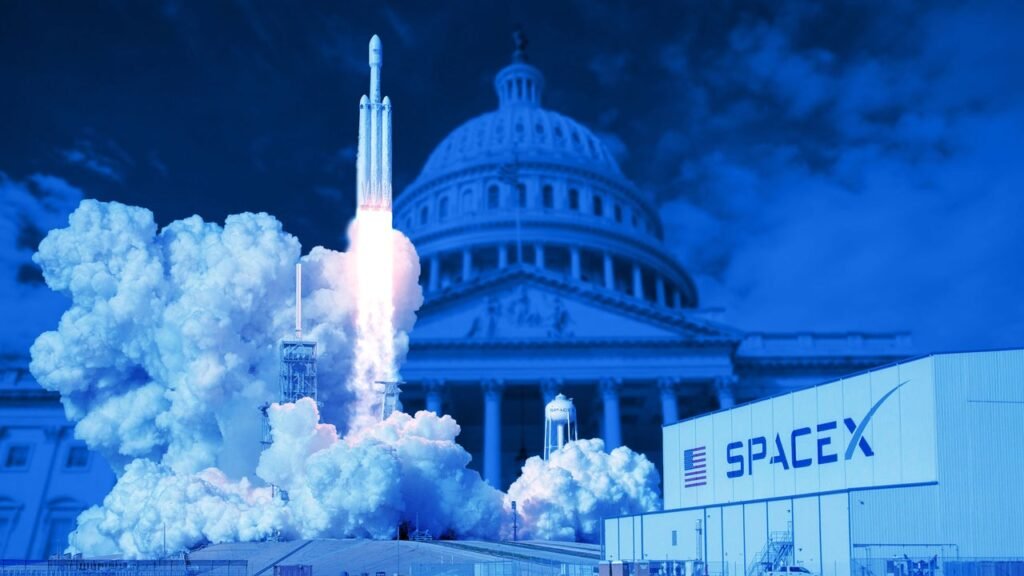
In a new filing with the Securities and Exchange Commission, SpaceX lays out ambitions that are expansive, even existential: deploying orbital data centers to build superhuman artificial intelligence, transporting humanity to Mars, and extending consciousness into the broader universe.
To make any of that happen, though, SpaceX remains highly dependent on the U.S. government, which must clear the path toward those goals. The company’s work has long hinged on regulatory approvals and buy-in from government customers. But the filing, which paves the way for ordinary investors to finally own a stake in arguably the world’s most successful space startup, makes newly explicit just how much SpaceX’s future still depends on persuading federal officials.
That dependence is becoming more politically complicated as CEO Elon Musk grows increasingly polarizing in Washington. While SpaceX has benefitted from favorable treatment in recent years, there is little reason to assume that will continue. Democrats, in particular, have grown more hostile toward Musk and his businesses, raising concerns about everything from xAI’s chatbot Grok, which has faced legal scrutiny over its nudifying feature, to Musk’s handling of the war in Ukraine, where troops rely heavily on its Starlink satellite system.
More broadly, critics increasingly worry that a single billionaire has amassed too much influence over critical communications infrastructure. Musk’s close alignment with the Trump administration and the MAGA movement could further complicate SpaceX’s relationship with future officials whom the company may ultimately need to win over.
A company with deep Washington ties
SpaceX is already deeply entangled with the federal government. Space launches require sending powerful rockets through national airspace, a regulated public resource overseen by the Federal Aviation Administration (FAA), which must clear flights during launch windows and investigate environmental concerns tied to launches. The company also coordinates closely with the Federal Communications Commission (FCC), which regulates and divvies up the wireless spectrum used by SpaceX’s communications services. The FCC also plays a role in space traffic management and orbital debris oversight.
At the same time, the U.S. government remains one of SpaceX’s most important customers. NASA buys crew launch services from the company, relies on it for support tied to the Artemis program, and has even tapped SpaceX to help deorbit the International Space Station. The U.S. military and intelligence community have also become deeply reliant on the company for launch services and communications infrastructure, including Starshield, the military version of Starlink. Plenty of other federal agencies use Starlink, too.
That dependence gives federal officials enormous influence over SpaceX’s future. Government procurement decisions are famously contentious, and acquisition officials are often, implicitly or explicitly, deciding winners and losers in extraordinarily lucrative markets.
According to the filing, those dependencies are only becoming more significant. Much of SpaceX’s future hinges on deploying Starship, the company’s next-generation partially reusable heavy launch vehicle, at scale. That, in turn, depends on continuing to secure clearances from the FAA, which must approve launches and investigate any environmental issues that might result from them. Starship is central to SpaceX’s plans to launch vast numbers of satellites into low-Earth orbit, expand its orbital compute program, and eventually travel to the Moon and Mars.
In fact, the company acknowledges that the FAA, already strained by ongoing air traffic control issues, may not even be prepared to handle the launch cadence SpaceX hopes to achieve. The filing warns that as SpaceX’s launch cadence and overall industry activity increase, “the FAA’s resources may become strained,” potentially slowing approvals and making it more difficult to secure launch licenses.
The same dynamic applies to the FCC. SpaceX’s plans to deliver satellite-to-phone connectivity depend on securing additional spectrum rights in an intensely competitive market. International regulators pose another challenge, as SpaceX seeks approval to expand Starlink globally while Musk continues clashing with foreign governments, including officials in South Africa.
The filing also warns that changing cybersecurity rules could affect the company’s ability to win federal contracts. Meanwhile, the addition of xAI and X introduces new exposure to online safety laws and digital platform regulation in both the U.S. and abroad.
Sky-high political pressures
SpaceX is no doubt a darling of the Trump administration, which has continued awarding contracts to the company and, through the State Department, encouraged other governments to do the same. The filing does not explicitly frame liberals or Democrats as risks to SpaceX’s business.
Still, under previous Democratic administrations, the company has faced a range of roadblocks and headwinds, including the revocation of a nearly $900 million award meant to help expand Starlink access in rural areas, scrutiny over conflicts of interest and spectrum allocations, and pressure to integrate Blue Origin into the Artemis program. Jessica Rosenworcel, the former FCC chair under the Biden administration, even once suggested that she viewed Starlink as a monopoly.
None of this is unique to SpaceX. Any company operating at the intersection of aerospace, communications, defense, and artificial intelligence would face intense regulatory scrutiny and political pressure. Nor is it likely that future Democratic administrations would want to sever ties with a company that has become deeply embedded in America’s space and defense infrastructure.
But SpaceX is the first company of its kind to go public. Investors are now being asked to evaluate not just the company’s technology and ambitions, but also Elon Musk’s increasingly complicated relationship with the government on which those ambitions depend.