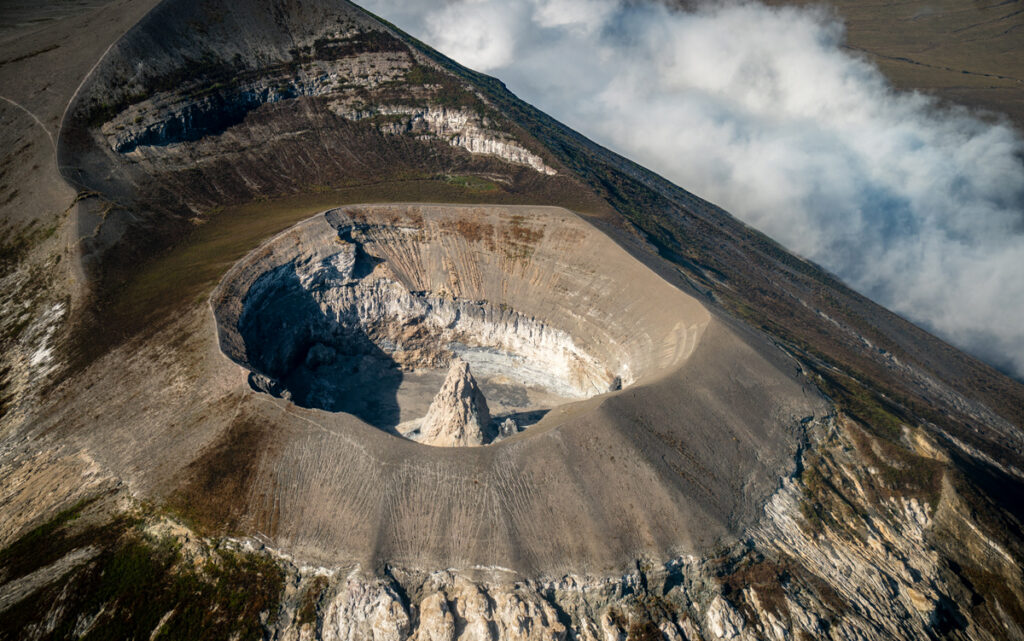
The volcano Ol Doinyo Lengai in Tanzania is unique on Earth: Its lava is rich in carbon compounds that melt at significantly lower temperatures than typical silicon-rich lavas from other terrestrial volcanoes.
It is possible, however, that carbon volcanoes could exist elsewhere, including on exoplanets, or—as suggested in a recently published article in Icarus—perhaps even on planet Mercury.
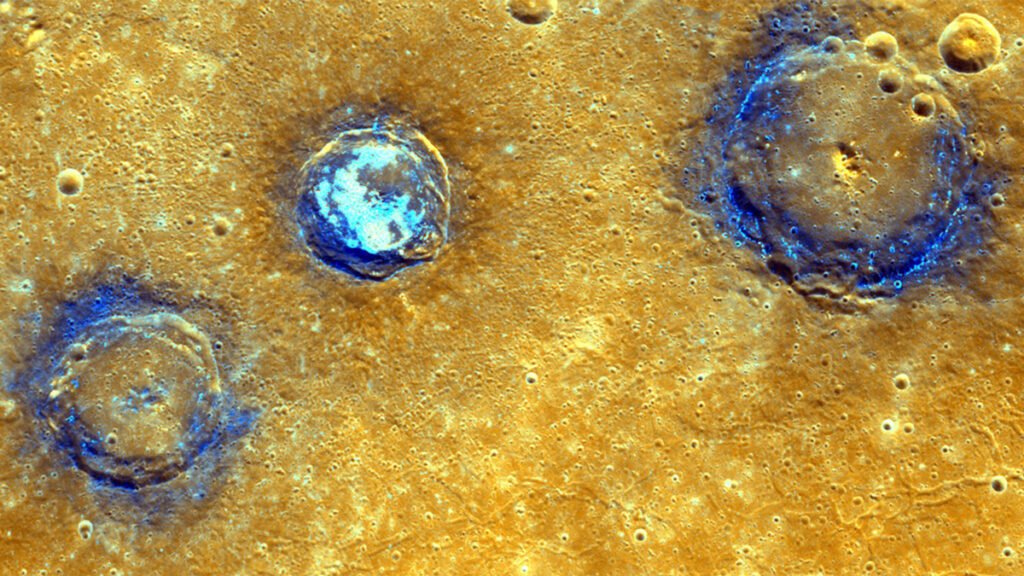
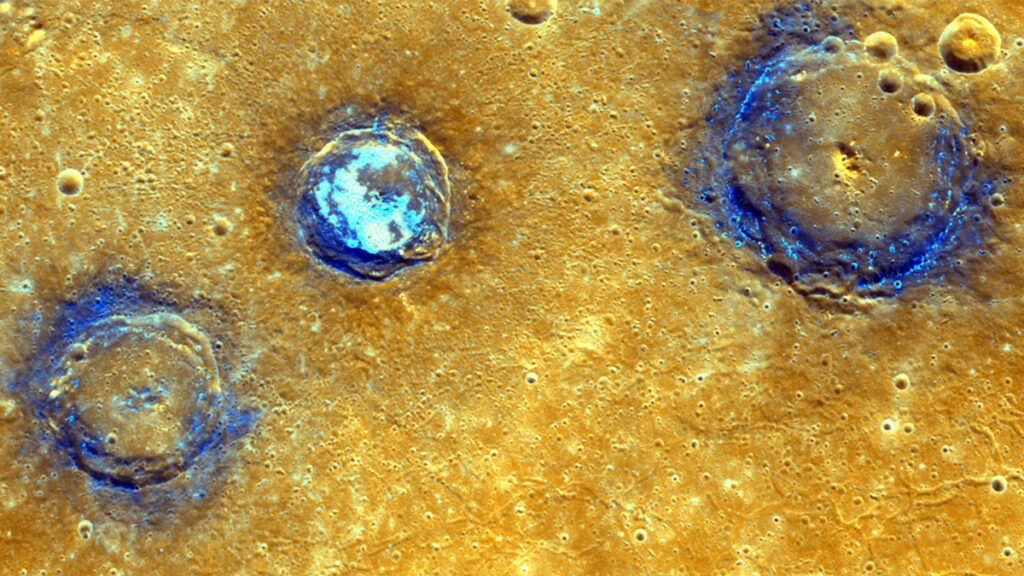
Despite being known from antiquity, Mercury is very hard to study because of its closeness to the Sun. As a result, the best data so far were gathered within the past 20 years by NASA’s MESSENGER (Mercury Surface, Space Environment, Geochemistry, and Ranging) probe. In particular, scientists identified mysterious pits they dubbed “hollows” scattered across Mercury’s surface. The hollows’ relatively bright appearance indicates they were formed in recent geological times, and could even be still forming today. The origins and geochemical makeup of these hollows are unknown.
“Mercury looks like the Moon a little bit, so we don’t expect large volcanoes,” said Maximilian Paul Reitze, a planetologist at Universität Münster’s Institut für Planetologie who is first author of the Icarus study. Without volcanic conditions like those on Earth or even on Jupiter’s moon Io, researchers expect Mercury to be largely geologically dormant. In other words, to explain hollows, “we need some volcanism under the conditions we expect on Mercury,” Reitze said.
Hence the interest in Ol Doinyo Lengai, known as the Mountain of God to the Maasai and Sonjo peoples. This volcano produces lava made up of carbonatites, igneous rocks composed of more than half carbon (and which are known to host critical minerals). These lavas flow at temperatures roughly 100°C lower than Mercury’s blazingly hot daytime temperature of 424°C. If the planet has a carbon-rich subsurface, as Reitze and his collaborators proposed, then the hollows could be Mercury’s version of Ol Doinyo Lengai.
This theory, however, has its skeptics.
“We know that there is carbon in [Mercury’s] crust, but the amount is very low,” said Paul Byrne, a planetary scientist at Washington University in St. Louis, who was not involved in the Icarus study. He also pointed out that the surface regions where carbon is most concentrated don’t correspond to higher concentrations of hollows. “For this to be some kind of carbon-based lava, it would imply a lot more carbon than we might think, given how widespread the hollows are.”
The Making of a Weird Planet
Mercury’s proximity to the Sun means that NASA’s Mariner 10 spacecraft provided humanity’s first-ever views when it flew by in 1974 and 1975. Three decades later, the MESSENGER mission was the first probe to orbit Mercury, mapping the planet’s full surface and turning up unexpected features like the hollows. The BepiColombo mission, a joint project of the European Space Agency and the Japan Aerospace Exploration Agency, is only the third mission ever to visit the planet, so when its two spacecraft settle into orbit in November 2026, it will almost inevitably reveal something unexpected, because it’s a weird planet.
“Basically, Mercury is a molten ball bearing wrapped in a thin blanket of rock.”
Unlike Earth, Mars, or the Moon, Mercury has a freakishly large core and a thin mantle.
“Basically, Mercury is a molten ball bearing wrapped in a thin blanket of rock,” Byrne said. “One explanation is that early in the planet’s life, either one large or several smaller impacts stripped the outer portion away.”
The question then becomes what got vaporized, and what was left behind, particularly when trying to understand hollows. Many planetary researchers proposed that sulfides in the mantle could drive volcanism, but Reitze had doubts.
“The problem with sulfides I see is that they’re stable up to 1,000°C or so, which cannot explain the explosive volcanism that’s needed to form those hollows,” he said.
Instead, he and his coauthors contacted a colleague working on Ol Doinyo Lengai, who obtained a sample of the lava for laboratory study while it was still molten. Because carbonatite lava reacts chemically with Earth’s air very quickly, the researchers needed to isolate it to understand how the unaltered materials might behave under conditions on Mercury, particularly infrared spectra that could be confirmed by the BepiColombo mission.
In the hypothesis proposed by Reitze and colleagues, impacts from meteorites heat the carbon-rich magma below Mercury’s surface, melting it and driving eruptions. The hollows, which are found frequently on the slopes of Mercury’s craters or their central peaks, are the remains of those eruptions. Over time, further meteorite bombardments and intense solar radiation destroyed older hollows, which is why the ones in MESSENGER data were all formed within the past 270 million years—a short time ago, geologically speaking.
“Anytime people have been confident about anything in planetary science, [planets have] shown you wrong.”
“The carbonatite angle is an interesting one, and I certainly wouldn’t rule it out,” Byrne said. “Anytime people have been confident about anything in planetary science, [planets have] shown you wrong. I’m certainly open to it, but is it the only explanation for all of the hollows? I am skeptical of that.”
Byrne and Reitze both dream of a future Mercury lander, a very challenging and expensive proposition nobody expects will happen soon. In the meantime, they agreed that BepiColombo data will help settle the question of whether the most Mercury-like place on Earth is a volcano in Tanzania.
—Matthew R. Francis (@BowlerHatScience.org), Science Writer
Citation: Francis, M. R. (2026), A unique African volcano could solve a mystery on Mercury, Eos, 107, https://doi.org/10.1029/2026EO260176. Published on 2 June 2026.
Text © 2026. The authors. CC BY-NC-ND 3.0
Except where otherwise noted, images are subject to copyright. Any reuse without express permission from the copyright owner is prohibited.