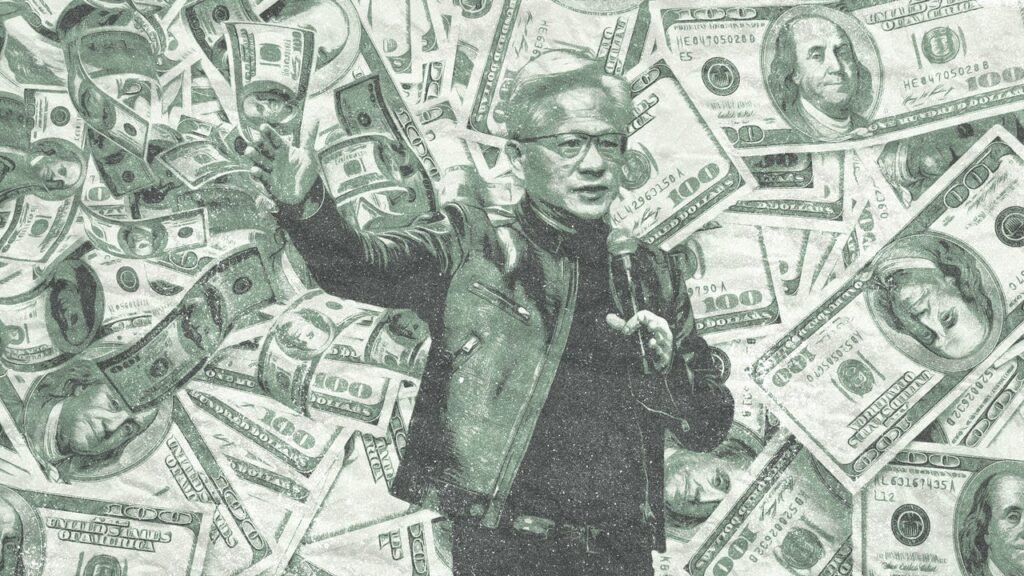
Jensen Huang has been busy talking all things Nvidia this week at the annual Computex trade show in Taipei. While the CEO has spent much of his time delivering keynote speeches and unveiling new superchips, he also gave reporters insight into how he treats his more than 42,000 employees.
“I think people should be paid as much as possible,” Huang told reporters. “I pay my employees as much as I can,” he added, responding to a question about Nvidia’s partnership with Samsung and its recent compensation agreement that would give eligible employees $400,000 bonuses.
Last year, an SEC filing noted that the median Nvidia employee made $301,233. Huang’s compensation was $49,866,251, making the CEO to median employee pay ratio 166:1. Huang has made multiple members of his board billionaires. Fortune also reported last year that two Nvidia’s senior leadership members became billionaires due to the company’s surging stock price.
During a panel last year, Huang said he’s “created more billionaires on my management team than any CEO in the world,” adding that he reviews every Nvidia’s compensation package.
“I sort through all 42,000 employees and 100% of the time I increase the company’s spend on [operating expenditure],” Huang said. “The reason for that is because you take care of people, everything else takes care of itself.”
Attaining those compensation packages is no easy feat for Nvidia employees. Huang has been known to be a tough boss. In an earlier interview with Channel News Asia, Huang was asked what he means by his “torturing people to greatness” management style.
“It’s torture the same way that Taiwanese parents torture people,” Huang, a Taipei native, said. “You know, [to] a Taiwanese parent, nothing is ever good enough. And you can’t go a day without some criticism.”
Huang said he operates Nvidia with the foundation he grew up with. “You can’t show me something without me giving you some criticism,” he said. “I’m always critical of everybody’s work so that I can help them be better.”
“My job is to create an environment where all of these amazing computer scientists and engineers and supply chain experts can come to Nvidia to do their life’s work,” Huang said. “I think that ultimately the purpose of leadership is to create the conditions for other people to realize their dreams.”
While the S&P closed out last month on an all-time high, only 20 out of 500 companies hit their own records. That number, comparable to those of the dot-com bubble, is worrying to analysts who believe these signs point to an AI bubble. The current stock market boom has been driven in part by Nvidia, which hit a record closing high of $235.74 mid-May.
Even with the most recent S&P 500 numbers, across various industries, companies from Meta to Standard Chartered have issued mass layoffs to offset heavy AI spending. In another recent interview with Channel Asia News, Huang said AI has been used as a “lazy” excuse for layoffs.
Huang has been staunch in his belief that AI is going to change the way humans work and create new employment opportunities in the long-run.
Huang himself has said he works seven days a week to actualize these dreams. “I don’t want Nvidia to fail because we have too many people who are counting on me,” he said in the recent CNA interview.
“I would like to work as long as I can,” he added. “I hope to die on the job. That would be a dream come true.”