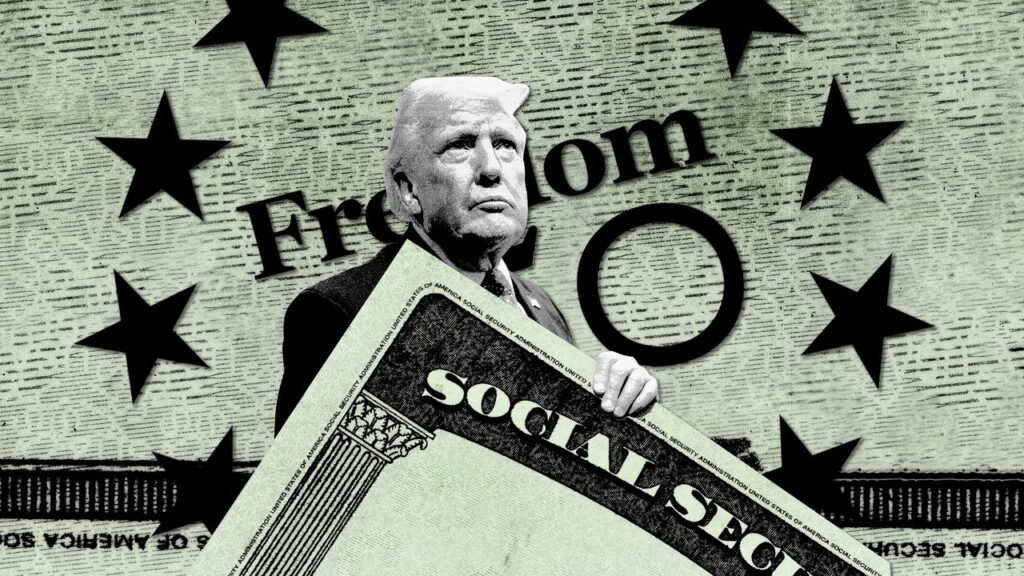
Everyone has encountered unnecessary company swag—from branded pens to an endless supply of canvas tote bags. But babies born July 2 through the end of the year may receive a surprising branded moment: a Freedom 250 Social Security card.
At a glance, the commemorative card, rolled out as part of the U.S.’s 250th anniversary celebration, looks like any regular Social Security card. But upon close inspection, the limited-edition version features the logo of Freedom 250—a public-private organization the Trump administration established to help with the semiquincentennial programming—in one of its corners.
While it may seem just a patriotic gesture and a chance at a special keepsake for some, the decision is bringing attention to Freedom 250 and its logo, which has become a political flashpoint.
Contrary to what some think, Freedom 250 is not an official commission tasked with overseeing the country’s anniversary celebrations—that would be the nonprofit America 250 Foundation. Instead, Freedom 250 is merely a so-called nonpartisan nonprofit that has taken over the stage as the celebration’s main organizer.
Freedom 250’s spectacles have included the Great American State Fair, which drew a lower turnout than anticipated, and UFC Freedom 250 fights hosted on the White House’s South Lawn.
Its logo has turned up in a number of other places. Notably, IndyCar—the partner for the Freedom 250–sponsored street race in D.C.—released controversial merch that included the nonprofit’s logo. Bearing the phrase “One Nation, One Race,” the design was quickly called out for its racist implications and taken down from IndyCar’s online store.
The organization’s vetting for its licensed use of the logo and its relationship to national celebrations has been called into question, particularly by a recent congressional investigation. “[That] an approved, cobranded product reached the public at all is evidence that Freedom 250’s licensing vetting is, at best, negligent,” an interim report says.
The report, produced by Democratic staff of a House subcommittee, also revealed concerns about how the organization as a whole operates, and the intentions behind its inception.
“The White House first attempted to bend America250 to its purposes,
demanding spectacles focused on promoting President Trump rather than the
country while forcing partisan content, campaign-style fundraisers, and favored
contractors onto an organization Congress designed to serve the whole country, not one party or president,” the report reads.
It added, “When America250 would not yield, the White House created a replacement: Freedom 250 LLC, a shadow organization capable of infiltrating the celebrations and injecting America’s 250th with Trump’s extreme, partisan agenda.”
One of the efforts to take over stage presence from America250 was by putting Freedom 250 branding all over the place through a program called “Logo for the People.”
In a massive licensing effort, the program provides brand assets to outside organizations, creating an association between Freedom 250 and the celebration. Despite not being officially linked to the government, the logo frequently appears in association with the president. The limited-edition Social Security cards are the latest example.
While the logo is not allowed to be used in association for fundraising for the federal government, the vetting process beyond that seems to be quite lax, with brands licensing the logo for events, initiatives, educational programs, community activations, and cultural projects.
The logo for Freedom 250 is in fact in a duel for relevance with that of America250, battling it out for recognition while generating public confusion.
“The brands are diluted, and for millions of Americans, the logo they may well associate with the commemoration next month could come from state-specific logos, or logos from corporate 250 tie-ins rather than the logos from the federal government,” Fast Company‘s Hunter Schwarz recently reported. “In an era of declining trust of institutions, it tracks.”