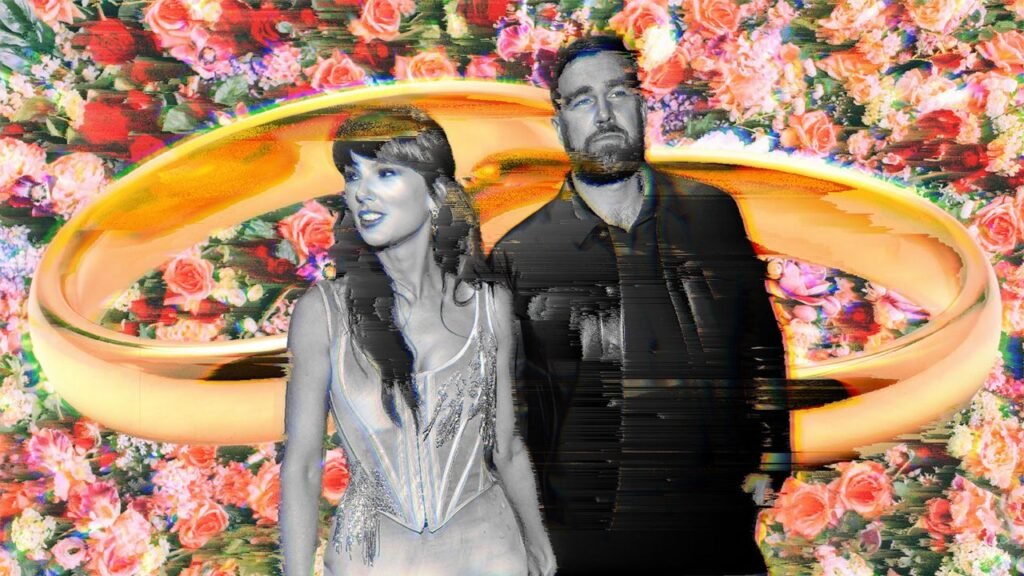
The Taylor Swift wedding has an AI slop problem.
Swift reportedly tied the knot with football star Travis Kelce on July 3 at New York City’s Madison Square Garden, joined by a massive entourage of celebrities including (to name just a few) Ed Sheeran, Gigi Hadid, Jack Antonoff, Tom Hanks, and former Disney CEO Bob Iger. Despite the undoubtedly star-studded guest list, no official photos of the wedding have been released, which, according to Variety, is a result of the couple’s watermarked, digital invites that came with NDAs.
But that doesn’t mean that photos of the nuptials haven’t been circling the internet—in fact, quite the opposite.
Over the weekend, social media erupted with what can only be described as a deluge of Taylor Swift-wedding-themed AI slop. The content runs the gamut from genuinely convincing paparazzi-style shots to truly ridiculous self-insert scenarios of average citizens attempting to claim attendance.
The trend is proof that, in our post-visual-truth era, every major event is an opportunity for an AI slop field day.
The two types of Taylor Swift wedding slop
Neither Swift nor anyone in her close circle has revealed actual images of her bridal look—but if you’ve logged onto Instagram or TikTok in the last few days, chances are good that you’ve come across a convincing imitation.
The first genre of likely AI imagery to emerge from Swift and Kelce’s big day are grainy, zoomed-in shots of the bride or happy couple that look like something a sneaky attendee or paparazzi might have snapped. But while many commenters have been convinced by these images, Swifties in the comments have been quick to point out inconsistencies, like the fact that, in one viral image, Swift’s dress strap appears to become briefly invisible; or, in another, Kelce’s face seems warped.
Taken on their own, these images look ultra-realistic. Together, though, many of the most viral images show Shift in entirely different outfits, but similar poses and locations—pointing to AI as the likely culprit.
“It’s all AI, don’t believe anything until they post the pictures,” one commenter warned under an Instagram post of the supposed outfits. “I’ve seen her in five different dresses already,” another added.
The second genre of Swift wedding slop consists of ordinary people claiming that they received a coveted invite to the ceremony. One wedding video team, for example, notched nearly 7,000 likes on Instagram after posting an AI-generated image of themselves filming the ceremony.
Another photographer tried a similar tactic, with the added caveat, “this is fully a joke” attached to the caption.
A San Diego-based cannoli brand claimed that it “catered the wedding of the year,” in a caption underneath an obviously AI-generated image of Swift and Kelce holding up the sweet treats.
And, in an extreme parody, one poster claimed to be the official helicopter partner of the wedding under the fake business name “Bones AeroX.”
“TMZ has obtained an exclusive image from the wedding rehearsal, showing Swift being expertly lowered by rope onto the roof of Madison Square Garden,” the post’s caption reads. “Precision, style, and a little Hollywood flair—that’s the Bones AeroX way.”
Why AI content is duping Swifties everywhere
These last few examples seem outlandish enough to set off most people’s AI radars—but, nevertheless, the comments are full of users who seem to be taking the images at face value.
Under the cannoli post, one user wrote, “Awesomee!! Congrats on the giggg!!” while another chimed in, “Whattt that’s amazing! Love that for you guys.” And, in response to the helicopter parody, several commenters appeared to congratulate the invented company, with responses including, “She worked hard for what she has. If she wants to enter like that, more power to her!” and “That’s the way to do it, 100%!”
And Swift’s wedding isn’t the first to have misled fans with an outpouring of speculative AI content. In March, AI images of Zendaya and Tom Holland’s wedding became so popular online that Zendaya had to clear the air about their fabrication on Jimmy Kimmel Live, where she explained that the images were so realistic that they’d even duped her friends and family.
These reactions point to a trend that media experts have been flagging for months. Last June, a wide-reaching Microsoft survey found that participants could only identify AI-generated imagery in 62% of cases, while another survey conducted by AI researchers and published in September 2025 by the journal Communications of the ACM put that figure closer to 50%. Both of these research efforts came before the release of the current most-realistic AI image generation tools, including ChatGPT Images 2.0 and Gemini’s Nano Banana Pro.
As AI imagery becomes increasingly difficult for the general public to spot, every high-profile event is about to produce its own wave of increasingly believable AI slop—and, ultimately, it’ll be up to the actual hosts and attendees to set the record straight.