Source: Geophysical Research Letters
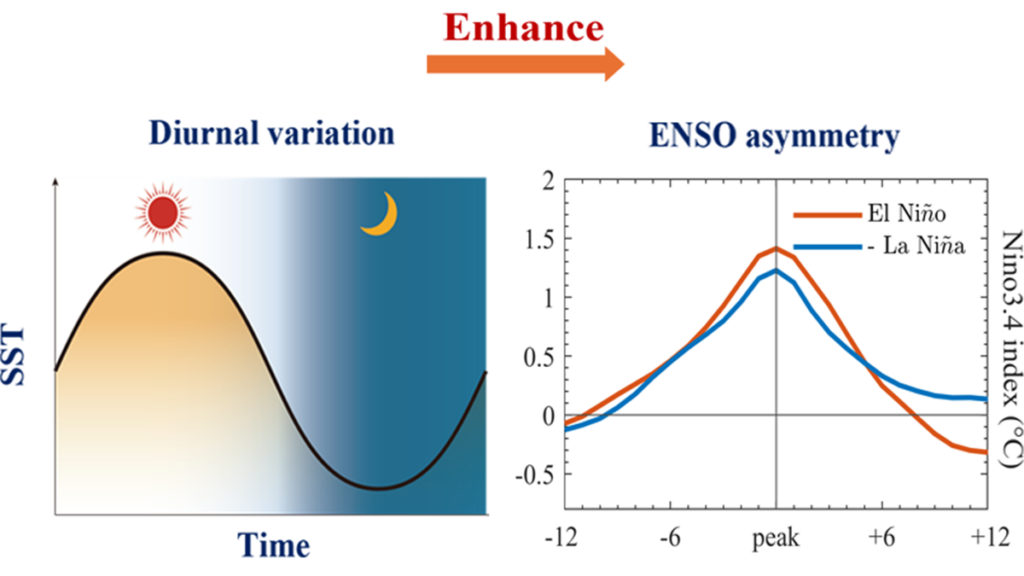
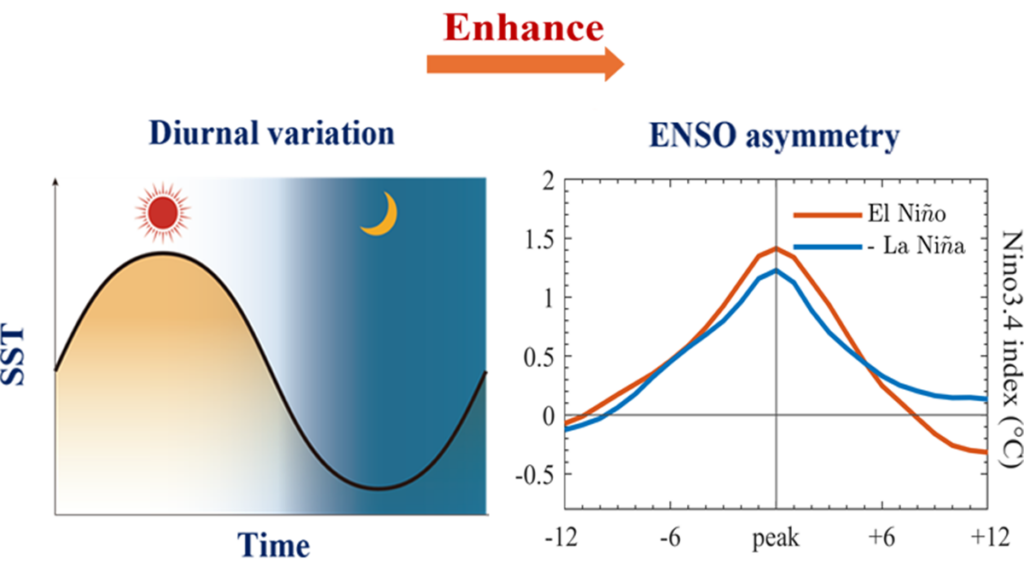
Researchers have long known that there is an asymmetry in the El Niño–Southern Oscillation (ENSO), the confluence of wind and water currents that create warm El Niño events and cooler La Niña events. Large-scale climate models tend to underrepresent this asymmetry for reasons that are still not fully understood. Better modeling of the mechanisms that push El Niño events to be warmer could both provide insight into Earth’s climate system and improve future ENSO predictions.
Previous studies of the asymmetry have looked at large-scale processes such as wind stress responses and thermal advection but haven’t fully answered the question. In a new approach, Yang et al. examine how variations in sea surface temperature from day to night affect ENSO asymmetry, approaching the problem at a much smaller scale.
Comparing 35 Coupled Model Intercomparison Project Phase 6 (CMIP6) models, the researchers found that models with larger diurnal amplitudes (DA) for temperature better captured the ENSO asymmetry. Looking deeper with targeted model experiments, they found that a major driver of this mechanism is opposing daily mean sea surface temperature anomaly responses in the central and eastern Pacific. This east–west temperature difference causes the ocean to warm unevenly over months or longer. As a result, El Niño warms the ocean more than La Niña cools it.
The authors point out that for climate models, using a larger DA improves the asymmetry in ENSO simulations by up to 38.5%, which underlines the importance of daily changes in sea surface temperature for large-scale climatic events like El Niño. Moreover, they note that implementing a large DA could affect ENSO simulations in multiple ways, including phase locking, asymmetry, and amplitude, offering valuable guidance for the development of other climate models. (Geophysical Research Letters, https://doi.org/10.1029/2026GL122494, 2026)
—Nathaniel Scharping (@nathanielscharp), Science Writer

Citation: Scharping, N. (2026), El Niño warming is stronger than La Niña cooling. What’s the right way to model this asymmetry?, Eos, 107, https://doi.org/10.1029/2026EO260216. Published on 7 July 2026.
Text © 2026. AGU. CC BY-NC-ND 3.0
Except where otherwise noted, images are subject to copyright. Any reuse without express permission from the copyright owner is prohibited.