Getty Images; Alyssa Powell/BI
The kids aren’t all right.
Gen Zers are graduating into a daunting job market. The housing market is a mess. Typical milestones — getting married, having children, buying a home — are drifting further into the future.
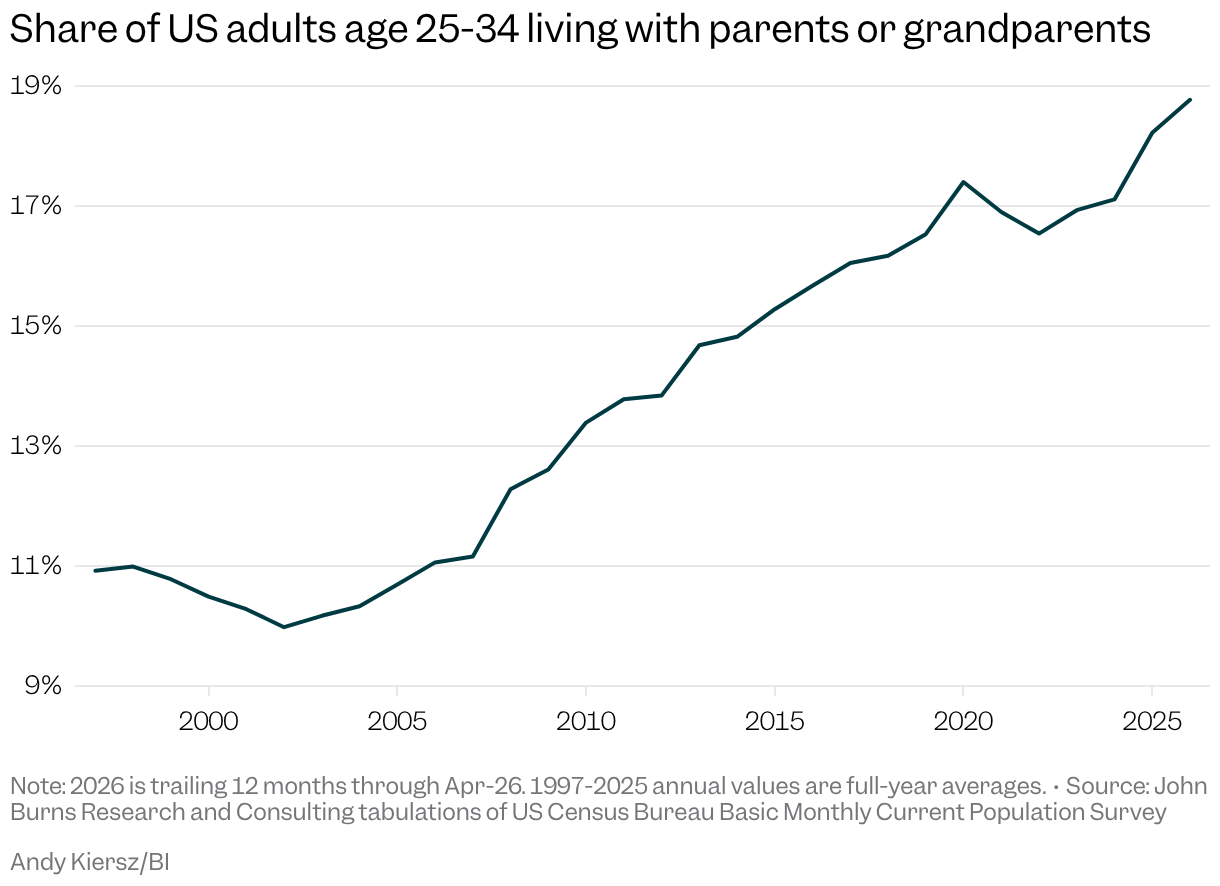
If there’s one stat that neatly sums up the current case of arrested development, it’s that nearly a fifth of 25- to 34-year-olds live with their parents or grandparents, a record high, per a recent analysis of census data by John Burns Research and Consulting. Rather than renting their first apartments or grabbing the keys to a starter home, today’s young adults are shacking up with their parents in droves.
By and large, young adults tell pollsters that they still harbor dreams of homeownership. But the affordability hurdles are steep, and social norms have changed, too — living with parents well into adulthood may no longer be the calamity it was for, say, Seinfeld’s George Costanza, whose move back home in a 1993 episode was portrayed as nothing less than rock bottom.
If all of this sounds familiar, it’s because millennials traveled a similar path. Overeducated and underemployed in the wake of the Great Recession, they spent their early careers scrounging for jobs and crashing with their parents to save cash. For many, the prospect of homeownership seemed distant. One 2015 headline from this very website summed up the gloomy outlook: “America’s ‘children in the basement’ won’t be moving out anytime soon.”
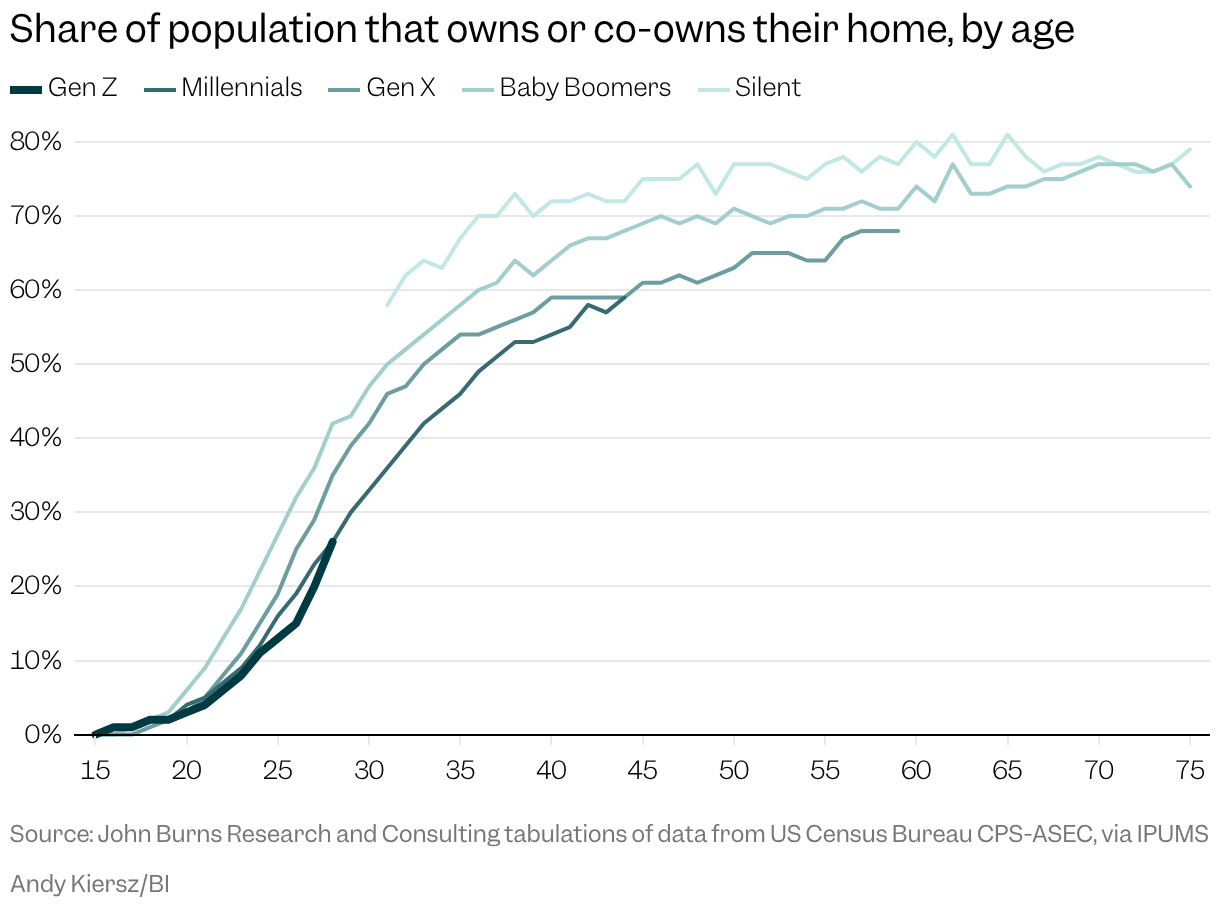
The millennial comparison, however, may actually offer some hope for Zoomers. Now in their early 40s, the oldest millennials own homes at roughly the same rate as their Gen X predecessors. The goalposts may have shifted back, but they didn’t disappear.
That’s no guarantee, however, that this game of catch-up will turn out the same way for Gen Zers, the oldest of whom are closing in on 30. Every generation encounters its own speed bumps en route to the American dream. Gen Zers, however, are caught in the middle of several unique forces, from the country’s slowing population growth to the death of the traditional starter home. Their housing choices today could reverberate for decades to come.
Millennials were once the poster children of stunted adulthood. The slow economic recovery after the financial crisis left the cohort struggling to find its footing in the housing and job markets. In 2016, roughly 16% of 25 to 34-year-olds lived with relatives, compared with 11% a decade earlier. The prevailing narrative in those days was, “Millennials will never become homeowners,” recalls Mark Fleming, the chief economist at the title company First American. Indeed, while nearly half of baby boomers owned their homes at 30, millennials’ share at the same age was a paltry 33%.
Since then, however, elder millennials have “mostly caught up,” says Eric Finnigan, a demographer at John Burns and a member of the cohort himself. A 42-year-old whose career might have appeared dead on arrival in 2008 has roughly the same odds of owning their home as a Gen Xer did at the same age. (Boomers, notably, were well ahead of both groups.)
“It’s just a delayed life stage, not a lost life stage,” Finnigan tells me.
Younger adults have yet to reach that point. The share living with parents jumped in 2020 during the height of the pandemic, but trended downward in the next couple of years as borrowing rates plummeted and companies hired with gusto.
“The job market for young people was white-hot,” Finnigan tells me. “Anybody who wanted to find a job could probably find a job, and that wasn’t true 10 years before.”
Then came the spring of 2022, when the era of ultra-cheap home loans came to an abrupt end. Interest rates spiked, making all kinds of borrowing more expensive, and the job market hit the skids. The homeownership rate for young adults fell for two consecutive years, erasing the steady gains made from 2017 to 2022. A little less than 30% of 25-to-24-year-olds owned their home as of 2025, down from about 40% in 1990, an Apartment List analysis of census data found.
The sudden shift in the market outlook was compounded by longer-term trends, like the shrinking pool of “starter homes” — cheaper, entry-level places that allow younger homeowners to start amassing equity. Given the rising costs of land, materials, and cutting through red tape, homebuilders are pivoting to more lucrative projects that favor older buyers with deeper pockets: A Business Insider analysis of census data found that by late 2022, hardly any newly built homes in the US were selling for less than $200,000. Meanwhile, more than 60% of new homes were priced above $400,000, double the share from a couple of years earlier. “It just became a lot more difficult to build entry-level homes,” Rob Dietz, the chief economist for the National Association of Home Builders, tells me. “There’s a lot fewer of those available.”
For young people, the hurdles to getting keys to their own place go beyond the dearth of cheap new builds. Renting a non-mom-and-dad-owned place is more expensive: The typical rent nationwide jumped by nearly 30% between 2020 and 2024, Zillow data shows. And a study a few years ago by the Federal Reserve Bank of St. Louis found that 36% of older Gen Zers were sitting on student debt, compared to 31% of millennials at the same life stage.
Chiamaka Onyemelukwe, 35, has lived with her mother in Alameda, California, since finishing her master’s program in 2018. She dreams of working as a storyboard artist for a TV or film company, but has spent the past couple of years job-hunting after being laid off in late 2023. “It’s just hard to find something stable right now,” Onyemelukwe tells me.
She recognizes that she’s lucky to have a place to stay in her mother’s two-bedroom rental, but she hopes the arrangement isn’t permanent. “I definitely want to get a house one day,” she says. For now, though, she’s dipping into savings and relying on her mother for support.
“When you’re in your head a lot, and you’re thinking about the situation you’re in, like not having work and not having a place of your own,” Onyemelukwe tells me, “it’s going to make it difficult for you to focus on what really matters outside of that.”
While some younger adults may be prioritizing careers or simply putting off the whole white-picket-fence thing, the stark rise in young adults living with their folks, combined with the mounting barriers to entry for wannabe homeowners, sends a clear message to economists like Dietz.
“I actually think there is reason to be concerned,” Dietz tells me.
One person who may see fewer reasons for consternation is Elizabeth Gomes, a 29-year-old in San Diego who works in public relations. Gomes lives the kind of rich, full life enjoyed by young professionals in big cities around the country. She travels, dines out weekly with friends, and enjoys going to concerts and Disneyland. She also lives with her parents.
“I have a ton of friends that are in very similar situations,” Gomes tells me. Some have settled back into their childhood bedrooms, while others are living on their parents’ properties. All have jobs. “It’s just the situation that’s happened, or that we’ve chosen because of how we want to live,” she says.
Of the roughly 7.5 million 25 to 34-year-olds living at home, seven in 10 are employed, according to a Realtor.com analysis of census data. The prevalence of those working but still living at home suggests “this is a housing cost story, not a jobs story,” writes Hannah Jones, a senior economist at Realtor.com. Gomes has scanned the nearby rental market and decided that moving out wouldn’t be worth the tradeoffs — less travel, more meals in, fewer concert tickets purchased. The $700 her parents charge for monthly rent is a fraction of what she’d pay if she lived alone, given that the median rent for a one-bedroom in San Diego stretches to nearly $2,000, per Apartment List. Plus, she likes hanging out with her parents. They’ve been roommates since she was a sophomore in college, when she decided to give up dorm life in favor of a cheaper (and calmer) alternative.
“I don’t really have any shame in living at home,” Gomes tells me.
Finnigan, the demographer at John Burns, spends a lot of time talking to young people about their living situations, and he’s come away surprised by how much the Seinfeld-era caricature of the stay-at-home adult has faded. “It’s way more of a normal thing,” he tells me. “There’s not a hit to status, or someone’s self-esteem.”
“I don’t take it as an embarrassing kind of thing anymore, really. Because I just feel like it’s the new reality.Nick Chapman, 30-year-old in Simi Valley, California
Nick Chapman, 30, works in film marketing and recently moved home to the Southern California suburb of Simi Valley. Though he could afford the $1,550 monthly rent at his old apartment in Los Angeles, the cost pressures of living on his own left him feeling “stagnant,” he tells me, with little room to save or splurge. Chapman grew up on movies like “Stepbrothers,” which played the idea of grown men living at home for laughs: “It was kind of a pathetic thing, and I’m obviously like, ‘I hope that’s not me,'” Chapman says. But his parents had always made clear that he’d have a place to stay if needed, and his older brother had also spent some time at home after school. So far, he’s enjoying the comforts (and savings) of home. Like the other young adults I spoke with, Chapman still hopes to buy a home one day. “That’s the ultimate goal,” Chapman tells me. But maturing, he says, has also meant accepting that “everyone is on their own clock.”
“I don’t take it as an embarrassing kind of thing anymore, really,” he says. “Because I just feel like it’s the new reality.”
Odds are that you know others in this boat. Maybe you find yourself back in your childhood bedroom, or perhaps you’re on the flip side, pulling double duty as a parent-landlord. My own 25-year-old brother has spent the past few years living at home. He has a good job, but making it in a costly city like Austin is a stretch for workers of all stripes. I’m glad he has a place to stay, and I often envy the moments he gets to spend with my parents while I settle for FaceTime calls. I wouldn’t trade it for my experiences living on my own, though, and I’ll admit that I hope he soon gets the same chance.
Mark Fleming, the economist at First American, offers a counterpoint to all the handwringing. “I think a lot of times the data is interpreted as, ‘Well, they will never become homeowners,'” Fleming tells me. “That’s not true.”
Fleming counseled similar patience when elder millennials were in dire straits, and he points to their rising homeownership rate as evidence that a delay doesn’t equate to total discouragement. Extend some of these chart lines into the future, and the group may surpass Gen X in terms of homeownership. “It just took time,” Fleming says.
This story has been playing out for decades — for the vast majority of their adult lives, even baby boomers appeared to lag behind the silent generation before them on the homeownership front. The economy shifts, and priorities change. If there’s one constant, it’s the younger generations’ knack for stirring concern among the silver-haired crowd.
All signs point to the idea that once Gen Zers find their financial footing, they’re likely to jump into the housing market. Finnigan views the delay as pent-up demand — people waiting in the wings to live on their own once conditions improve or the timing feels right.
“They’ll catch up at some point,” Finnigan tells me. “It’s just a matter of when.”
James Rodriguez is a correspondent on Business Insider’s Discourse team.