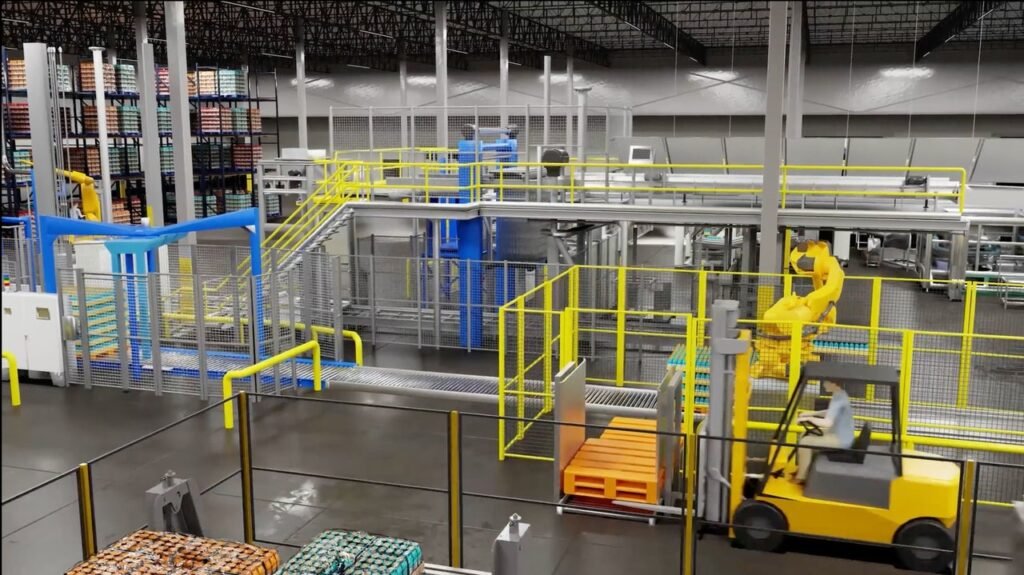
Reconfiguring a factory used to mean shutting it down, making costly bets, and hoping the design worked in the real world. PepsiCo found a way around that. Rather than rely on engineering blueprints to solve the problem, the company used a specialized laser to scan the facility and create a digital representation that was accurate to within a millimeter. It then used this 3D model to simulate the current manufacturing process and identify production bottlenecks. This exercise gave engineers a blank canvas to experiment with new layouts that would help expand and speed up production—all before touching a single machine.
“What you’re trying to do is optimize every part of the space, from the hardware and the software to how people navigate through the space,” says Athina Kanioura, PepsiCo’s CEO, Latin America, and global chief strategy and transformation officer. “We’re taking every data point within the design of the physical infrastructure to create millions and millions of simulations to design the perfect building.”
In recent years, artificial intelligence (AI) has made it possible to create digital twins—living, data-rich replicas of physical environments that behave like the real thing. These simulations don’t just mirror reality; they allow companies to pressure-test decisions, model disruptions, and redesign entire systems in advance. For manufacturers, that means fewer guesses—and far fewer costly mistakes.
“Transformation at PepsiCo is really about being fit for the future,” says Ashin Parikh, senior vice president of strategy and transformation for PepsiCo’s global supply chain and procurement organization. “When we think about transformation within our supply chain, it’s about modernizing our operations, making them more agile and flexible so we can meet consumer demand.”
LAUNCHING A DIGITAL PILOT
PepsiCo’s experimentation with digital twins started a few years ago while the company was researching how other industries were utilizing physical AI that drives machines such as autonomous vehicles and warehouse robots. The auto industry was an early adopter of digital twin technology, with companies such as BMW using it to design factories with superefficient production lines. “That sparked our idea,” Parikh says. “How could we take what the automotive industry is doing and bring it to the consumer packaged-goods industry?”
PepsiCo quickly began piloting digital twins across its U.S. operations, using them to simulate both retrofits of existing plants and the design of entirely new facilities. Results were immediate and measurable. One beverage facility is expected to see a 40% jump in production capacity, and Parikh says digital twins have seen throughput gains of 15% to 20% in several other locations. More importantly, PepsiCo moved from reacting to bottlenecks to predicting and eliminating them before they happen.
Those efforts got a big boost earlier this year when PepsiCo announced a partnership with Siemens and Nvidia. Now, the food and beverage giant is using a Siemens digital twin platform built with Nvidia technology to accelerate its shift to a digital-first planning strategy. “Instead of a digital twin being a one-off or a pilot, we’re incorporating it into our workflow and using it at scale,” says Ali Peyrovi, vice president of global warehouse strategy and transformation at PepsiCo. “And we’re not just stopping at North America—we’re taking it globally.”
BEYOND EFFICIENCY
Efficiency is just the starting point. PepsiCo is using digital twins to respond to a fundamental shift in how consumers buy and consume its products. For example, more of the company’s sales are happening online, with the majority of those orders customized for retailers and consumers. This shift is driving an uptick in smaller orders and smaller package sizes, which in turn is fueling efforts at PepsiCo to build a more agile supply chain and more efficient manufacturing processes. “A lot of the capabilities we’re deploying is to fulfill the promise to our consumers,” Parikh says. “We want to make sure that whatever product our consumers want, where they want it, and how they want it, they’re going to be able to get it.”
Ultimately, technologies such as digital twins are critical tools that will enable manufacturing companies like PepsiCo to adapt more quickly as the world around them evolves. Companies that can simulate, test, and adapt in real time will be in a better position to move quickly and stay ahead of shifting consumer demands, supply chain hiccups, or any other disruptions. “The digital capabilities that exist in the industry are advancing very quickly. The way we think about solving the problem today is going to be different in three months or six months,” Parikh says. “Being a student of AI and technology is supercritical for people leading large organizations. Because how we solve and how we run our operations are going to be different; being able to lead your organization that way is going to be critical for the success of your operations.”