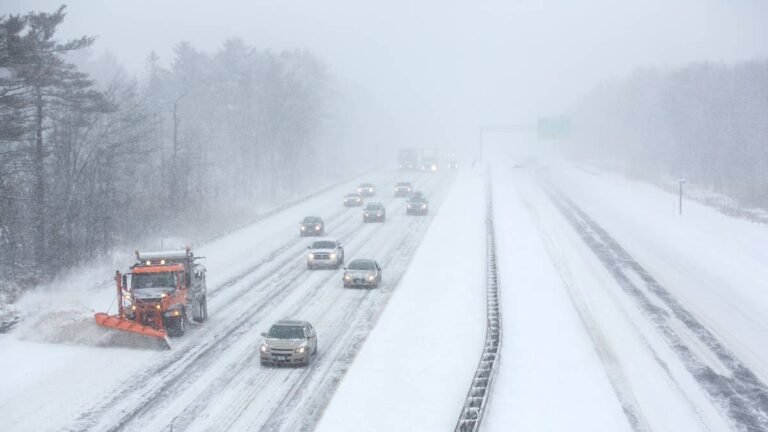
The Winter Weather Advisory that put a stretch of American highway under a snow alert in the last week of July has expired. The road it covered has not gone back to summer.
National Weather Service forecasters in Fairbanks let the advisory lapse at 4:13 a.m. Alaska time Monday, noting only that as precipitation tapered off, some snow could still mix in through the morning. That is the official end of the event. It is not the end of the driving problem.
The peak danger now is not falling snow. It is the overnight refreeze on a 4,739-foot pass where the north descent runs at grades up to 12 percent and there is no alternate route.
What the Advisory Actually Called For
The alert covered the Central Brooks Range, specifically Atigun Pass, Anaktuvuk Pass, Galbraith Lake and the Dalton Highway from mile post 232 to mile post 322. Forecasters called for mixed precipitation with total snow accumulations between 2 and 6 inches, plus ice accumulation around a light glaze. Widespread totals were pegged near 2 inches, with the 6-inch figure reserved for higher elevations. Freezing drizzle was flagged as a possibility overnight as the snow wound down.
A companion Special Weather Statement extended the same 2 to 6 inch snow outlook across the Brooks Range as an Arctic cold front pushed southeast out of the Chukchi Sea, with under an inch expected for most of the Eastern Arctic Coast.
Why Atigun Pass Is the Pressure Point
At 4,739 feet, Atigun is the highest pass in Alaska maintained year round, and it is the only place a road crosses the Brooks Range. Drivers do not get to reroute. They go over it or they stop and wait.
The pass sits at mile post 244, right where the Dalton crosses the Continental Divide. Snow shows up here in June and July with some regularity, and the mountain has a long history of putting vehicles off the road. This is also the second time this summer the corridor has drawn an alert-level snow forecast. Back in early June, the same zone was under a Winter Storm Watch for 6 to 12 inches with gusts to 30 mph.
Road Conditions and the Refreeze Risk
Warm pavement in July does most of the work on the first round of snow. It melts. Then air temperatures at pass elevation slide below freezing after midnight and that meltwater becomes a sheet.
That sequence is what caught drivers here. A road that looked merely wet at 8 p.m. can be glazed by 3 a.m., and a light glaze on a 12 percent grade behaves nothing like a light glaze on flat ground. Add north winds moving loose snow across the exposed upper switchbacks and visibility drops on the least forgiving section of the climb.
Alaska DOT updates conditions through 511.alaska.gov and runs programmable message boards on both sides of the pass specifically to communicate Atigun conditions. Check before you commit to the climb, not after.
Summer Snow Driving Tips for the Dalton
The gap between February and July is not the snow. It is the preparation. In July, almost nobody heading north has chains, a shovel, extra layers or winter-rated tires in the trunk. Summer tires on a glazed grade are a genuinely bad combination.
Slow down well before the grade rather than on it. Leave far more following distance than feels reasonable. Brake in a straight line and finish braking before you turn. If you are in a loaded truck, remember that engine braking on the north side matters more than your service brakes.
Also worth remembering: there is no cell service across the Dalton’s 414 miles, and Coldfoot is the last fuel stop for 239 miles before Deadhorse. Getting stuck here is not a roadside assistance situation.
Timing and What Comes Next
Precipitation diminished through Monday morning, and drier conditions were expected to follow across the North Slope through the day. Interior Alaska is forecast to climb back into the 70s by Tuesday and Wednesday.
No new winter weather product has been issued for the Central Brooks Range as of Monday evening. But the corridor has now produced two snow forecasts in a week and three alert-level events since early June. Snow driving on the Dalton is not a seasonal skill. It is a year-round one.