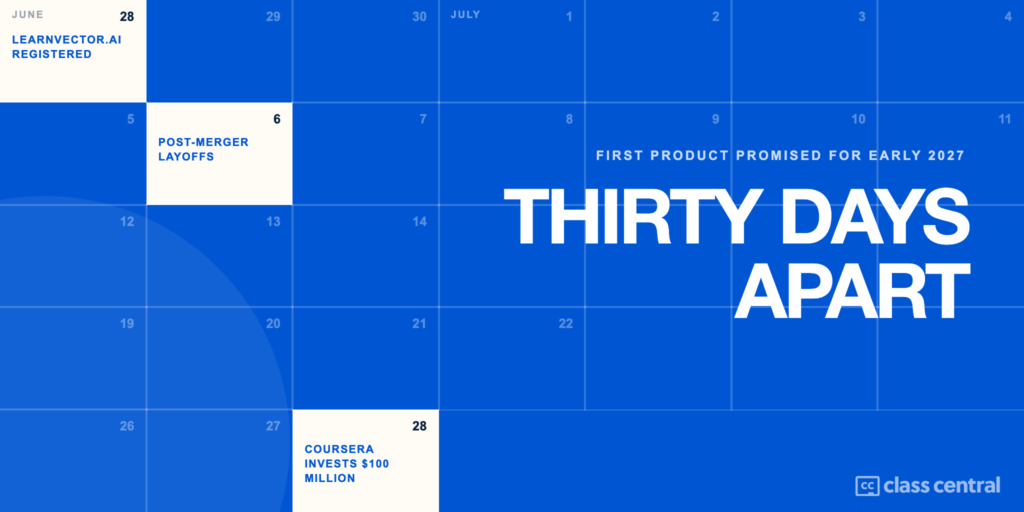

This afternoon, Coursera reports its first quarterly earnings since the Udemy deal closed. Yesterday, it announced a $100 million investment in LearnVector, a new AI learning company founded by Andrew Ng.
LearnVector’s domain was registered exactly one month ago and somehow it’s worth $300M?
It’s a single page website with five open roles in Mountain View, and a promise of a first product in early 2027.
Its founder is the co-founder of Coursera and the chairman of its board. If my reading of the announcement is right, Coursera is supplying the cash, the content, and the distribution, and getting a third of the company in return.
My spider sense is tingling.
What is LearnVector?

The LearnVector site has a lot of words, but very little substance on what it actually does. Feels typical of a vibe-coded AI website, with quotes like “To accelerate human development.” or “For most of history, great teaching has been scarce.” and my personal favourite, “Labor → Love”.
One thing it is not: a chatbot. And it explicitly points that out, linking (twice!) to a paper published in June 2025 titled “Generative AI without guardrails can harm learning: Evidence from high school mathematics.”
Its thesis hinges on the claim that “one person with a good teacher learns more — and faster — than the same person in a classroom of two hundred.”
LearnVector plans to bring one-on-one learning to the masses (but definitely not chatbots!) and combine it with “trustworthy learning,” by which I think it means Coursera (and maybe Udemy) content.
Another section describes the solution: an adaptive, custom learning path, aka “A trustworthy guide for learning.” That’s as specific as the website gets.

For anything concrete, you have to read the press. Ng told Reuters it will make individualized courses for white-collar workers, tracking progress and getting harder as they improve. LearnVector isn’t building its own AI models. Those will come from other companies.
And who pays for it? Ng said he expects to sell to corporations, governments, and higher education.
One-on-one learning is finally possible if you already have a job or are enrolled in an institution.
Coursera already tried this
To me this sounds like a Duolingo-style gamified clone, but for job skills rather than languages, built on top of Coursera content.
But wait! Coursera already tried that.
In June, it launched an app called Ollie. I installed it and started writing it up under the working title “A Vibe-Coded Wannabe Duolingo.” I never got around to finishing it.
Ollie is a microlearning app, and you need Coursera Plus to use it.

It’s vibe-coded and fully featured. Leaderboards. A store. Streaks. In-app points called beans, which you spend on customizing the mascot. And of course an AI.
At its core, it breaks Coursera videos into chunks and recommends them to you.
Some of it can be useful. Looking up photosynthesis worked fine.
The AI shows up in three places. “Discuss with Ollie” is where you hear the AI voice. AI-generated videos sit interleaved between the real Coursera content. And after every video, it generates a quiz, with the format changing from one to the next.
So that’s the AI-native product Coursera built and shipped eight weeks ago.
One more thing. LearnVector’s pitch is built on not being a chatbot. Coursera’s flagship AI product is a chatbot called Coach.
Why not build it inside Coursera?
Ollie was Coursera’s first AI-native app. Two months in, it has seven reviews on the App Store and 100+ downloads on Google Play.
“AI-native” is also the exact phrase Coursera’s press release uses for LearnVector.
So Coursera’s first AI-native product went nowhere, and its response was to buy a third of somebody else’s.
A bad first attempt is a reason to try again. I’m not sure it’s a reason to start a separate company.
Nothing in the announcement explains why this has to happen outside Coursera. Ng is the co-founder. He is the chairman of the board. And the new company is being built with Coursera’s money and, if the announcement means anything, Coursera’s content and Coursera’s learners.
Andrew Ng > Coursera + Udemy?
Coursera is paying $100 million for one third, which values LearnVector at about $300 million. The first product ships next year.
And the money might be the least of it. Here’s how Axios described the arrangement:
“Coursera will own roughly a third of LearnVector, and the two companies will explore commercial partnerships that combine LearnVector’s AI technology with Coursera’s content library and global distribution network.”
That global distribution network is how Coursera and Udemy do about $1.5 billion in revenue a year. Getting access to it is like partnering with an influencer who already has the audience you want. That alone could be worth a third of a startup.
The catalog is the same story, and LearnVector says so itself: “Coursera has a trusted library of materials from authoritative sources.”
So Coursera is either underpricing what it’s putting in, or it thinks Andrew Ng’s name is worth more than all of it. He is an influencer in his own right, in the most lucrative industry on the planet.
Some of it might come back. Circular deals are common enough in AI to be a genre, and if LearnVector ends up licensing Coursera’s content or paying for access to its learners, that’s revenue on Coursera’s side. The announcement doesn’t say either way.
What I keep coming back to is the $300 million. AI companies get valuations like that before they ship anything. Education companies don’t. The public market values Coursera and Udemy together at about $1.68 billion, roughly 1x their revenue. LearnVector doesn’t have any revenue.
So how does a one-month-old website with no product get to $300 million?
He’s done this before

In 2017, Andrew Ng launched the Deep Learning Specialization on Coursera. Not under Stanford, where his original machine learning course came from. Under his own company, DeepLearning.AI.
He’d stepped back from running Coursera by then. He was still on the board.
DeepLearning.AI now has more than 150 courses and specializations on Coursera. And we know what they’ve earned, because Coursera has to tell us.
Related-party transactions get disclosed in the annual 10-K. Ng is a related party. So every year since 2018, buried in the filing, there’s a number.
| DeepLearning.AI revenue | |
| 2018 | $4.3 million |
| 2019 | $5.9 million |
| 2020 | $6.1 million |
| 2021 | $6.5 million |
| 2022 | $5.7 million |
| 2023 | $7.4 million |
| 2024 | $8.6 million |
| 2025 | $8.7 million |
| Total | $53.2 million |
That’s $53.2M to Ng’s company over eight years. (At a 50/50 split, Coursera booked about the same again on its side.)
DeepLearning.AI courses also aren’t in Coursera Plus, the subscription that covers most of the catalog. If you want them, you pay separately.
And DeepLearning.AI doesn’t only live on Coursera anymore. It runs its own platform now, with more than a hundred short courses and its own membership. It built its brand on Coursera, and now the new courses go on its own site.
To be fair, Coursera handled this one by the book. The investment was negotiated and approved by “a special committee comprised entirely of directors determined by the Board of Directors of Coursera to be independent and disinterested,” so Ng had no part in approving it.
This time Coursera is paying $100 million before LearnVector has shipped anything.
Investor >>> Learner + Instructor
Coursera and Udemy have spent the last few years taking things away from learners and the people who make the courses. Every time, there has been a reason, and the reason is usually some version of investing in the platform. That’s supposed to be good for learners and the people who make the courses.
In July 2025, Coursera locked its course videos behind a paywall, ending more than a decade of free auditing. I called it the day MOOCs truly died.
Three months later it told university and content partners it would start taking a 15% platform fee, to “sustain progress and continue investing in innovation.” Class Central broke that story.
Partners have paid in before. An estimated $40 million in membership dues went into edX because it was a nonprofit, and then Harvard and MIT sold it for $800 million. Most of that is still sitting in a foundation, and the universities who paid in got nothing.
Over on Udemy, instructors got 38% of revenue in 2020. By 2025 it was around 21%. Revenue went up over those years.
The 2023 cut was meant to “enable key investments and business growth,” and came with a promise that instructor payouts would “equal or exceed their current levels each year.” The stock jumped 50% that day. We checked, and payouts fell from $210 million in 2023 to $192 million in 2024. I estimate around $169 million for 2025.
Both companies also cut staff, more than once. Coursera’s July layoffs were about “operating efficiencies” that would “increase the company’s ability to invest in its long-term strategy.”
Put the two companies together and they had about $1 billion in cash going into the merger. Days after it closed, Coursera authorized a $500 million buyback, and it had bought back around $70 million of its own stock by late June. On July 28 it put $100 million into LearnVector.
So far instructors are earning less, and learners are paying for what used to be free. The shareholders got a buyback.
If I was a Coursera investor
Ng is giving prepared remarks about the investment on this afternoon’s call. Here’s what I’d want to know.
How did you get to $300 million for a business with no product?
Does any of the $100 million come back to Coursera as revenue?
And why only a third?
I doubt we’ll get answers this afternoon. But related-party transactions have to be disclosed, so the numbers will turn up in a filing eventually. I’ll be reading it.
The post Coursera Bets $100 Million That Andrew Ng Can Do What Coursera Can’t appeared first on The Report by Class Central.