The Kansas City Chiefs were taking on the New England Patriots on September 29, 2014, when, with just eight seconds to go in the first quarter, the volume of the crowd’s roar reached 142.2 decibels. That’s about as loud as a jet engine taking off, and good enough to break the Guinness World Record for loudest crowd roar at a sports stadium.
A new Chiefs stadium might help them break it again.
The Chiefs previously set the record for loudest crowd in 2013 at 137.5 decibels, which was broken later that year when the crowd at Seattle’s CenturyLink Field reached 137.6 decibels. But since 2014’s game, when the Chiefs handed out earplugs to fans beforehand, the record has remained untouched.
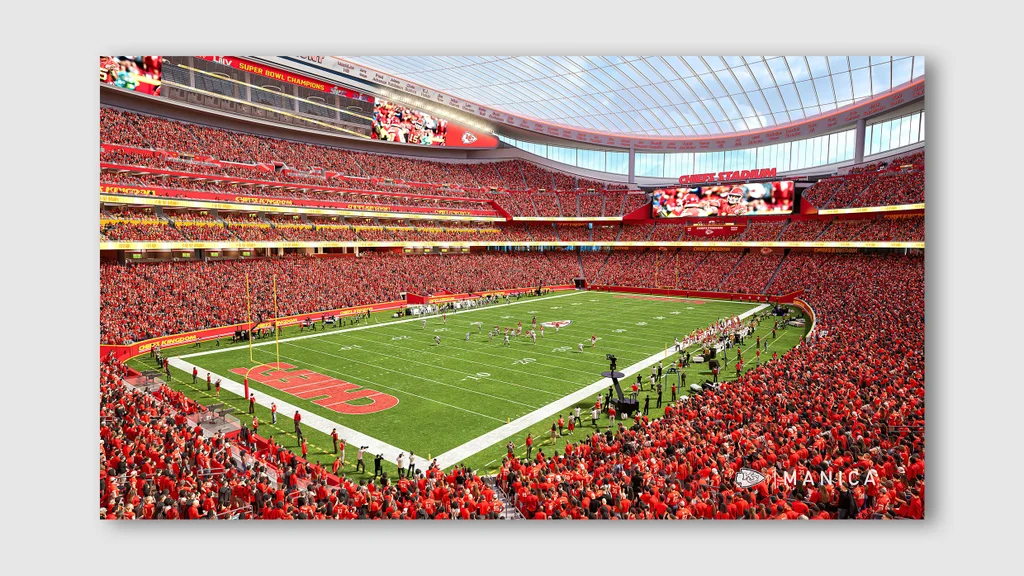
When the team’s planned $3 billion stadium opens in 2031, though, that record could be at risk again. The lead architectural firm behind the stadium says it is designed to be as loud as possible by containing the sound through the actual size, shape, and roof geometry of the venue.

“We carefully designed the layout of the seating environment, the roof, and the concourse areas to contain the sound inside the seating environment, much more than the existing Arrowhead stadium does today,” David Manica, owner of Manica Architecture, tells Fast Company.
Manica, the Kansas City-based firm behind venues like Allegiant Stadium in Las Vegas and the Oklahoma City Arena in Oklahoma City, designed the stadium, and HNTB, another Kansas City firm, is the lead design architect.
The team says the stadium was designed to prioritize fan experiences like tailgating, with parking lot infrastructure big enough to hold more than 20,000 parking spots, and the pre-game flyover, by using 400,000 square feet of translucent panels for a clear view through its fully enclosed roof. When it comes to maxing out the volume inside the stadium, the entire venue’s shape was optimized for loudness.
The biggest challenges revolve around the density of the crowd and their proximity to one another.
“The secret to making a stadium loud is its ability to contain the sound energy within the volume,” Manica says, so they designed the new stadium with as few interruptions in the seating sections as possible. All spectators are as close to the field and to each other as possible.
The more compact the venue, the more concentrated the noise. The new stadium removed exit passageways in the bowl, while seating was designed to be as dense with people as possible, with continuous seating tiers and fewer internal aisles. The new stadium is expected to seat about 70,000 people, fewer than Arrowhead Stadium’s maximum capacity of more than 76,000. The roof shape, which is parabolic, makes sound louder because the shape directs sound waves back down toward fans.
Acoustic engineers digitally tested and analyzed the new stadium design, Manica says, and their analysis found that a crowd of a certain volume in the existing stadium “will actually be perceived as louder in the new building.”
“The new stadium will be even louder than the existing record-breaking Arrowhead,” he says.
When the Jumbotrons at the new Chiefs stadium say, “let’s get loud,” they’ll really mean it.