Editors’ Highlights are summaries of recent papers by AGU’s journal editors.
Source: AGU Advances
In near-Earth space, charged particles and plasma waves can exchange energy most effectively through resonance. Cyclotron resonance is one such interaction, where particles whose gyromotion synchronizes with the wave fields can gain or lose energy from waves, influencing phenomena such as the radiation belts, auroras, and space weather effects that can affect satellites and communication systems.
Li et al. [2026] explore the particular conditions leading to anomalous resonance, which occurs when cyclotron resonance is altered by very large amplitude of plasma waves. The distinguishing contribution of the study is the exploration of anomalous resonance in realistic inhomogeneous environments. The results prove that the interplay of resonances may give rise to an inhomogeneity-driven pathway for energy redistribution across a broader energy range than previously recognized. The above findings provide new insights into a fundamental and previously underappreciated mechanism shaping plasma dynamics across a wide range of space and astrophysical systems.
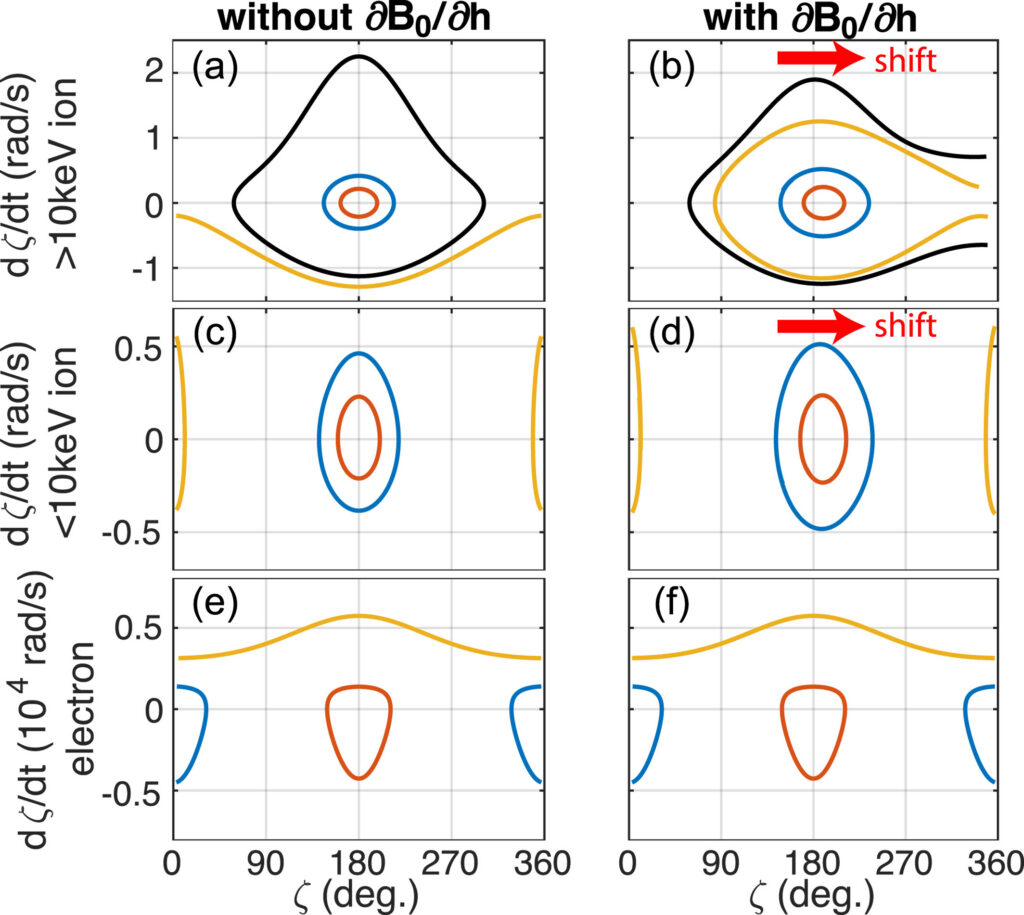
Citation: Li, J.-H., Zhou, X.-Z., Wang, S., Liu, Z.-Y., Khotyaintsev, Y. V., Graham, D. B., et al. (2026). Bidirectional energy transfer via simultaneous wave-particle resonances in inhomogeneous space plasmas. AGU Advances, 7, e2026AV002479. https://doi.org/10.1029/2026AV002479
—Alberto Montanari, Editor-in-Chief, AGU Advances
Text © 2026. The authors. CC BY-NC-ND 3.0
Except where otherwise noted, images are subject to copyright. Any reuse without express permission from the copyright owner is prohibited.