From the Cool Cat Teacher Blog by Vicki Davis
Subscribe to the 10 Minute Teacher Podcast and Cool Cat Teacher Talk anywhere you listen to podcasts.
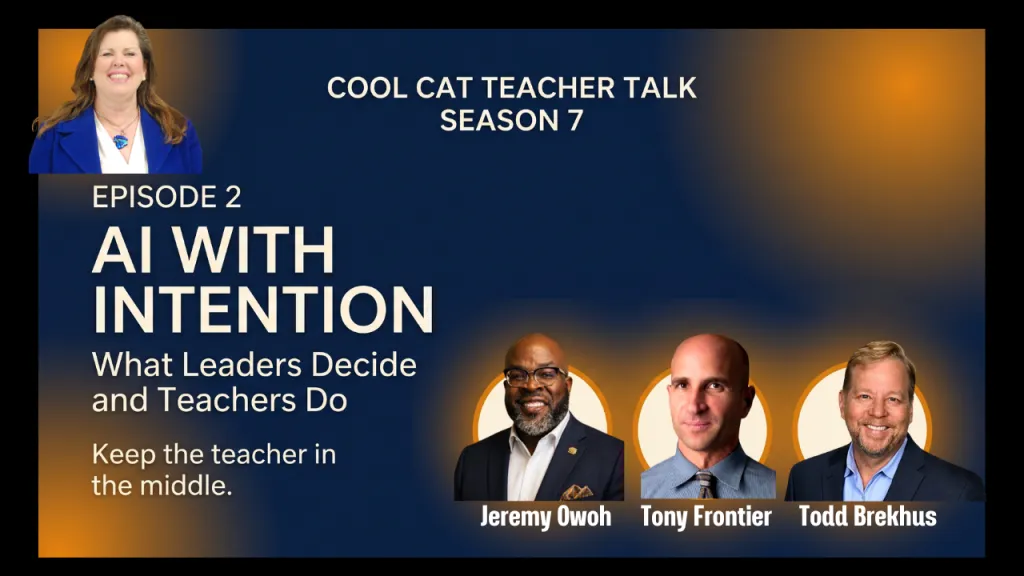
Whew, getting all this ISTE 2026 information and conversation up has taken a moment. That is what happens when you have a great experience. But for those of you who were there and want some different views and those who were not, you’ll want to hear these experts and thought leaders share their take on the issue of the day: AI. From Tony Frontier, author of AI with Intention, Todd Brekus about how Renaissance Intelligence is not working with student facing AI (yet), and an interview with the remarkable outgoing chair of ISTE/ASCD, Dr. Jeremy Owoh.
This show is sponsored by Renaissance Intelligence. All opinions of each guest are their own.
Subscribe to Cool Cat Teacher on YouTube
Chapters — Part 3
- 00:00 Intro + free AI tools for U.S. teachers
- 02:58 Dr. Jeremy Owoh — relationships first: leadership in the age of AI
- 18:49 Tony Frontier — AI with intention: learning detection, not AI detection
- 39:25 Todd Brekhus — Renaissance Intelligence: keep the teacher in the middle
- 56:45 Close — the craftsmanship of teaching is human
Key Takeaways — Part 3
Dr. Jeremy Owoh — leadership in the age of AI
- Relationship is the precondition, not the garnish. When you connect with them, they connect with you, and then learning starts.
- Audit your tech policy for “don’ts.” If it’s a list of prohibitions, rewrite it — and rewrite it with a committee that includes students and teachers.
- Bring the whole team to learn together — curriculum people and infrastructure people in the same room, so decisions don’t collide when everyone gets home.
- Pilot everything, and judge it on qualitative data too. Talk to the students and the teachers, not just the score report.
- Argue screen value, not screen time. Vetting what goes in front of kids is the job AI can’t do — everything companies put out there is not what’s best for kids.
Tony Frontier — using AI with intention
- Stop writing cheating policies and start writing integrity policies. The question shifts from “did the student do the work?” (which you have to prove) to “does this work represent what you actually know?” (which you share).
- Put three things in place: guidelines and boundaries; explicit definitions of effective, ineffective, and inappropriate use; and core commitments of integrity, transparency, and explainability.
- Normalize disclosure from kindergarten. “Who helped you with this?” Mom, a sibling, a tutor, Google, an AI — same question.
- Teachers owe the same three back: fidelity to priorities, transparency about the tools they use, and the ability to explain and justify anything they put in front of kids.
- Protect the inner voice. “I’m stuck, I don’t get it” is a powerful signal. When the next voice becomes “I must not be smart,” the kid stops trying — and that can happen by the end of first grade. Teach kids to use AI as a tutor (“teach me the difference between this and this”), not an answer vending machine.
Frontier’s figure that students report using AI for roughly 25–40% of their schoolwork comes from his own focus groups in urban, suburban, rural, public, private, and parochial high schools. It is his finding, not a national statistic.
Todd Brekhus — building tools that keep the teacher in the middle
- They built student-facing AI and pulled it back — because it lied and rushed kids past the productive struggle. The AI went to the teacher’s side first.
- Kill the back-of-the-room headphones model. Twenty-five years of pulling kids out of the core instruction is disconnected and stigmatizing — everybody knew that kid needed something extra.
- Say “personalized teaching and learning.” Putting the teaching back in is the whole point; unattended personalization is how kids get off track.
- Coherence plus agility: assessment data tied to the textbook tied to the supplemental resources, so a teacher can see that twelve kids already have it and twelve don’t — and adapt that morning.
- The difference from a wrapper app is bringing the student’s own assessment data into the recommendation and handing it to the teacher to act on.
Classroom Takeaway
The through-line across all three shows, said back to me nine different ways: the craftsmanship of teaching is human. Every time. Pick one thing from this page and take it into your room this week. You can’t boil the ocean — innovate like a turtle.
About the Guests — Part 3
Dr. Jeremy S. Owoh
“Our students are our students. And it’s not like our parents are choosing a set of students to send to us each day. They’re sending the students they have at home. And our job is to teach them.”
Dr. Jeremy S. Owoh
Superintendent, Jacksonville North Pulaski School District; President, ISTE+ASCD Board of Directors

Dr. Jeremy S. Owoh began his career in 2003 as an English teacher at Parkview Magnet High School in the Little Rock School District. In 2017, Dr. Owoh was named the Assistant Commissioner of Educator Effectiveness and Licensure and was later appointed as the Superintendent of Schools for the Pine Bluff School District. Currently, Dr. Owoh serves as the Superintendent for the Jacksonville North Pulaski School District. Dr. Owoh serves as the President for the ISTE+ASCD Board of Directors.
More about Jeremy: ascd.org/people/jeremy-owoh
Dr. Tony Frontier
“That’s a kid who has confused learning with compliance. Right? And we did that to that kid.”
Dr. Tony Frontier
Director, AI Center for Effective Teaching and Learning

Dr. Tony Frontier was a teacher in Milwaukee Public Schools and a high school principal, K-12 curriculum director, and University Professor. He is currently the Director of the AI Center for Effective Teaching and Learning where he works with schools and districts to ensure AI tools are used in ways that support, rather than undermine, effective teaching and learning. He is author of 6 books and numerous articles. His most recent book, AI with Intention: Principles and Action Steps for Teachers and School Leaders, with a foreword by Jay McTighe, has been praised by John Hattie as “the best book I have read to introduce all to optimize the power of AI.”
Connect with Tony: tonyfrontier.com · LinkedIn · ASCD · AI Center for Effective Teaching and Learning
Todd Brekhus
“How about when the teacher is differentiating in the moment? … that’s where the power of the human and the AI and the data come together.”
Todd Brekhus
Chief Product Officer, Renaissance & General Manager, Nearpod

Todd Brekhus is chief product officer at Renaissance. A former educator, he is the co-founder of multiple education technology solutions, including the myON digital literacy platform.
He is the recipient of the SIIA CODiE Award for Lifetime Achievement and many other accolades in recognition of his contributions to the field of education technology.
Learn more: Renaissance Intelligence · Nearpod
Full Transcripts
These transcripts were generated with AI assistance and then corrected by a human against the final edit. Speaker names, proper nouns, and organization names have been verified. Timestamps match the published episodes.
Read the full transcript — Part 3: AI With Intention (S7E2)
Vicki Davis (00:00)
AI with intention. This is part three of our ISTE AI and EdTech super series, and this show is brought to you by Renaissance Learning.
Announcer (00:11)
Ever wondered how remarkable teaching happens? Find out right now at Cool Cat Teacher Talk with award-winning teacher Vicki Davis. Get insights from top educators, tips and inspiration to elevate your teaching.
Vicki Davis (00:25)
There were so many great things about ISTE 2026 this year. All the people and wonderful things, but I really ended on a high note. In room W312AB on Wednesday at 11:30, it was the last slot and the lunch slot, and the room was packed. Teachers gave up their lunch to sit in a windowless room and hear me run through my 50 plus AI and ed tech tools.
Vicki Davis (00:52)
They came because they wanted to be better. And it was a room full of fired up educators. The thing about an amazing conference is something happens to you. Even if you present and share what you’re doing, you leave sharper than you came in. And sometimes you leave believing again.
Vicki Davis (01:11)
So that’s the energy I brought home from Orlando this year. And it’s the energy behind today’s show, our part three of the AI and Ed Tech super series. But before we go one step further, I’ve got a free gift for you. Well, it’s not from me, but if you teach in the United States, you’re going to be excited anyway. Right after ISTE, Anthropic made their teacher tools free for U.S. K-12 educators.
Vicki Davis (01:36)
This is on top of OpenAI already giving their tools free for K-12 educators. So Claude, including the cowork tool I talk about all the time and I use to help run this show, is free for verified teachers. And ChatGPT is free in a private workspace that doesn’t train on your student data.
Vicki Davis (01:58)
So I put the how to, the links, and who qualifies all in one place. So write this down. coolcatteacher.com forward slash free AI. I’ll come back to that. So this first interview we recorded right in the media room in Orlando. The camera, a folding table, and we all had our bit of coffee. Part two of this series was about teaching kids how AI works. Today It’s about us grown-ups, what the leaders decide, and what the teachers do tomorrow morning, and what the tools should and shouldn’t do. First up, Dr. Jeremy Owoh He started as a high school teacher in Little Rock back in 2003. Today he leads a district in Arkansas and is president of the board of the newly combined ISTE and ASCD, now the International Society For transforming education. I asked him what’s still the same about reaching kids in the age of AI. his answer is the oldest one in the book and the truest. Let’s learn.
Announcer (02:58)
Cool Cat Teacher Talk with award-winning teacher Vicki Davis.
Vicki Davis (03:02)
Our guest today has sat in just about every seat in education. Dr. Jeremy Owoh started as an English teacher in Little Rock, Arkansas in 2003, went on to lead at the state level. And today he serves a district in Arkansas while serving as head of the board for the newly combined ISTE and ASCD. We are at ISTE 2026 talking about leadership in the age of AI. So Jeremy, thanks for coming on the show.
Jeremy Owoh (03:32)
Thanks for having me. It’s a pleasure joining you.
Vicki Davis (03:35)
have sat in every seat, all of them, and you’ve seen a lot of change. What things are still the same about reaching kids?
Jeremy Owoh (03:42)
That it takes a personal relationship to really reach young people. And when you connect with them, they connect with you and then learning starts. But it’s unrealistic to think that learning will happen without that relationship.
Vicki Davis (03:56)
Absolutely. What did we learn from the pandemic? Kids sitting there with a computer alone, all learning. So we need the teachers. And so I’ve heard, you’ve probably heard it, at one point when AI really started coming around after LLMs (large language models) were invented, we’re going to replace teachers with AI. And we heard it with YouTube, didn’t we? So what do you think about the role of the teacher in the classroom in this age of AI?
Jeremy Owoh (04:21)
Well, to me, an effective teacher was always the teacher who facilitated learning, gave the students the opportunity to take ownership. And in today’s time, even now with as much innovation we have, that remains true that educators, we have to be the facilitator and let the students have that spark of creativity, that spark of innovation while using ed tech tools in the classroom. But The teacher can facilitate that. There’s power and facilitation of it because you create the environment for learning to happen. And of course, like you just said, AI can never create that type of environment. I do.
Vicki Davis (04:58)
So you lead a district and you got a little bit of pressure from like leading ISTE, right? So what are you telling all of your principals and your teachers about the role of AI? Because we don’t want kids circumventing their education by using artificial intelligence inappropriately, but a lot of districts aren’t telling people how to use it.
Jeremy Owoh (05:19)
Right. We’re actually doing the opposite. You know, I believe in learning together. So every year I bring a team with me and my team consists of teachers, media center specialists, assistant principals, principals, curriculum staff, and my executive staff, assistant superintendents. And we learn together at ISTE/ASCD We even bring the infrastructure side of technology of our school district with us by bringing technology specialists so that we’re able to have the curriculum conversation, leadership conversation while ensuring that we have the infrastructure for implementation at our district. So learning together is important and they know that’s my philosophy. We’re going to do what’s possible. But I also tell you one of the learning moments for me was when Richard visited my campus and I was just giving them a tour, Richard the C our CEO.
Vicki Davis (05:58)
Richard Culatta.
Jeremy Owoh (06:15)
Mm-hmm. He said, Well, Jeremy, let me look at your technology policy. And I showed him, he said, Hmm, it’s typical. It was a list of don’ts, don’t do this, don’t do this. And so that was about three years ago. And it sparked a really a revolution of how we looked at technology or ed tech because we started revamping our technology policy. We presented it to our board.
Jeremy Owoh (06:31)
But we did that by creating a committee of students and teachers and getting their input on what technology. So instead of running away from AI or innovative technology, we run to it and and make sure that we provide the infrastructure, the training, the learning, consistent, constant learning for our teachers so they’re comfortable with it so that the students are comfortable and they know when to appropriately use it. I do.
Vicki Davis (06:57)
You believe in pilot program.
Vicki Davis (06:59)
I think it’s the only way to implement new stuff. But so talk about your philosophy behind pilot programs. And when do you know that like it’s time to make one?
Jeremy Owoh (07:03)
Always willing to pilot programs. We do it so much, even with a like curriculum or content courses like English and math. When the state comes out with a new program, we’ll pilot like we did high impact tutoring. And really, the high impact tutoring, the state asked us if we would like it. They showed us research behind it and the high impact tutoring we utilized or opted in was AI. And and it was small doses of high impact tutoring. And that was a game changer. So
Vicki Davis (07:37)
So it worked well
Jeremy Owoh (07:37)
It worked very well. And when I tell you it worked well, I always look at not just the quantitative data about any type of implementation, but also qualitative. So I had conversations with my students, conversations with the teachers, leaders, and the feedback was very positive. We’re always in the habit of and always willing to do pilot programs because we never know what’s going to impact the students we have today. The thing that educators have always have to keep in mind, especially leaders at the district level.
Jeremy Owoh (08:07)
that our students change every year, their learning styles, their interests, but also our educators. So you cannot continue to do everything the same way all the time. And so we’re always looking for new ideas, new ways to engage our students, to continue to build the capacity of our educators and stretch us as adults.
Vicki Davis (08:26)
Yeah, I’d like to work for you. I’m not applying for a job. But it requires a dose of humility.
Jeremy Owoh (08:31)
It does. The one recognizing we don’t know everything. Yeah. And that our students may know more than we know. That’s why it’s so important that we facilitate and be okay with our students taking full autonomy, ownership of their learning. Because that’s what’s going to propel them to hire critical thinking, problem solving beyond high
Vicki Davis (08:54)
school. And having the real conversations because so many schools I know you’re talking to feel like they’re just playing AI whack-a-mole. It is pointless.
Jeremy Owoh (09:02)
Pointless. And we have this debate about screen time and what we really have centered on here even at ISTE/ASCD now known as International Society for Transforming Education is is more about screen value, right quality than screen time. And that’s w as educators, that’s our job to vet these ed tech tools or any type of resources that we put in front of our students. That’s why AI can never replace a good teacher because there still has to be a vetting of what’s out there because everything that people or companies put out there is not what’s best for kids.
Vicki Davis (09:49)
You know, I’ve been around long enough in the 1990s was, the Internet’s going to ruin everything. Let’s block it. And then we had social media is ruining everything. Let’s block it. Well, how did blocking the Internet work for us and how did blocking social media work for us?
Jeremy Owoh (10:07)
Is I gave that example about the internet earlier this week, and I’m like, we were so hesitant about using the internet, and now adults, we use it all the time and we see the value. Yeah. Why can we not look at AI like that? Right. And in fact, AI has been around for years and we’ve used it as adults, but now because it’s more modern and mainstream, we’re trying to hinder it. Yeah. Which never really works for us.
Vicki Davis (10:25)
So I do watch Survivor. The blind side is awful when you don’t see it coming. And I think a lot of teachers feel like they’re on an episode of Survivor, that they’re being blindsided. And it goes both ways. You have great writing kids who don’t touch AI. And because it’s great writing, it’s getting flagged as AI. And then you have kids who are deceiving teachers. And nobody likes to feel like they’re wasting their time. And as a teacher, it’s so frustrating when I sit there with a hundred assignments to grade and I’m looking at them and I’m like, some of these don’t line up. Where do I even start? What am I going to do? Because we want to be fair. Like that’s part of what teachers are. So what’s your advice to the superintendents who have a lot of teachers like me who are like, okay, now I just want to teach. Like I want to know that they learn. And I’ve started doing oral assessment, all kinds of things to try to give myself some flexibility because I want to detect learning. don’t want to take AI.
Jeremy Owoh (11:20)
Right. And you shouldn’t have to take time to detect AI. And I think as a former English teacher, I tell you one of the things I’ve learned is that what’s more important? Grading up a five paragraph essay or knowing that your student has learned the skills and the components of the essay. And when you really look at it as a teacher, as an English teacher, my job was to teach the skill, not to have them to literally write a five paragraph essay, but They should know how to create one, how to develop one. You can do a lot of that in class. To me, handwriting still has a place in education. And to me, we need to create an environment where students have a combination of all of it. Technology use, but also just pen to paper. I would always Tell superintendents and leaders, I would not say follow my advice, but what my thoughts have always been is to always remember what it’s like to be a teacher and as you lead, because that’s where the important work happens. But also make sure you leave your office and get into the classroom and have conversations with your teachers, with your students, and see how you can assist, how you can support, and then make well informed decisions. Because you cannot make well informed decisions by sitting behind your computer and telephone.
Vicki Davis (12:38)
because it’s all about people.
Jeremy Owoh (12:39)
Right. And when you engage, if you’re in the classroom and engage with your teachers, you can see what the struggles are and you can have those instructional professional conversations and dialogue and work with your teachers and leaders through those struggles. Because there’s always going to be struggles, reaching kids, engaging kids. Our kids are different. But I think there’s power and dialogue. And absence of that is what creates opportunities for chaos and confusion and distrust. And we can’t have that.
Vicki Davis (13:08)
They always say is we shouldn’t play king or queen of the hill. We should always make a bigger hill. Because it’s going to take a lot of conversations, moving forward, authentic, real honest conversations because AI is different for everybody. And so let’s talk about the name change because ISTE and ASCD several years ago merged and came together. And it’s interesting as the instructional tech coach.
Vicki Davis (13:30)
I’ve always worked closely with the curriculum directors at my school and they would go to the ASCD conference, I would go to ISTE and then we would compare notes and we found out that there was a lot of overlap obviously every year. So what are the thoughts behind the name change? You’re working on the board as you all made those decisions. How does it impact the organization?
Jeremy Owoh (13:53)
And so I was fortunate to start on the ASCD board, but I had always attended ISTE as well. And so as I continue to move up in leadership principal assistant superintendent, I was assistant superintendent for curriculum instruction, then an assistant commissioner, and then I realized that when we had the opportunity, when the first idea of us merging came together, I was like, this makes sense. Because as a superintendent, I’m looking at I have my technology department over here, my curriculum department. And a lot of times they’re making decisions without really corresponding. yeah. And then when they do come to the table, it’s too late because the technology department said, we don’t have the infrastructure for this. We don’t have the capabilities of this, or this doesn’t migrate with this program. And so when we came together as an organization, it was a game changing opportunity for educators, for students, because now As a superintendent, I can bring teams, whole teams, and they could actually curate their own path of learning here, but at the end of the day, we can come together and debrief and have meaningful conversations. And I tell you, it’s important for me because then it’s not a hodgepodge of ideas when we get back to the district. We’ve all learned together, seen the same thing, heard the same thing, and then we can make meaningful decisions in a timely manner.
Jeremy Owoh (14:56)
as I look at the name change and what I tell people that when Richard and I announced the name on stage, it w you can kinda tell it was mixed feeling.
Vicki Davis (15:10)
I mean, curriculum development is so important. they don’t want to get lost. They need a place.
Jeremy Owoh (15:24)
It is they don’t want to get and I told people we may have kept the acronym. We did go through several name changes, options and iterations. We did settle on the acronym, but more so the name change, International Society for Transforming Education. And when we re look when we really look at the heart of transforming education, that’s what all of us should be about. And it’s transforming, which is an ongoing development of what teaching and learning should look like. And ed tech has a role in that. Curriculum and content and development has a role in that. Leadership has a role in it. Right. All educators have a role, both licensed and classified. So when I look at transformational learning, transformational education, that’s inclusive of all of us. And I so I always told people and I I was telling people yesterday that it’s important for us to utilize the entire name because international is just as important as transformation because we had over eighty countries represented to this year, but there’s a lot of great work that’s happening across other continents. And so we have to continue to to bring those educators in and have dialogue back and forth. Learn from them, let us learn from them because there’s power and learning from peer each other. Transforming education to me is really the heart of the work that we need to be doing.
Jeremy Owoh (16:48)
And also what we as educators need to make sure we continue to put out there in the media, in the research, in legislative sessions, because when people are making those decisions that impact us, they need to be well informed. So we have a responsibility as an organization to make sure we let them know what transformational learning looks like and what it needs to be and how it needs to be supported.
Vicki Davis (17:14)
And from the perspective of the heart of a teacher for kids, that’s what I like about meeting leaders like yourself who have been in the classroom and your heart is still in the classroom because the work is happening in the classroom. It is and we have to stay close.
Jeremy Owoh (17:29)
And I tell you, stand close. Thank you for saying that because that’s important. So I still teach adjunct. it’s on a graduate level. What I’ve always told my wife is that I never wanna forget what it’s like to be a teacher. So I still teach.
Vicki Davis (17:42)
I mean, it’s never been easy, but in a time of change, teachers are more important, but can easily get more discouraged because when you have the world talking down to you, you don’t know what you’re doing. Just because you learned one way doesn’t mean that’s the science of learning to reach every child because we can’t choose who walks in our room. The difference between, I started off in business, the difference between business and teaching is if somebody didn’t come, to work, I could fire them. If they don’t come to class, I still got to teach them somehow, right?
Jeremy Owoh (18:12)
Our students are our students. And it’s not like our parents are choosing a set of students to send to us each day. They’re sending the students they have at home. And our job is to teach them.
Vicki Davis (18:17)
That’s right.
Vicki Davis (18:23)
Well, it’s been a delight. Dr. Jeremy Owoh from Arkansas. We’re wrapping up ISTE. And I think the big thing is to remember that our kids, this is about reaching them, it’s about teaching. And thanks for being a voice for the classroom.
Jeremy Owoh (18:42)
And thank you for being a voice across the country. Thank you. Really appreciate the work that you’re doing in the classroom and outside the classroom.
Announcer (18:49)
Cool Cat Teacher Talk with award-winning teacher Vicki Davis.
Vicki Davis (18:53)
Relationship first, learning doesn’t start without it, and a kid alone with a screen and a set of headphones proved that to everybody during the pandemic. So if the relationship comes first, where does the AI go? That is the exact question our next guest has built a center around. Tony Frontier directs the AI Center for Effective Teaching and Learning, and his newest book, AI with Intention, is the one John Hattie.
Vicki Davis (19:19)
calls the best he’s read on optimizing the power of AI. Tony’s been running student focus groups all over the country, and he says you can’t tell one school from another. The story is the same everywhere. Let’s learn.
Vicki Davis (19:37)
So our next guest has spent his whole career on a deceptively simple question. What actually moves learning? Tony Frontier has been a teacher in Milwaukee, a high school principal, a district curriculum director, and university professor, and today he directs the AI Center for Effective Teaching and Learning.
Vicki Davis (19:57)
author of six books. Including Teaching with Clarity and Five Levers to Improve Learning. And his newest is AI with intention. It’s one that John Hattie calls the best book I have read to introduce all to optimize the power.
Vicki Davis (20:13)
of AI and that’s what we’re talking about at IST twenty twenty six. Because the question is not whether AI is in our schools, it is whether we’re using it on purpose in a way that protects productive struggle required to learn. So Tony, you’ve been spending a lot of time talking to people, talking to students about what’s actually happening.
Vicki Davis (20:23)
But what are they saying?
Tony Frontier (20:35)
I’ve been doing focus groups in in high schools around the country, urban, suburban, rural, public, private, parochial. and when you sit down and look at the transcripts, you can’t tell one school from the other. The message is the same. kids are using AI tools. typically kids say they use it twenty-five to forty percent of the time for their school work. Small group of students say they don’t use it, usually ethical reasons or environmental reasons.
Tony Frontier (20:50)
And there’s a group of kids say they use it all the time. I’ve had kids say they haven’t read anything since they were a freshman. They just have AI summarize everything.
Tony Frontier (21:06)
That is very problematic. but the other piece that that students are saying very consistently, they’re not receiving a lot of support or instruction from their teachers. There’s some vague permission, there’s a lot of outright bans, but there’s very little focused, specific lessons. Here’s how, here’s why.
Vicki Davis (21:25)
So AI with intention. What should be a school’s intention? Because some folks are just saying, Hey, let’s forget it, let’s go back to paper, which kind of feels like an ostrich in I don’t know if that’s realistic, but what does it mean to use AI with intention? Is it possible?
Tony Frontier (21:43)
Yep, absolutely. So I’ll start with this. we’re really faced with three choices right now. Because we’ve gone in just a few short years from these tools being a novelty to being available to being unavoidable. If you write if you go on a computer, would you like me to summarize this for you? Would you like help with your writing? Google is changing their search bar for the first time in 25 years to handle longer AI types of questions. So if you have access to a search bar, you have access to an AI.
Tony Frontier (22:02)
tool that can do pretty much all of your homework, kindergarten through PhD.
Tony Frontier (22:07)
what we’re faced with then is we can just let the kids figure it out on their own. A lot of videos out there on TikTok about how to use AI to cheat. we can just let the tech companies decide and tell kids, you know, hey, Use it all the time. or we take the lead, right? We stand up and take the lead. the kids are ahead of us right now and we have to get ahead of the kids. So an intentional approach.
Tony Frontier (22:30)
the way I talk about an intentional approach is intentional learning, looking at some of the cognitivist research from the 80s, specific actions designed with a goal of learning something in mind. So it’s not just Discovery or random, it’s cognitive effort to learn. Intentional teaching, we can draw on John Hattie’s work, right? Just good alignment, good backward design from Jay McTighe. It is aligning opportunity to learn with success criteria, with targeted lessons, et cetera. So when I talk about intentional uses of AI, I mean how are we using AI in ways that support intentional teaching and learning? So if I’m a teacher, how am I going to reach for AI tools in ways that, yes, create some efficient efficiencies, maybe even automate some processes. But if those actions don’t have fidelity, to priorities for teaching and learning, what was really gained? And for students, intentionality is are they using these tools with integrity and with agency?
Tony Frontier (23:24)
So these tools are th they’re a mirror, right? They’re going to reflect our values and if we want to use them to support deeper learning or if they absolutely can be used that way. or they can be used to cut corners. So I’m interested in how do we minimize the corner cutting and right actually find some efficiencies but ensure they’re used with integrity, ensure they’re used to really free us up, some time, but also build our capacity to just engage in those good practices, right, of what we know are effective teaching.
Vicki Davis (23:55)
You know, Tony, so many of teachers feel like it’s up to the teacher to come up with their policy. And that is really a hard place because if you’re not all on the same page, it just sends such such mixed messages. So when you consult with principals and superintendents, what’s your message about AI policy that also gives teachers freedom
Tony Frontier (24:05)
Yeah, okay.
Tony Frontier (24:15)
So there are three things we need to do. We need to put some guidelines and boundaries in place, Guidelines, how should these be used effectively? Bound right boundaries, how do we want to ensure they’re they’re not being used? If we’re just following the letter of the law and ensuring compliance, we’ve got some boundaries in place, but Compliance has nothing to do with effectiveness. Right. Right? So guidelines are what we use to describe what more effective uses of AI look like. So for teachers, aligned and intentional, another AI, right? How do we ensure that if AI tools are being used, they’re being used in ways that ensure aligned and intentional teaching? For kids, those guidelines need to be in place to ensure AI tools are used with agency and integrity. So that’s one piece: guidelines and boundaries. Second piece, we need to define what effective, ineffective, and inappropriate use.
Tony Frontier (24:59)
use looks like for administrators, for teachers, for for kids. So we because these tools are so flexible, right? we can’t just have vague policies in place that don’t give any direction. We can’t be so specific that it’s down to with this specific tool So we have to do it in ways that support teacher autonomy, teacher agency. So there’s a toolkit recently published through the AI Center for Effective Teaching and Learning, and I have examples in there. It just you can do it in a sentence. What does effective use look like? What is ineffective use look like? So for students, that could be superficial use. I used AI to complete my work.
Tony Frontier (25:35)
But I can’t explain the work that I completed, right? That’s ineffective. And then inappropriate, right, they’ve, you know, violated privacy or they’re cheating, things that are completely inappropriate. But we can’t just put that out there as a wish.
Tony Frontier (25:47)
So the third thing we need to put in place are some core commitments, and those core commitments for students are integrity, transparency, and explainability. So we need to put in place a set of expectations for AI use. You can do three levels or four levels, you know, no AI, AI for feedback, whatever it may be. But what’s most important with those pieces then, integrity, Can a student say I used AI tools in ways that are aligned to my teacher’s communicated expectations? Transparency, I document and report any tool or resource I use. And I’ve yet to hear a compelling reason why kindergarten through fifth grade kids should be using LLMs. But but the notion though of transparency, right?
Tony Frontier (26:26)
We should just make it normal starting in kindergarten. Who helped you with this? My mom helped me, or my older sibling helped me, or middle school if a kid has a tutor, right? Because if if I don’t know what you can and can’t do independently, I can’t teach you. And that doesn’t matter if it’s an AI tool that helped or or a parent or a tutor or Google or it doesn’t matter. we need to make it acceptable to just transparently document what tools and resources you used. And then the third is explainability.
Tony Frontier (26:52)
when a student turns in his or her work, they are always accountable to explain, justify, or further explain the work that they did. But that means we need to teach a bit differently, right? We need to assess differently because we have to build those questions and those opportunities to share that transparency and to share that explainability.
Vicki Davis (27:11)
It takes time to have this conversation.
Tony Frontier (27:13)
Absolutely takes time. And if we can do some of that, I mean there’s some things you know, some ways we can use AI to do that, but you know, just that quarter sheet of paper, right? You uploaded your assignments to the content management system last night. here’s a important word in last night’s homework. Why don’t you write your definition of it for me? And what was the main idea? What was your biggest takeaway from last night’s assignment? So Do we have time, especially if we teach middle of school or high school, to, check all hundred and twenty or forty of those all the time? No, but the point is.
Tony Frontier (27:42)
When we communicate a message to our kids that it’s not just getting her done, right? It’s not just turning it in. I want to know what you know. I want to know what you don’t know. I want to know what questions you have. It it starts to shift the culture, right? Where kids say, this teacher is attuned and aware, and they’re gonna hold me accountable for learning. but they also have enough trust in that teacher to know it’s okay to not know, it’s okay to have questions, So then on the teacher end, we’re gonna have those three those Three sets of criteria on the back end as well, and that’s fidelity. So anytime, again, if I’m using AI or not, if I’m putting something in front of students or sending something out to parents, right, I I’m accountable to ensure that this is aligned to stated priorities for teaching and learning, right? That’s what we mean by fidelity. I don’t mean everyone’s on page 263 of the teacher’s manual, right?
Tony Frontier (28:31)
transparency. We need to model the transparency we expect from our kids. Administrators need to model the transparency. So if we’re using AI tools in our own teaching, we need to show kids what that looks like to say, here’s this specific tool I used, and ensuring that it was edited right accordingly. And then finally, explainability. Teachers, just like kids are accountable to explain their work.
Tony Frontier (28:52)
Teachers are accountable, to be able to articulate and and justify an explanation of anything they’re putting in front of kids. So if I used AI to create a slideshow or an assessment I should be able to say, here’s why this specific academic language is here. If there’s a bulleted list that, an AI tool generates, you should be able to say, if a colleague or a student were to ask, are these a range from most important to least important, or least important to most important?
Tony Frontier (29:17)
because we can’t micromanage teachers’ use of of these tools. What we have to do is really emphasize those elements of accountability, not because we’re looking to catch people doing the wrong thing, right? Just because if I’m a teacher And I I’m awake at two AM worried about something, and I know I used AI for something the day before. I want to know that I have administrative support, right? And and I’ve just found in the in the schools and districts we’ve been putting these pieces in place, just being able to say, is this aligned to priorities? What tools or resources did you use? How did you prompt them? And how did you ensure that everything in here you you can explain, it’s prioritized, et cetera. that creates a nice balance between accountability and autonomy, the right to use AI tools as you choose.
Vicki Davis (30:10)
AI detection, that whack-a-mole, to me as a teacher is pretty pointless. I mean I’ve moved to have at least two oral assessments every grade period. but what I take them on is up to me. You know, it’s not playing gotcha. It’s like, hey, let’s have conversations about this. now my A P computer science principals class is little different. be ready to explain every line of code. Well yeah, sure. They should be able to you’re accountable for the code that you have. I feel like that we shouldn’t be about AI detection, we should be about learning detection.
Tony Frontier (30:37)
Exactly.
Tony Frontier (30:42)
Because that’s what we care about. and it’s exactly that switch. And if I’m engaged in trying to catch someone cheating, right, the question that drives that is essentially did the student actually do the work?
Tony Frontier (30:48)
And if I’m going to levy a charge of an accusation of cheating, now it’s on me to prove that you cheated, right?
Tony Frontier (30:55)
I don’t know of any educators who, you know, really wanted to go into law enforcement, but they decided to go into teaching instead. that’s stressful and it takes a lot of time. I mean I’ve been involved in destroying with the false accusation, or if you let things go and other kids know you’re right. It this very difficult line to walk. so catching kids cheating. It’s did the kid actually do the work and can I develop the evidence to prove it? If I’m trying to catch kids learning, that’s about integrity.
Vicki Davis (31:08)
Yeah.
Tony Frontier (31:21)
And integrity is a shared responsibility between the student and the teacher. Because the question we want to answer with integrity is does this work actually represent the student’s true knowledge and skills? Right? Now that’s a partnership, But now we’ve also shifted.
Tony Frontier (31:36)
You have to prove to me that your work has integrity, that your evidence has integrity, right? now we’re we’re back to that transparency and explainability. What sources and resources did you use? Can you explain every bit of this work? Can you justify what you did and why? the the shift there as you get your head around it, and I talk about it in detail in in the book, but What a lot of people realize is their academic integrity policy. It’s really a what we’ll do if we catch you cheating policy. It’s really about what not to do. and we need that, and kids need boundaries, right? but written language, a policy around integrity, right, is going to talk more about What are we, teacher and student, going to do to ensure that any evidence you put in front of me represents what you actually know? If you don’t understand something, you ask questions, that there’s trust.
Tony Frontier (32:25)
that if you need help, I’m here to help you. If you do use an outside resource, it’s okay to tell me because I can’t teach you if I don’t know what you can and can’t do independently. And I have that language in in the book and in some other resources. but I really do find as I work with teachers in schools and districts, what once they’re ahead really clicks in, okay, cheating and integrity are two really different things. it changes the conversation. I just saw the other day there’s a technology tool out there now that will type students’ work and backspace and correct. So if a school is using Draftback or something, it looks like the kid actually did the work.
Tony Frontier (33:03)
yeah, exactly. And this yeah, and this is humanized.
Vicki Davis (33:05)
The only kids who get caught using AI are the ones who don’t know how to use AI.
Tony Frontier (33:10)
I’ve heard kids say that in focus groups. I mean I’ve heard kids go to great lengths to talk about the the lengths they’ll go to to avoid getting caught. I’ve heard kids who are
Vicki Davis (33:16)
Generate then type it.
Tony Frontier (33:22)
yeah, exactly, exactly. But I’ve also from kids, you know, who are kind of tried and true rule rule followers who who come up in AI detectors and now they’re really upset, they’ve been falsely accused. It’s interesting, I’ve had a few kids in a few different schools say, I didn’t use AI, but once I got accused, now I run everything through a humanizer. it’s like the teacher forced them into using AI.
Tony Frontier (33:37)
Exactly.
Tony Frontier (33:51)
but the the technology arms race is always going to be one that the students can win. Simply because there are more of them, than there are of us. So, back to what I said before, if a kid wants to learn some really creative ways to cheat, they’re social media sites that will give that information to them. We’ve got to be ahead of the kids. We need to be using these tools so we understand their limits and and their benefits as well.
Vicki Davis (34:05)
one thing that as a mom of a couple of dysgraphics that gets me upset is that, you know, there are people who can get writing coaches for their kids. And so they pay to get a writing coach and you have a dysgraphic kid and they can’t write clearly or they may have a written expression problem.
Vicki Davis (34:23)
But they have great thoughts. Yep. So they go to a writing coach, they have the back and forth and all of that sort of thing and they type it. And they get that help. They can afford to get that help. Yep. But then you have kids who have parents who can’t afford to get a writing coach or don’t even know that a writing coach exists. but then when we say, well I’m gonna solve this where everybody’s gonna handwrite their paper. how is that right?
Vicki Davis (34:39)
The last twenty years and say, Okay, all of you who can’t spell too bad, you just can’t spell, you can’t get your thoughts on paper, we can’t read your handwriting. we’ll just give you zero. that means now you didn’t write that paper, you typed So as a mom who advocates for dyslexics, dysgraphics, those who struggle with written expression, does it make it okay if you can pay to have a human writing coach? Now that’s okay, but it’s not okay to turn AI into a human writing coach.
Tony Frontier (34:56)
Yeah.
Vicki Davis (35:12)
because it could do some great writing coaches. the kids who struggle where do they fit in because it seems like a lot of are really suffering when they go back to handwriting.
Tony Frontier (35:22)
if it’s a specific situation where there’s an IEP (Individualized Education Program) involved or a student, right, then absolutely they need to have access to those
Vicki Davis (35:28)
they have to handle
Tony Frontier (35:29)
those tools and resources. Yeah. And I would consider that certainly if if I were teaching, I consider that on a case by case basis, right? what you want to work with work with kids to meet them where they are, obviously. There are definitely are places though I think we have gone overboard with for just the general population with turning to technology for everything, right?
Tony Frontier (35:50)
but but the point that you mentioned, you know, from an equity perspective. when my kids came home from school, stuck on their schoolwork, you know, they had a dad with a PhD and a mom with a master’s degree to to help them. And no one ever asked, did your parents help you with this? but we’re hyper concerned now about today I help you with this. Right? we should have been asking those questions all along, right?
Tony Frontier (36:11)
So for me at the intersection of of technology and learning, what I want kids to know are what are those skills they’re going to need to be successful with or without technology. And the notion of of student agency, right? Of can I slow down? the voice inside my head that says, I’m stuck here, I don’t get it. That’s a really powerful voice that we want kids to listen to. But all too often, by the time kids are in second or third grade, some research would say as l as early as the end of first grade. If after the voice that says, I don’t get this, I’m stuck, if the next voice is, I must not be very good at this, I must not be very smart, Right, that’s a kid who is going to stop trying.
Tony Frontier (36:52)
That’s where we lose kids is when they they stop trying. they don’t think it matters if they ask for help. AI tools then present a bit of a a conundrum. and I’ve used AI tools a million ways Because I’ve been playing the role of a student. So some stuff that I’ve forgotten about forever ago, maybe never even fully understood, From high school biology I’ve been jumping back into some of that content. teach me the difference between this and this, right? Now I wouldn’t go to a high school biology teacher and could you teach me, you know, about the Krebs cycle? Because I forgot. But it’s totally appropriate to do that with an AI tool, right? Same thing with our learners. We want them to know if they’re stuck, There’s a tool that, if prompted in certain ways, it’s an amazing job at teaching concepts, at clarifying important distinctions, at giving feedback. but we’ve got to show kids how to think in those ways and how to use tools in those ways. when it’s said and done, right, if a kid is given a task.
Tony Frontier (37:43)
And the only thing they can think of, the only way they can think of using an outside source to complete that is by saying, can you tell me the answer to this question? That’s a kid who has confused learning with compliance. Right? And we did that to that kid. Right? That’s a learner without agency.
Tony Frontier (38:00)
Challenge then is, how do we acknowledge that if we want kids to use AI tools well?
Tony Frontier (38:05)
We need to keep that inner voice of possibility alive, right? We need to teach kids how to be agentic. Agentic learners, they ask questions, they want personal relevance, they’ll ask for more examples, that they’ll want to share things that are of interest to them, right? all really powerful things. And those are all things that AI tools are really good at. If you looked at any resource about how do I prompt AI tools effectively.
Tony Frontier (38:31)
It’s you are in charge. If you don’t like what it’s given you, you say, nope, that’s not what I wanted. I need it differently. Try again, incorporate this, that, the other thing. So I I think an important piece to keep in mind is our students with the greatest level of agency in our schools, there are kindergartners. Right? They come in, they ask questions, they want to know, they want to tell you. That’s how we want kids to interact with AI tools.
Vicki Davis (38:56)
So we’ve been talking with Tony Frontier, AI with intention. I love that you’re talking to kids and then you’re seeing what you’re saying because if you sit down and talk to kids, you understand that this is not a genie you can put back in the bottle. It’s done, it’s out.
Vicki Davis (39:10)
And we have to move forward and figure out how to live in the it it feels so much like conversations in the nineties and then in web two. We had a lot of the same conversations and a lot of the same fears. But thank you for sharing and thanks for keeping students in
Tony Frontier (39:24)
Appreciate it. Thanks for the work you do.
Announcer (39:25)
Cool Cat Teacher Talk with award-winning teacher Vicki Davis.
Vicki Davis (39:29)
Kids are using AI for a quarter to 40% of their schoolwork with almost no guidance from us? Not because we don’t care, but because nobody has really shown us how. I’d rather have learning detectors than AI detectors any day of the week because I want to know if my students are learning. So, what does a tool look like when it’s built to keep the teacher in the middle instead of sending kids to the back of the room? Our next leader has spent 25 years.
Vicki Davis (39:55)
Building the technology students learn with. He’s Chief Product Officer at Renaissance and General Manager of Nearpod. Let’s learn.
Vicki Davis (40:07)
Our guest today, Todd Brekhus has spent over twenty-five years building the technology our students learn with. And like me, he got his start back in the nineteen nineties helping people figure out this brand new thing called the Internet. Todd Brekhus is the chief Product officer at Renaissance and general manager of Nearpod. He’s a former English teacher technology director and the creator of the myON.
Vicki Davis (40:30)
literacy platform. So Renaissance is launching something called Renaissance Intelligence. And we’re sitting down at ISTE 2026 to talk about purposeful AI, technology that brings a fragmented classroom back together and keeps us as the teacher right at the center. So welcome to the show, Todd. So we both got our start in the 1990s. I know teaching people how to use the internet
Todd Brekhus (40:48)
Thank you so much. It’s great to be here.
Todd Brekhus (40:51)
We’re gonna start there.
Todd Brekhus (40:54)
Isn’t that funny now?
Vicki Davis (40:58)
it is. But you know, there are some similarities ’cause we’ve lived through web one, web two, now whatever we want to call it now, the AI age or whatever. But do you see any similarities from when you started teaching the internet and what’s happening now with artificial intelligence?
Todd Brekhus (41:13)
Yes, for sure. And especially in education technology, one is fear, uncertainty. I do I have to throw at everything I learned about teaching to do this? And A lot of technology coming at us at once. So I would say a lot of apps, a lot of things. And in that time I had been teaching for eight years and I’m now out in the field and I’m building for MCI and actually the creator of of the internet, literally, Vint Cerf, TCP/IP protocol. Yeah, I got to run around the country with him for a while in the world. but building a teacher training program that all teachers were able to use at their state level. It was called Marco Polo, then became ThinkFinity.
Todd Brekhus (41:48)
And that program launched to many, many teachers. But I I remember the first worries we had about putting our credit cards on the internet. That was the fear part of it. Am I going to transact business here? how do I think differently? And then we all watched the Pets dot com Super Bowl and the crash and you know the dot com era. But at the same time, I think education was struggling with, wait, how do we put this?
Vicki Davis (42:07)
How do we do Everybody’s saying teaching is over, we’re done. Yeah, the internet’s gonna teach, yeah. Or YouTube’s gonna teach Yeah, how does that work?
Todd Brekhus (42:14)
And I think the AI similarities are we have fear right now is it are the bots taking over? I mean, it’s a robot replacing replacing my job, and clearly that’s silly. And I think we all think education is so human, so fundamentally human. But I think there is advantages like there were back in the 90s, and how could we how much easier has hard lives gotten many ways? And some things we might want to skip that got onto the internet, but I think that’s probably true with AI as well. There’s some things that will last that will impact teaching and learning in a very positive way and there’s a lot of noise and there’s a lot of chaos and there’s a lot of disruption and there’s a lot of uncertainty.
Vicki Davis (42:46)
Well and as us teachers do, because you I feel like once you’re a teacher you’re always a teacher. It goes wild west and then we kinda come in and civilize it. There’s a lot of conversations about, okay, now a lovely tool, but how do we use it with kids?
Todd Brekhus (43:02)
What happens Wednesday morning, right?
Vicki Davis (43:03)
So I will say this is all the conversation about okay, take away their screens and I will admit, ’cause I’ve been using Nearpod since like the beginning. Okay. I love Nearpod. I teach A P computer science principles and I couldn’t live without it because my goal is every six to eight minutes I’m gonna be doing a formative check. Exactly. And it has to I can’t like leave my slides and come back to it or whatever and so time to climb or whatever the tool is. Right. It’s just part of what we do even with my seniors.
Vicki Davis (43:30)
Amazing. So, when people say no screens, I’m like, no, but I use them. Right. Like I use them. So how do we get to there’s a lot of talk here at ISTE 2026 about meaningful use of the screen. Yeah. And so what’s your philosophy on that? Because we’re gonna get into really cool what your product is doing.
Todd Brekhus (43:50)
think it it probably goes back to myON And in two thousand nine, the iPad hadn’t released yet. And I was hired by a publishing company, Capstone Publishers, lar one the largest book publishing companies in children’s books, and they said, Look, we really want to go digital with our with our products. Can you build something digital? And I said, Okay, yeah, I can build something digital. Let’s try this. And so then we built this on idea of an unlimited Literacy environment. And at the time, you had to have a Kindle and you had to have a subscription to a Kindle, and then your Kindle had to have the right connections to the school roster. And you couldn’t give an individual Kindle to multiple groups because the codes were based on how you bought the product, right? Well, that created a very difficult environment to bring digital books to. So we created this amazingly large, it’s now 17,000 books in a digital platform, all interactive. And I think the difference was it wasn’t just that it went to a screen, but that it went to the screen meaningfully in in terms of how do you interact with a book as a student. And one, can I have every version of that book myself? Can I write on the book? Yeah. Can I interact with the book? Can I clip pieces and parts out of it so I can use it in a citation? Can I connect it to my notes and my learning? And so what we were trying to do there is actually, wait, when you go to the library, when I took my kids to the library as an English teacher, they get two books And the kids that didn’t check their book back in, they don’t get any books. That’s right. So there was this balance between why are we shielding all this content in the library and how can we make it unlimited and create a better, more efficacious environment for the classroom teacher to use any book you want. So I remember when I was a my pr myself, I wanted to do a book report on Muhammad Ali, mm-hmm. But I got Amelia Earhart. No, I love Amelia Earhart, really cool, really interesting story. But I like sports.
Todd Brekhus (45:33)
Muhammad Ali. And anyway, the point being is what about kids’ choice? What if you give unlimited access to books? What if you’re not worried about the check-in, check-out, and how do you change and build that model? So that’s just the point of the screen was the ability for us to get this unlimited access. And I think that’s true with Nearpod. You have this unlimited access to connected teaching and learning. And how do you build that rapport and that connection? And how do you get that hundred percent pass rate if you don’t have those capabilities?
Todd Brekhus (46:01)
Now flip side of this, I think there’s a lot of screen time. This is not great screen time. And we’ve forced screen time to an effort that hasn’t shown the efficacy necessary. That’s right. So how do we choose the right models and the right pedagogy and the right instructional design approach for when the screen actually has advantages over the physical print? And I think the case of my example with myON, or the case of your example with Nearpod, are examples like that. I think we’re gonna find the same thing with AI and and Teaching and learning with the new tech.
Vicki Davis (46:30)
So I spent time at your booth yesterday with your amazing folks there and so many teachers work for you, which is refreshing as a teacher.
Vicki Davis (46:38)
So Renaissance Intelligence kicks off July first, twenty twenty six. dig into this screen time piece because it was really something I had never seen before because you’ve got textbooks in there. We do and then the teacher can drill down into the textbook and then they see where are my students according to the standards and then they’re able to like say, Okay, you get some of this and you get some of this and everybody gets some of that.
Vicki Davis (47:01)
like I’ve oversimplified and you know it. So what’s your vision behind how you’re gonna bring AI to the classroom through this new product?
Todd Brekhus (47:09)
I think first all, let just connect the dots on the screen time piece to the Renaissance intelligence launch. What Renaissance Intelligence Launch does for Renaissance is we unify all of our products. We have 20 applications now getting embedded into one singular experience. And in addition to that, as you mentioned, the textbooks, we took to heart what the Council of Chief State School Officers said and in encouraged the industry to get to coherence where the high quality instructional material was your textbook.
Todd Brekhus (47:36)
Would relate to your supplemental, would relate to your assessments, and would provide a more dynamic teaching and learning process. So we took that to heart. And that piece was strong for us in building a coherent connection between the assessment data, the core, and all of our supplemental resources. So now we can create a deep and integrated alignment structure where we can match that student’s information, their data, to maybe a prerequisite skill that came from their textbook, or a supplemental tool that we could give.
Todd Brekhus (48:03)
them like a near pod lesson or another print activity that they might need to go do and deep dive in with a specialist. So the benefit is this operating system model.
Todd Brekhus (48:13)
I think what it’s going to do is remove what we’ve had about 25 years in ed tech is go to the back of the room, put the headphones on and do your stuff and spend 90 minutes on that or 45 minutes and then come back to the classroom. Well, that’s disconnected from the core, that’s disconnected from the high quality instructional process that teachers built. And it almost is this disruption, and it’s kind of the computer lab model that we all taught in for a while.
Vicki Davis (48:21)
Pulling them out of the classroom.
Todd Brekhus (48:38)
Right, and it’s like wait, let’s stick with the standards, let’s skip within the stick within the flow of the textbook. So really how do we just bring this closer and closer together? And I think your screen time conversation is gonna start to go down because you’re you are the teacher in charge of this classroom and you know best how these kids learn and you now have the data and the tools to adapt this learning automatically.
Vicki Davis (49:00)
here’s what I love about doing it inside a tool like this, this student might need this and that that when you took the headphones and you put the kid in the back, everybody knew that kid needed something extra. And it was very isolating and very Yeah. But when you’re doing it a true personalized way, which has always been hard, it’s always been a lot of work. And that’s what I like about the product that I saw yesterday.
Todd Brekhus (49:22)
Vicki, just to interrupt you for a second, I’m saying the word personalized teaching and learning. Just personalized learning. Because personalized learning is like, okay, go to the back of the room and do your thing. Right. And then come back with the rest of the class. But if I’m a teacher and I have these kind of Ironman like tools and I can see and hear and understand and have data and have information, that would be great to adapt to the learner.
Vicki Davis (49:37)
that.
Vicki Davis (49:44)
So let’s talk about personalized teaching and learning. Because you’re saying personalized teaching and learning is important.
Todd Brekhus (49:59)
I yeah, I think I’m making maybe a an important point to put the teaching back into personalized learning. I mean we’ve been here at ISTE for fifteen, ten maybe years talking about blended learning, personalized learning. I think what we thought of then was this is gonna be dynamic. Every student gets their own lesson and every student’s individual. But unfortunately the what the data shows is sometimes kids are off on their own. And so collaborative track
Vicki Davis (50:13)
they get off track and they’re we can’t I mean if kids sitting in a computer worked then we would have had the best learning gains ever during the pandemic. Yeah we did. But we didn’t we had some of the biggest losses ever. So we know that the teacher needs to be involved.
Todd Brekhus (50:31)
Yeah, and think you’re a you’re a real proponent of Nearpod what we’ve learned from watching, and by bringing Nearpod into the center we’ve watched this amazing environment be this collaborative nature of teaching and learning of independent, formative, go work on some things, connect this together, we’re gonna jigsaw this, we’re gonna collaborate. And that’s a a richer environment for ed tech and where it I think has its benefits in an AI driven model.
Todd Brekhus (50:50)
is now the teacher has adaptation to that lesson for everyone and customized to their individual needs. Now the difference that we’re building with Renaissance intelligence, if I could be so bold to say, is we’re providing your assessment data in the mix.
Todd Brekhus (51:05)
there are a lot of magical apps out there today that are doing AI and I respect them. I think that’s amazing. They built them on the wrappers of ChatGPT and other things. What we’re doing quite a bit different than those apps are we’re first bringing the students data, informing the teacher about what’s working, connecting it back to their core, and then providing the AI recommendations for that teacher to adjust the teaching and learning. And so that’s what I mean by personalizing.
Vicki Davis (51:15)
I’m not losing anything ’cause my big question I had to ask privately, I’ll admit it, is does Nearpod go away?
Todd Brekhus (51:37)
Anything, we’re gonna increase the focus on Nearpod for the students and schools that that are using it independently. But we believe in it so much that we brought it into the entire product, so every product interacts around Nearpod now. So imagine having that digital library where you have Nearpod and you have your assessment data with Nearpods and you have personalized teaching opportunities with our applications like Freckle and myON and Accelerated Reader.
Todd Brekhus (51:58)
This becomes a rich dynamic environment for AI and for Nearpod. yeah, a hundred percent. Well you you saw one of our folks demo it. But can customers pilot it? Yes, as of July first, we probably already have about four hundred districts. Our will be starting in July. Yeah.
Vicki Davis (52:02)
So can people demo it?
Vicki Davis (52:09)
That’s wonderful.
Vicki Davis (52:17)
So what are your thoughts about purposeful AI with teachers at the center? Because you keep talking teachers and it sounds like your team won’t let you get away from the teachers because you weren’t.
Todd Brekhus (52:24)
Well, this whole launch has been about the teacher. So what we experimented with some student side of the apps, and we decided it wasn’t time to build an AI-driven student model. And we just felt the AI lies a bit too much, it tries to get to an answer too quickly. And that struggle for learning, that curiosity, that productive struggle, that curiosity, that giving a student a sense of getting to their knowledge of information and synthesizing.
Todd Brekhus (52:56)
It themselves before they’re siccing the bots at this, we thought was more important, and so we pushed that development to the future and we zeroed in on the teacher in the classroom because we’re in about 90% of the districts in some way, shape, or form in with our products. We have a lot of customer testimonials and test beds to work with. So, what we found is that the teachers were saying we want to be closer to our core, we want to deliver our core with efficacy, and we want to use our STAR or FastBridge data.
Todd Brekhus (53:23)
to influence that. And then we want to use Nearpod and our practice applications to embed that instruction along the way at different levels for different learners.
Vicki Davis (53:32)
Silos have been the problem for so long and so you’re kind of getting rid of those silos.
Todd Brekhus (53:37)
Not only that, but we’re bringing others into our into our world. So we’re creating more of an open environment for publishing and teaching and learning. And frankly we’ve had this experience, twenty applications. How do you get twenty applications to become one? And that’s not easy.
Vicki Davis (53:44)
So Todd, you if you went back to your English classroom today and you were using Renaissance intelligence, what’s the first way you would use it?
Todd Brekhus (53:59)
let me see my students in light of the assessment data that I know about them. Let me see last year’s test scores. Let me understand the granularity, what skills they might miss. Because I don’t want to just teach a lesson because I’m told to teach a lesson. I want to teach a lesson because these students will accelerate their learning. And so if I know that twelve of these students already have this information, I want to challenge them with tomorrow’s lesson and give them a hint of what’s coming.
Todd Brekhus (54:25)
Or put a bit deeper thinking process together and let me hone in on these other 12 students who may not have that backbone background and I can adapt my teaching and learning. I can maybe center that, move to between my two centers. I might be able to adapt the specific prerequisite skills and give you some remedial tools to get some tips. I would adapt my learning much more than open up to it’s Monday, I’m doing this lesson, it’s third period, I’m doing this thing. No, let me be a little bit more.
Todd Brekhus (54:51)
Agile. And so I think the word that there’s two words that come out of this experience. Coherence. It connects together. It makes sense. I can unify unify around my standards or my textbook. And the and the set and the second word is agility. I can be agile. And teachers are always agile. They have to be. You got somebody freaking out over here. You got somebody who won’t do a thing for you over here. You’ve got a bunch of kids fighting over here. And you know, that’s our classroom management techniques. But agility.
Todd Brekhus (55:17)
of instruction is different than one size fits all instruction we’re going to give it to you. But I think we’ve misinterpreted as ed tech to go, if it’s not one size fits all, that means it’s on a computer giving it to themselves. Well how about the teacher is differentiating in the moment? That’s right. And that’s I think where the power of the human and the AI and the data come together.
Vicki Davis (55:37)
Todd as we finish up, what is your dream for this product?
Todd Brekhus (55:42)
gosh. I mean my dream for this product is that the students in Georgia, South Georgia, where you live, will read on grade level will grow faster and accelerate their learning and their math skills and we will start to see confidence in teachers and more smiles and more happiness in the classrooms because people are feeling success and they know it’s the impact that they’re making on students. Because if when you see impact, you feel like you love your job. You feel like you can do your job better.
Todd Brekhus (56:10)
at the end of the day let’s see learning get accelerated.
Vicki Davis (56:13)
We’ve been talking to Todd Brekhus, Chief Product Officer at Renaissance and General Manager of Nearpod. And you can tell that he is a former English teacher, still has that teaching heart. I love these applications that artificial intelligence is finally coming into the tools we’ve been using for a long time and making them more useful in safe places and helping out us teachers, which I appreciate. Thanks for coming on the show.
Todd Brekhus (56:26)
Appreciate it.
Todd Brekhus (56:39)
Thank you very much.
Announcer (56:41)
Cool Cat Teacher Talk with award-winning teacher Vicki Davis.
Vicki Davis (56:45)
Todd told me they built student-facing AI and then they pulled it back because, in his words, it lied too much and it rushed kids to the answer. So they put the AI on the teacher’s side first. Keep the teacher in the middle.
Vicki Davis (56:57)
We’ve been talking about this for three episodes now, and every single guest at ISTE said it back to me in their own words. The craftsmanship of teaching is human. And remember the free gift I told you about at the top? Well, here’s your reminder. If you’re a U.S. teacher, go claim it. Claude and ChatGPT, both free for verified educators. Go to coolcatteacher.com forward slash free AI.
Vicki Davis (57:24)
then do what I always ask. Don’t try to boil the ocean. Innovate like a turtle. Pick one thing this week, one tool, one lesson where the kids get to see for themselves what AI gets wrong. Just one. You’ll find every link in the rest of this series at coolcatteacher.com forward slash ISTE2026. I’m Vicki Davis. You’ve been listening to Cool Cat Teacher Talk. See you later, Educator.
Announcer (57:51)
Cool Cat Teacher Talk with award-winning teacher Vicki Davis.
The post AI With Intention: What Leaders Decide and Teachers Do – AI and Edtech SuperSeries – Part 3 appeared first on Cool Cat Teacher Blog by Vicki Davis @coolcatteacher helping educators be excellent every day. Meow!
If you’re seeing this on another site, they are “scraping” my feed and taking my content to present it to you so be aware of this.