
From the Cool Cat Teacher Blog by Vicki Davis
Subscribe to the 10 Minute Teacher Podcast and Cool Cat Teacher Talk anywhere you listen to podcasts.
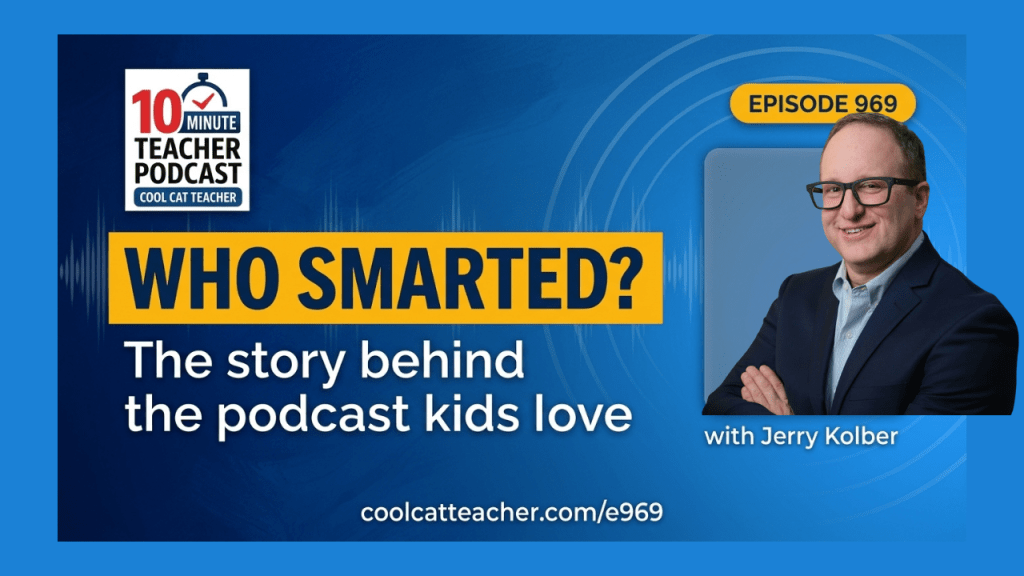
“Who Smarted?” OK, the name would make middle schoolers laugh. Yes, the topics might be gross to some of us adults. (Like who wants to talk about digestion even though probiotics seem to be the rage right now?) And yet, they cover topics that kids are learning, and if you’re a classroom teacher, you can sign up to listen ad-free. (And if you’re going to use this in the classroom, you need to take the ads off.)
In this show, we talk about the growth of the show, why human-created content is more important than ever, and how teachers are using podcasts to promote listening skills and screen-free learning and fun. Of course, as a podcaster, I think podcasts are great for transition time (so many people listen to this show in the car!). But transition time in the classroom is great for students. Also, search back episodes of the podcasts you love. When you have shows with a lot of content, there are great nuggets in the back catalog. I hope you enjoy Jerry Kolber talking about Who Smarted? Let’s learn!
…the AI demos I’ve seen are so cold. I mean, they are filled with misinformation, but they just also sound like a machine…
Jerry Kolber, creator of Brain Games (Nat Geo) and Brainchild (Netflix)
Table of contents
Listen to the Show

Watch this video on YouTube.Subscribe to the Cool Cat Teacher Channel on YouTube
Watch on YouTube and subscribe for new episodes every week.
Key Takeaways for Teachers from Jerry Kolber
Elementary students and middle schoolers. Get the ad-free classroom version.
- Building listening skills is important and screen-free is a great way to do this. Jerry says that teachers tell him they like to play episodes after they return from lunch or recess, or as the class shifts to the next subject.
- Question breaks. In the podcast, they run mini quizzes every three or four minutes. You can pause there and have students answer out loud. This builds listening, comprehension and brings teachable moments to the forefront as students ask questions. I love to encourage students to ask “good questions” (and every question is a good question except the one that was just answered – because if you repeat the one that was answered, you guessed it, you weren’t listening!)
- Co-listening is a great activity. Common Sense Media recommends this podcast as a great one for co-listening.
- Giving feedback. When a human makes a podcast, then you can offer feedback. If a bot creates a podcast, who fixes it? Right. But if a human makes one and you disagree or have another point, you can reach out and contact them. Even this point encourages students to understand the difference between bot-created and human-created content. There is a place and need for both, but humans have values and you can learn what to expect from them.
Pick one 15-minute episode (I’ve given you five great choices below to select from) and play it Monday as students come back from lunch. Don’t introduce it, don’t assign anything — just press play. When the show asks its multiple-choice question (it will, every three or four minutes), pause and have students hold up one, two, or three fingers for A, B, or C before you play the answer. Search back episodes to find one that is about current topics in your classroom.
Resources Mentioned in This Episode
- Who Smarted?+ free subscription for educators — The one to do first. Classroom educators get the ad-free version of the show free. Go to whosmarted.com, click Educators, and enter your school email (.edu, .k12, .org, .gov, or .schools). If your address doesn’t qualify, email WhoSmarted@WhoSmarted.com and they’ll help you sort it out.
- Who Smarted? — The main show. Short episodes on history, the human body, space, and whatever else kids are asking about, hosted by the Trusty Narrator.
- The Who Smarted? episode archive — Browse the back catalog by topic and find something that matches what you’re teaching this week.
- Who Smarted? on Apple Podcasts — Or search “Who Smarted?” in any podcast app. No subscription and no special app required.
- Atomic Entertainment — Jerry’s company, and home of Mysteries About True Histories (M.A.T.H.), the scripted series where two kids solve mysteries in their hometown using math, logic, and history. Worth a look if you teach math or social studies.
- The Anxious Generation: How the Great Rewiring of Childhood Is Causing an Epidemic of Mental Illness by Jonathan Haidt (Penguin Press, 2024) — The book Jerry references on screen time, anxiety, and depression in kids.
Clinicians at the Charlotte Speech and Hearing Center, a nonprofit that runs more than 2,000 screenings a year, now identify communication delays in about 38% of the preschoolers they screen — nearly double the pre-pandemic rate of 20–22%. Staff point to missed face-to-face interaction during the pandemic years, more screen time, and fewer chances for back-and-forth conversation. This is one organization’s regional screening data, not a national study — but it matches what a lot of teachers are describing. WCNC Charlotte, August 2026
About Jerry Kolber

Jerry is the creator of educational TV shows including Brain Games (Nat Geo) and Brainchild (Netflix). He and his company focus on making learning fun and accessible for everyone. His podcasts Who Smarted? and Mysteries About True Histories are used by families, teachers, and homeschoolers around the world to get kids engaged and excited about math, history, science, and more.
Connect with Jerry: AtomicEntertainment.com | LinkedIn | Facebook
Before you put any content in front of students, ask who you would email if it were wrong. If there’s a name on the other end, you have a correction path. If there isn’t, you’re the only quality check in the room — and you should read or listen all the way through before you press play. That test works on podcasts, on AI-generated worksheets, and on whatever comes next.
Kids Podcast and Listening Resources for Teachers and Administrators
As always, follow your district’s policy on what you play in class.
STEP 1: Get the Ad-Free Classroom Version First
Do this before you play anything for students. The public feed is free but ad-supported, and the ads are not aimed at children (more on that in the safety notes below). The educator version removes them.
- Go to whosmarted.com/educator
- Enter your school email — .edu, .k12, .org, .gov, or .schools addresses qualify
- You get a promo code back within seconds for Who Smarted?+, which is the ad-free tier plus bonus episodes, at no charge
- If your school email doesn’t end in one of those, email WhoSmarted@WhoSmarted.com and ask — they say they’ll try to sort it out for working educators
STEP 2: Pick Your First Five Episodes
There is no published “most popular” list, so I built this from what Jerry actually named on the show — food and human-body episodes are the runaway favorites — plus one the show itself labels its most requested. Every link opens the full episode with a transcript on the page, which is useful if you have readers who need to follow along.
- Where was the first School? — Start here in August. Compulsory education, one-room schoolhouses, a boat school in Bangladesh, a kindergarten in Germany shaped like a giant cat. Perfect for the first week when you’re building routines anyway.
- How are Pickles made? — The food category Jerry says always wins. Fermentation, food preservation before refrigeration, and a real pickling recipe kids can do at home with an adult.
- What causes a Geyser? — Earth science with pressure, steam, and tectonic plates, wrapped around a true story about 1877 tourists washing their laundry in Old Faithful.
- What events were in the very first Olympics? — Ancient Greece, the city-state truce, and where the Olympic rings actually come from. Good social studies tie-in.
- Why is Roblox our most requested episode? — The show’s own title tells you how often kids asked for this one. Hand it to the student who says podcasts are boring.
Browse the rest at the full episode archive. That back-catalog point is the one I’d underline from this episode — with a library this size, there is almost certainly something that lines up with your current unit.
STEP 3: Build the Listening Routine
An episode playing is not the same thing as students listening. Here are some tips to encourage listening skills:
- Use it at a transition, not as a lesson. Coming back from lunch or recess, or the shift from one subject to the next. You are replacing noise, not adding a block.
- Stop at the question breaks. The show asks a multiple-choice or true/false question every three or four minutes. Pause it. Make students answer out loud or show fingers for A, B, or C before you press play. That is the whole intervention.
- Let them hear it more than once. Replaying an episode later in the week costs you nothing and might be something to do for your more popular episodes or if a lot of students didn’t catch something.
Tool Safety Notes
Here’s what you’ll want to know about this podcast from resources you trust.
- Common Sense Media rates Who Smarted? age 6 and up and gave it a Common Sense Selection award. Their reviewer flags exactly one content item: mild potty humor. Violence, language, sexual content, and consumerism are all marked not present. They also call it “co-listening at its best,” which is the same thing Jerry says he designed for. Read the full review.
- ⚠️ The free public feed carries advertising, and it is not kid-targeted. In several current episodes, the ad breaks included a children’s debit card and money app, a language-learning subscription, a website builder, a tutoring subscription, and a personal-finance podcast about couples arguing over money. None of that is inappropriate, exactly — but it is adult marketing, some of it financial, playing to a room of eight-year-olds who cannot opt out. This is the practical reason to get the educator version before you play anything in class.
- Episodes run about 16 minutes according to Common Sense Media’s listing, so plan for a little more than the fifteen minutes. I’m not going to criticize on that one (ahem, someone paying attention will get why I say that.) Their short “Trusty Trivia” episodes run closer to six or seven if you need a smaller block.
- No account is required for students. Kids never sign in and never enter anything. You play it; they listen. That keeps this well clear of most student-data questions.
Resources for Building Listening Skills
Listening is the one language domain we test and almost never teach directly. A few other places you can wbuild listening skills worth knowing about:
- Listenwise — Podcast and video lessons for grades 2–12 built specifically around listening comprehension, with auto-scored quizzes, interactive transcripts, and standards alignment. Strong for multilingual learners. It’s a paid platform with a free trial, and it carries ESSA Level IV evidence validation — worth knowing if you’re the person who has to justify a purchase.
- ASHA: Typical Speech and Language Development — From the American Speech-Language-Hearing Association. The Communication Development: Kindergarten–5th Grade page is the one to bookmark; it tells you what listening and comprehension should look like at each grade, which is what you need before you decide a student is “not paying attention.”
- Common Sense Media podcast reviews — Age ratings and content notes for hundreds of kids’ podcasts. Check here before you queue anything new for a class.
Other free kids’ podcasts worth a listen
If Who Smarted? lands with your students, Common Sense Media rates these in the same neighborhood: Brains On! (science, age 8+), But Why: A Podcast for Curious Kids (age 6+), Tumble Science Podcast for Kids (age 7+), Forever Ago (history, age 5+), and NASA’s Curious Universe (age 7+). Rotate them so listening time doesn’t become one more thing that feels the same every day.
Go deeper on screens and young learners
- The Anxious Generation by Jonathan Haidt (Penguin Press, 2024) — the book Jerry names on the show.
- Why more kids are struggling to communicate — Clinicians at the Charlotte Speech and Hearing Center, a nonprofit running more than 2,000 screenings a year, now identify communication delays in about 38% of the preschoolers they screen, up from a pre-pandemic 20–22%. One organization’s regional screening data rather than a national study — but it matches what a lot of us are seeing walk through the door.
Other Shows for Elementary and Middle School Teachers
- Smart Ideas for Teacher Prep, Reading, Writing, and Screen-Free Fun — Cool Cat Teacher Talk Season 3, Episode 9. Jerry’s original conversation aired here alongside Dr. Jacob Kirksey, Malia Hollowell, and Nancy McCabe.
- Brain Friendly Reading Strategies That Actually Work — Malia Hollowell on science-based reading strategies for young learners.
- Cool Cat Teacher Talk — My radio and TV show, on YouTube and stations across the country.
Listen and Subscribe
If this episode gave you something you can use Monday, share it with a teacher friend who needs a better transition routine.
Episode Transcript
This transcript was generated using AI and has been reviewed by humans for accuracy. Minor errors or artifacts may remain but I worked my best to find any issues with the transcript as I reviewed the show. – Vicki
Click to read the full transcript
Disclosure of Material Connection: This episode includes some affiliate links. This means that if you choose to buy I will be paid a commission on the affiliate program. However, this is at no additional cost to you. Regardless, I only recommend products or services I believe will be good for my readers and are from companies I can recommend. I am disclosing this in accordance with the Federal Trade Commission’s 16 CFR, Part 255: “Guides Concerning the Use of Endorsements and Testimonials in Advertising.” This company has no impact on the editorial content of the show.
The post Who Smarted? Why Human-Made Kids’ Media Still Beats the Bots appeared first on Cool Cat Teacher Blog by Vicki Davis @coolcatteacher helping educators be excellent every day. Meow!
If you’re seeing this on another site, they are “scraping” my feed and taking my content to present it to you so be aware of this.