Peak dahlia season is almost here, and I want to share a recent field trip with you to The Dahlia Daughters, a small Connecticut flower farm. There is still something right about a universe where you can contact someone OUT OF THE BLUE, ask to see their garden, and they say yes.
After picking up a delightful bouquet of dahlias from my local farm stand, I noticed the farm behind this bouquet was right around the corner.

I found the farm on Instagram and dropped into their DMs. (To be fair, I do have a public profile. With a few quick clicks, it’s clear I’m a stalker of flowers and fun, not people.) That being said, Allison Chase, the farmer behind The Dahlia Daughters, answered my DM promptly and agreed to give me a tour.
I drove over to Allison’s farm on a sunny Thursday afternoon. Most people I know think of Sharon, Connecticut, as a place full of gentlemen farmers who made money in the city and came north to chill in wide-open spaces. But in reality, it’s full of locals who grew up here, with farms and small businesses, and who are the backbone of the community.
The locals aren’t in the business of scaring off newcomers. They’re proud of their towns and what they produce. And while they welcome the weekenders, they aren’t looking to turn passion projects into scalable startups. They seem comfortable doing things that make them happy, connect them with neighbors and spark joy—whether that’s a small farm stand selling zucchini run by a teacher or a business growing sunflowers as a side hustle from building.
There is joy in the process, not the profits.

A Generational Project
When Allison met me at her front door, it was immediately apparent that she was proud of her flowers and had a real passion for sharing her knowledge.
Like Allison, I’ve inherited my love of flowers from my mom. My parents fawn over roses and peonies, but for Allison’s mom, it was the dahlia. I have always loved the shape and careful intensity of the dahlia. (Fun fact: The dahlia was named for Swedish botanist Anders Dahl.)
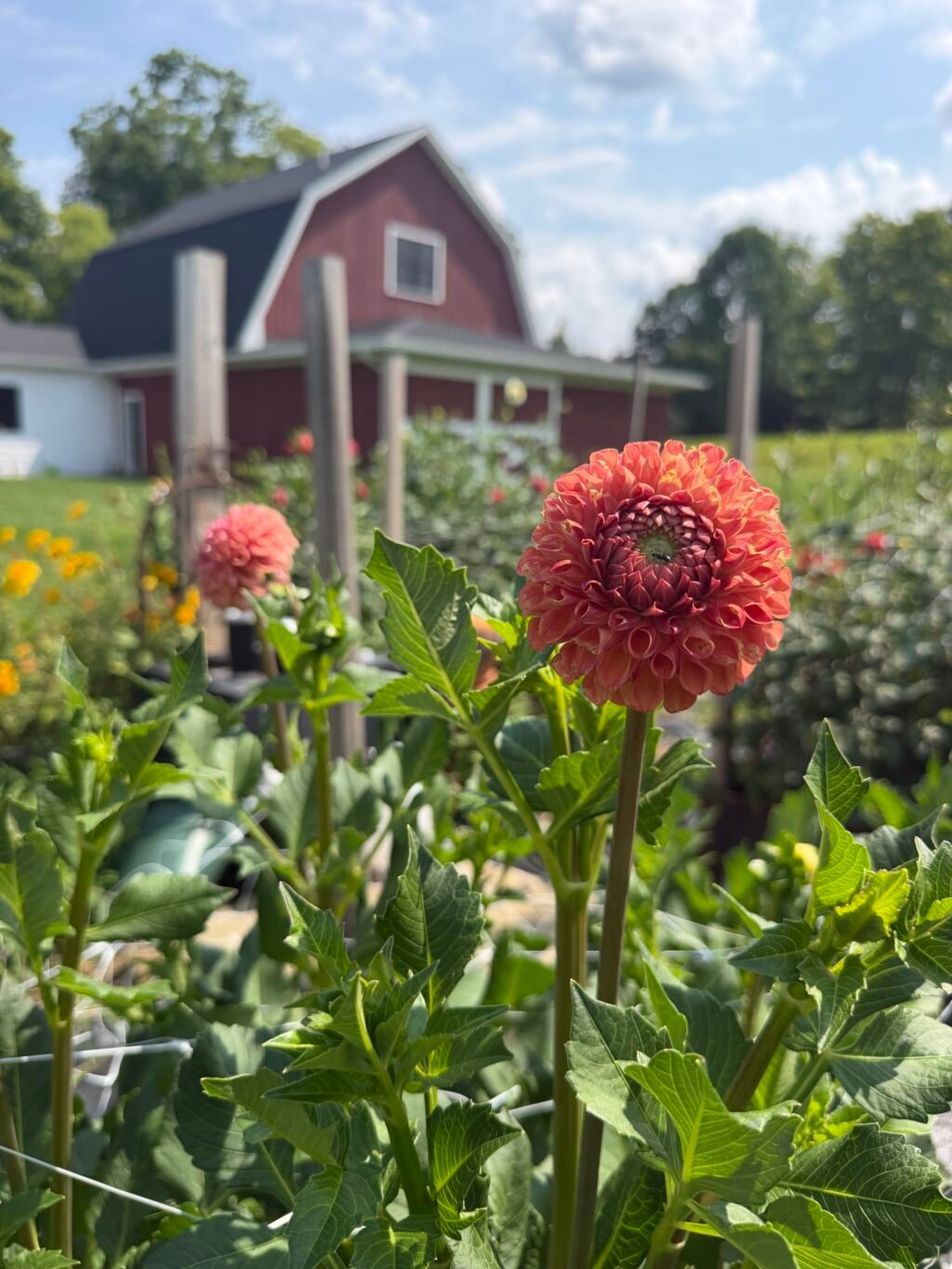
Like many other flowers, the dahlia has depth and character. There are tens of thousands of named dahlia varieties in an extraordinary range of shapes and sizes (see below for a few new favorites). If you love a horticultural rabbit hole–you’ve stumbled on a good one.
Allison’s mom definitely got the “bug.” Over the years, Allison’s mom grew her collection of tubers into the thousands. From my afternoon chat with Allison, it seemed that, as a daughter, she observed her mom’s operation from a distance. Allison opted to pursue work that took her away from the farm (she still holds down her job as a risk officer at a Connecticut bank) but after her mom passed in 2020, something shifted.
Allison inherited all those tubers.
Thousands of the potato-like plant “seeds” sat in the basement, ready to be planted and transformed into the hearty and beautiful flowers that stopped me in my tracks at my local farm stand. To honor her mom (and get through COVID), Allison planted the flowers and resurrected the raised beds on the family farm.
And the planting process stuck.

The Dahlia Daughters Today
No, Allison doesn’t maintain the thousands of tubers that her mom did. She downsized the operation to the hundreds, but she’s managing this side hustle out of joy and as a way to honor her flower heritage.
She works with florists and a local shop, runs her own little farm stand and, every year, begins the process all over again.

How Dahlias Grow
In the spring( in Northwest Connecticut, this is around the first week of May, so mark your calendars), Allison covers her 25 raised wooden flower beds with black plastic tarp and places the tubers in cut-out sections.
Once planted, there’s not much to do. The tarp keeps weeds manageable, and the plantings don’t need much water during their first stages of growth.
Once they’ve sprouted and start to shoot up, it’s time to get the plastic netting up. Fitted between four stakes, the netted grid helps keep the flowers from flopping over under the weight of their heavy heads.
Right around the Fourth of July, Allison starts to see the first blooms. When the blooms start to appear, it’s time to up the watering. But these flowers demand patience. It’s not until August that things start to get lively. Then, in late August and early September, the blooms explode.
If you’ve got an early fall wedding, this might be the perfect flower to pick.
At the end of the season, Allison digs up the roots, rinses the tubers and stashes them in the basement until the next spring. A single plant can produce 30 tubers, and Allison sells tubers (which she says look like small potatoes) in the spring, too. (Be sure to follow her on Instagram.)
Naturally, I went home and down a tuber rabbit hole. A tuber is a thickened underground part of a plant that stores water and nutrients. Think of it as the plant’s pantry, helping it survive winter and grow again in spring. Each viable division needs part of the original stem, called the crown, containing at least one “eye” that can produce new growth. Unlike a bulb, which has distinct layers, a tuber is solid inside. Yeah, probably more than you needed to know.
A Few Growing Tips
The science of the tuber might not intrigue you, but these helpful tips could be more useful. One of Allison’s recommendations is Alaska Fish Fertilizer for Plants.
She also uses molasses in her dahlia-growing routine. A commonly shared soil mixture is:
- 2 tablespoons unsulfured molasses
- 1 gallon of water
Dissolve the molasses in a little warm water, add the remaining water and apply it to the soil around the base of the dahlias about every three weeks during early summer. This is a soil treatment, not a spray for the flowers or leaves.
Why I Love Dahlias
The flower looks ridiculously architectural.
The layered blossoms have incredible depth and geometry, and the color arrays are intense and varied. A dahlia “flower” is actually made up of many tiny flowers called florets. They remind me of the Sydney Opera House and the Oculus in downtown NYC.
While the symmetry is stunning, the variety of hues makes them even more captivating. From dusky sunset colors to showy pinks, these flowers won’t be ignored.
And that’s where the fun comes in. A garden can be a collection of varieties that offers incredible visual appeal. And just like a garden, a bouquet can be a mix of colors, shapes and textures.
Then there is the generosity of the flower itself: Cutting dahlia flowers encourages the plant to produce even more blooms.
So when they’re in bloom, cut a bouquet for yourself and your friends. Don’t be stingy.
The more you give, the more you get.

Then There Are the Names
This might be where my full-blown dahlia obsession begins.
Pooh. A cheerful collarette dahlia with red-orange outer petals edged in yellow, a sunny yellow inner collar and an open center. The warm colors call to mind the famously honey-loving bear from A. A. Milne’s books. Blooms are typically about 3½ inches across and are attractive to pollinators.
Hissy Fitz. Produces bright-yellow, roughly 6-inch blooms with dramatically fringed or “shaggy” petals. Strong stems make it a reliable cut flower.
Cornel Bronze. This popular ball dahlia produces compact, nearly spherical blooms in glowing copper, bronze, burnt orange and caramel tones. The 3½- to 4-inch flowers have sturdy stems and an excellent vase life.
Penhill Watermelon. This spectacular dinner-plate dahlia produces enormous, loosely ruffled blooms in watermelon pink, coral and peach, sometimes with soft yellow undertones. Flowers can approach 12 inches across and often vary slightly in color.
Café au Lait. One of the best-known dinner-plate dahlias, with large informal decorative blooms measuring approximately 6 to 10 inches. Its famously subtle coloring can shift among ivory, champagne, blush, peach and dusty rose—even on the same plant.
Hulin’s Carnival. This formal decorative dahlia has approximately 4-inch white blooms splashed, striped and speckled with red, pink or burgundy.
Peaches-N-Cream. Tidy, 3- to 4-inch formal decorative blooms brushed and streaked with peach, pink and creamy white. No two flowers display exactly the same markings.
Now I want to plan a full raised bed. And here’s one more tidbit my research unearthed: In the language of flowers, dahlias can symbolize strength, creativity, elegance and lasting commitment.
Where to Find The Dahlia Daughters
Allison works with florists, one local shop (my favorite, Paley’s) and manages her own little farm stand. Her mason jar bouquets hold about half a dozen stems and go for $10, while the large bouquets are $20.
It’s not unusual to see a driver make a very sharp U-turn on Route 41 when they spot the stand—and it’s also not unusual to see the stand empty very early in the day due to the high demand for these gorgeous flowers.
The Dahlia Daughters
Allison Chase
229 Amenia Union Road
Sharon, Connecticut 06069
Follow The Dahlia Daughters on Instagram

The post The Dahlia Daughters: Inside a Connecticut Flower Farm at Peak Dahlia Season appeared first on Mom Trends.