
From the Cool Cat Teacher Blog by Vicki Davis
Subscribe to the 10 Minute Teacher Podcast and Cool Cat Teacher Talk anywhere you listen to podcasts.
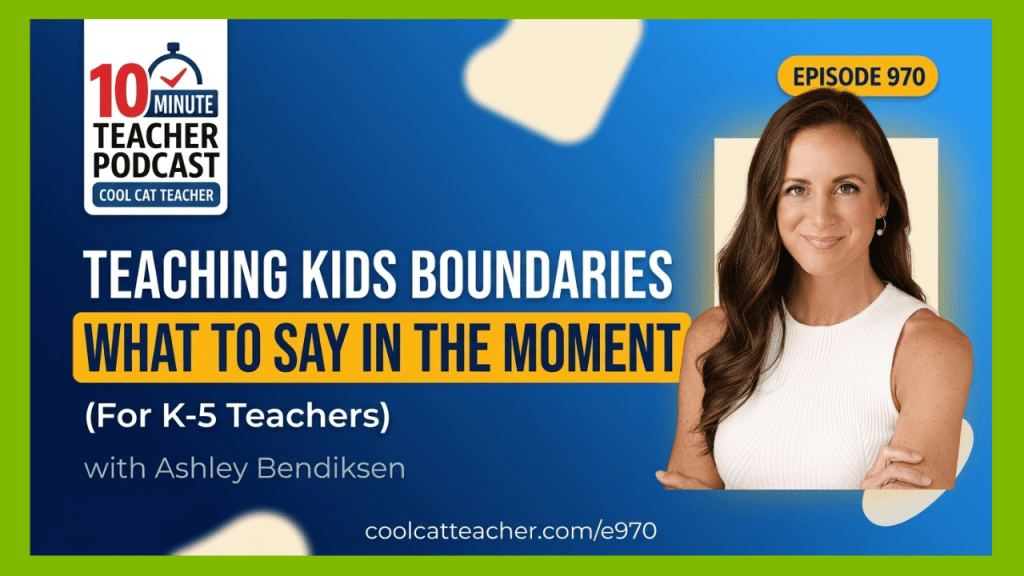
Boundaries. I wish I had learned more earlier. How to say no. How not to be steamrolled. How to be more sensitive to others when I was not listening. All these things. Today’s guest, Ashley Bendiksen, has moved from reactive counseling to prevention of trauma by writing a book that caregivers and parents can read with children about boundaries.
Sponsored: Ellis, a program of Children’s Health Council, sponsored this podcast episode. All opinions are my own and that of the guest. Ellis pulls from a knowledge base on content from trusted partners like CAST, CASEL, Understood and others, and gives you evidence-aligned ideas for students who are struggling with learning, behavior, or the emotional side of school (but not clinical advice).
If you’ve got a student (or two) who you can’t stop thinking about, try it and see what it brings you. No personally identifiable student information is collected, and it is a much better place to start than “brainstorming” with your general-purpose AI chat tool. Try Ellis today.
She also rehearses words we can use with kids as we work to help kids learn not only how to “get along” but how to respect each other. And yes, of course, we talk about teacher boundaries too. Many of us teachers struggle with pleasing and not saying no. (This took me at least 15 years to learn how to do wisely and well and it was 15 years too long!) So, this conversation will help teachers of all ages but especially those working with littles. It will be useful for parents as well.
This conversation touches on dating abuse and domestic violence. If you or a student needs help right now: the National Domestic Violence Hotline is 1-800-799-7233 (TTY 1-800-787-3224). For teens and young adults, love is respect is 1-866-331-9474, or text LOVEIS to 22522. Both are free and available 24/7.
Listen to the Show

Watch this video on YouTube.Subscribe to the Cool Cat Teacher Channel on YouTube
Watch on YouTube and subscribe for new episodes every week.
Key Takeaways for Teachers from Ashley Bendiksen
- Boundaries are not just physical. They can be emotional and social too. Interestingly, Ashley says that teens who hear her dating violence talk come up afterward and say, “Can your best friend do these things?” Well, if you have a friend who always says what everyone will do and has an overcontrol issue over your life, possibly.
- Learn the words to use. Sometimes kids need to know the words to use. Ashley talks about “micro-moments” such as mentioning to a child “did you ask first” or “make sure you tell them that you don’t like that.”
- Respecting boundaries in addition to expressing them. Sometimes kids (and adults) can steamroll another person. We need to be sensitive to the boundaries of others when they express them to us. (As a mom of adult children, I’m super sensitive to this one.) This is something we can teach at a younger age.
- The boundaries we teachers struggle with…. We, teachers, know that our jobs can be super high-burnout. In my 24-year career, it took me a good 16 years to learn to express my own boundaries with my administrators. As Ashley says, “no” is a complete sentence. (But it can be hard to learn to say it wisely, well, and respectfully.)
Today’s show is one to talk about with others and with students. One thing we can do to help children is to give them the language to use by picking a few “low stakes” scenarios before they might happen. Some examples are:
- “Someone wants to look at your homework”
- “Someone wants to always pick the game that is played,” or
- “You feel like people don’t listen to you.”
For Blended Learning Environments: The beginning of the year is a good time to make sure you include your boundaries in your class newsletter or an email home. Something I would say was:
All assignments are due at 8 am or at the end of the school day. If you’re having trouble turning in work or have questions, email as soon as you have a problem (so there’s a timestamp showing you didn’t wait until the last minute), but remember, I’ll reply on the next weekday. You can also come to school early – I’ll be there at 7:30 to help anyone who didn’t have internet at home.
What are your boundaries? Have you been clear with parents and others about when you’re available to help?
If you have challenges at home.
When I was caring for my Dad in his last days, I created several emergency lesson plans for each class. I never knew when I would be back. I had them ready to go and on my desk each day when I left school. I made sure my principal and the admin team knew they were there and that, if something unexpected happened, they could use the emergency lesson plans without having to call me. I also had a block in Google Classroom called “emergency lesson plans” that were ready to go. That way, I could log in and hit publish, and they were ready, and I didn’t have to remember. Sometimes planning ahead like this can really help reduce the stress of worrying about your classroom. I lived this last year, and this really helped me draw boundaries so I could be there for Dad. Here’s my substitute teacher manual you can fill out for yourself on Tpt if you want a copy.
Resources Mentioned in This Episode
- A Kids Book About Boundaries by Ashley Bendiksen — written for children ages five to nine, meant to be read with an adult. Lots of white space, few illustrations, built for step-by-step conversation rather than a read-aloud. Also on Penguin Random House.
- A Kids Book About — the series Ashley’s book belongs to, covering topics from anxiety to belonging in the same adult-and-child format.
- Boundaries: When to Say Yes, How to Say No by Dr. Henry Cloud and Dr. John Townsend — the adult book I open the show with, and the one that helped me most as a teacher.
- ashleybendiksen.com — Ashley’s speaking programs for schools and youth organizations, first responders, and workplaces.
- What Every Teacher Needs to Know About Teen Dating Abuse — Ashley’s first appearance on this show, episode 534, July 31, 2019.
- The National Domestic Violence Hotline and love is respect — the teen dating abuse helpline, a program of The Hotline.
About Ashley Bendiksen – Bio as Submitted

Ashley Bendiksen is an acclaimed national speaker, award-winning activist, and survivor-turned subject matter expert in domestic violence, teen dating violence, early intervention, and trauma resilience. She supports diverse audiences nationwide — uniquely specializing in working with schools and youth-serving organizations to address risks, prevent harm, empower students, and equip caring adults with the skills to provide trauma-informed care.
Ashley’s personal lived experience is supplemented by extensive professional work across the criminal justice system, victim services, primary prevention, policy, and advocacy spaces. Ashley is also the founder of a global storytelling platform for survivors and co-founder of Island Youth Coaching, an organization specializing in supporting adolescents and youth-serving nonprofits.
Ashley is also the author of A Kids Book About Boundaries — a practical and powerful book for school-age children and caring adults, teaching boundary-setting, communication, and self-advocacy skills.
Connect with Ashley: ashleybendiksen.com · LinkedIn · Instagram · Facebook · YouTube
Other Shows for Elementary Teachers and Counselors
- Cool Cat Teacher Talk, Season 6 Episode 6 — “Helping Kids Through Tough Situations.” Ashley’s full conversation aired here first on radio and TV, alongside two other guests, on the theme of reaching every child.
- What Every Teacher Needs to Know About Teen Dating Abuse — Ashley’s first appearance (episode 534, July 2019), on the signs teachers miss.
- How to Make Schools Safer and Build Positive School Relationships
- How to Help Students and Schools Through Traumatic Times
Listen and Subscribe
If this episode gave you one thing to try tomorrow, share it with the teacher down the hall.
Episode Transcript
This transcript was generated using AI and has been reviewed by humans for accuracy. Minor errors or artifacts may remain but I worked my best to find any issues with the transcript as I reviewed the show. – Vicki
Click to read the full transcript
Announcer (00:22): This is the 10-Minute Teacher Podcast with your host, Vicki Davis.
Vicki Davis (00:00): In his book, Boundaries, Henry Cloud says the most basic boundary-setting word is no. But how do we help our younger children set those boundaries? Today’s guest, Ashley Bendiksen, teaches us how to help younger kids set boundaries in class. Happy Motivational Monday. This is episode 970.
Vicki Davis (00:27): Today’s show is sponsored by Ellis. A free tool from Children’s Health Council that helps teachers think through tough student moments and find practical next steps. Tune in at the end of the show, and I’ll tell you more about Ellis.
Vicki Davis (00:45): Today, we’re welcoming back Ashley Bendiksen, an expert in abuse prevention and trauma resilience. She was on this show back in 2019 talking about teen dating abuse that we’ll include in the show notes.
She just wrote A Kids Book About Boundaries, published by Penguin Random House. It teaches children the communication and self-advocacy skills, if you ever wished, there was a way to help kids understand boundaries before they’re in crisis. This is the conversation for you.
Ashley, what happened in these seven years since we talked that led you from awareness to prevention?
Ashley Bendiksen (01:29): Part of my belief is that early intervention is the strategy. It’s great if I can reach students and people who have already experienced these issues. But the big question is always, how can we prevent this? And I don’t think that always necessarily means having these big, heavy, complex conversations, but instead teaching those tiny micro empowering life skills that can help us in situations where we need to use our voice.
So certainly in my field, talking about dating violence or unhealthy relationships, even if that’s unhealthy friend relationships as a teen, learning as a child how to use your voice, how to recognize what doesn’t feel comfortable, that’s really preventative and really empowering. So it was a no-brainer for me to publish a book that reached kids even younger than my typical audience.
Vicki Davis (02:16): Ashley, you’ve talked very openly about your dating abuse situation on the Crime Junkie podcast. When that wonderful, loving, great relationship took a dark turn, how would you have acted differently if you had read this book?
Ashley Bendiksen (02:31): It sounds silly as an adult, but as a kid, and this is a very common experience, I didn’t know that I had a choice when things happened to me. I had a very limited sense of agency in my life, and so I thought I had to navigate what life threw at me. The idea of speaking up, expressing a boundary, saying no, and not just trying to be compliant or avoid conflict or just people please, I was very foreign.
I think I just didn’t realize I had a voice. And just knowing that I could simply even say the word no, period, as a full sentence, really would have helped me, I think, in those early moments where I kind of sensed that something was wrong or that this person was changing. I could have stopped it so much sooner had I just had the skills to speak up and communicate in those moments.
Vicki Davis (03:16): So what was the light bulb moment that made you think, hey, we need to start having this conversation before kids go in crisis?
Ashley Bendiksen (03:23): I think a lot of my work certainly was born out of my own self-discovery, right? Part of healing from trauma or abuse or any challenge in life, you look back and you ask a lot of questions. What could have been done differently? So it was certainly something that started as a personal reflection. But now that I’ve been speaking in schools for, my goodness, nearly 18 years, it’s just become so evident that this is a huge piece of the puzzle.
Vicki Davis (03:47): So you really encourage kids to read this with their caregiver. Like, what’s your ideal scenario for how young could kids be to read this book, and how should parents, caregivers, teachers approach this?
Ashley Bendiksen (04:02): This book is part of a best-selling kids’ book series called A Kids Book About, an incredible collection of books on all different topics. They are all kind of written from that same approach. It’s meant to be read between an adult and a child.
It’s a great read for an adult to sit down, go page by page. There’s lots of blank space, not filled with tons of designs and illustrations. It’s very much meant for clear, communicating, step-by-step conversations and leaving room for those nuanced questions in between, which is really helpful because I think not only are you teaching the child who is listening to the book or reading with their caregiver, but also parents and caregivers are adopting some language that they can use to teach these mini lessons and these skills around boundaries, because many adults don’t really know how to navigate this topic either. I think it’s really helpful for both of them. Hopefully the book becomes the beginning of ongoing conversations, ongoing reinforcement, and they can pick it up as the child gets older too.
You had asked about the ages. It’s written for young people aged five to nine. So this is for that elementary level. Believe me when I say I painstakingly wrote this, thinking about every single word. Will a child understand this? Will this makes sense to them? Is this example relevant? So it’s super kid-friendly. But again, these become those transformative skills that they can apply in different ways and contextualize as they get older throughout life.
Vicki Davis (05:28): Ashley, I came across Henry Cloud, who writes a lot of adult book on boundaries. But teaching boundaries is important. And it’s not just, don’t touch me here or there. I had a friend in college who I had to break off the friendship because she wanted to always say where we would go eat, who I could be friends with, and was really trying to control everything about my life. And it took me a while to open my eyes to that.
So what do you want a kid to feel after they read this book that will help them carry forward to circumstances later in life like mine or like yours?
Ashley Bendiksen (06:02): It’s definitely something I hear often among teens. I mean, when I give the dating violence talks, they’ll come up and say, can your best friend do these things? It absolutely applies to all people, all relationships, all scenarios.
And one of the things that I teach in the book is that boundaries are not just physical, they’re emotional too. And we can set these emotional boundaries where we speak up when people say or do things or treat us in ways that make us feel uncomfortable or even unsafe in some way. Those are dynamics where it matters just as much as the physical scenarios where you need to use your voice and speak up because obviously young people are learning to develop their sense of self, their sense of identity, and not just adopting what their friends want or becoming who other people want them to be. It’s really powerful to protect themselves, but also protect their sense of self and authenticity and autonomy.
Vicki Davis (06:54): What do you think the biggest misconceptions that parents and teachers have about helping kids understand boundaries?
Ashley Bendiksen (07:02): Simply that it’s some big, heavy, complex topic, that it’s about physical contact. The misconception is that it’s this mammoth issue and many people don’t really know where to begin or where to start. But really, teaching boundaries is a simple, sustainable approach. It’s something teachers can do in very small ways in the classroom. It’s something parents can do on a regular basis.
And it’s really just kind of using those micro moments to teach what boundaries are, reinforce the fact that a child has choice in certain situations, giving them two options, giving them language. Like, if you don’t like that, you can say, I don’t like that. And it’s just those little moments when repeated that really make a big impact. So it’s not about needing to know all about boundaries or adding this whole extra lesson into your lesson plan. It’s just about those small daily moments that reinforce these skills.
Vicki Davis (07:55): So Ashley, I’m sure some teachers are listening to this thinking, my students need this. Is there a boundary building activity they can do in their classroom like this week?
Ashley Bendiksen (08:04): As far as activities go, kids love role-playing. When I do workshops with students, they love a scenario. They love talking it out. They love reading a script and practicing these phrases. And I think that’s probably one of the biggest barriers that young people face is that they don’t always have the words, the language to communicate things.
So I think a simple thing that teachers could do this week is look up some scenarios, create some, have the students help create the scenarios, and then have them discuss and kind of practice what might you say if you didn’t want to play that game or you didn’t want to let someone look at your homework. That’s a fun activity and one any teacher can do.
Vicki Davis (08:42): So often, we teachers, we just want everybody to get along, right? And so you have the kid who always tells everybody else what to play, really fusses if they don’t get their way. When we gloss over it and don’t help with that boundary-setting activity. Sometimes we have to pause. Sometimes we have to have those conversations when we see that there is a dominant student, for everyone’s sake. That’s not always an easy thing to do.
Do you think sometimes we send the wrong message, just trying to help everybody to get along? Oh, let’s just go along with what so-and-so wants because they’re a pain, right? When they don’t get their way. Like, that’s not the message we want to send.
Ashley Bendiksen (09:22): I agree. And it’s certainly not helping that child as well. That’s the other side of this whole coin — is it’s not just teaching young people to express boundaries, but respect boundaries as well.
This doesn’t mean you have to pull that dominant student aside and have this whole coaching moment or lesson with them. But we can just say things like, hey, let’s pause. Did we ask first before we grab their pencil? Let’s give them a moment to finish. Or little things that we can say to call out — I don’t know, you just, that was a little disrespectful where you just talked over your classmate, or maybe your classmate doesn’t want to play that game. So it’s just those little micro moments, again, of just reinforcing classroom norms, norms of respect and how it goes both ways.
Vicki Davis (10:03): One of the things about teaching is it’s high burnout. You know that. It bleeds over into our lives. Like, that’s why I think the Boundaries books helped me so much, because as a teacher, it’s so hard to have boundaries.
Ashley Bendiksen (10:16): It certainly is. Physical boundaries, time boundaries, tech and digital boundaries, emotional boundaries. When you’re working with kids that are challenging, you’re right, it can feel really hard. And suddenly you wake up one day and realize that you don’t have a boundary line at all with anything.
As some advice, don’t be too hard on yourself for that. It’s not necessarily because you’re not practicing enough self-care. That is just the system you’re in. Sometimes it doesn’t support you to have boundaries, but I think in those moments of awareness, that’s when we just course correct a little bit and maybe just set one small boundary where we re-communicate to the kids and the parents that you don’t answer emails after a certain time of night. Realizing that you really need to just do something for yourself Saturday morning and scheduling it in. So it’s just one small thing at a time.
Vicki Davis (11:06): We had a boundary setting conversation after COVID and we said, hey, all our assignments are going to be due at either 8 a.m. the next morning, the end of class or the end of school. We’re not going to have any assignments due at midnight for boundary reasons for both kids and for teachers.
I could just feel everybody relax when we openly said, OK, this is a boundary. We all need to have a personal life. We shouldn’t apologize for that advocacy. See. Now, sometimes we all get in situations where the boundaries do blur. If we’re always saying yes, and we’re not setting boundaries, we’re not setting boundaries. We’re not setting, then does that model what we want our students to do?
Ashley Bendiksen (11:44): We are constantly modeling behaviors for the young people around us. So that is a big piece of it. Some people might feel their school or their administration doesn’t support their ability to take breaks, practice self-care, set boundaries. And maybe that’s a conversation to have too, but it starts with, again, at any age, using your voice, expressing how you feel, seeing what you can do, and then just taking it one step at a time from there.
Vicki Davis (12:07): Ashley Bendiksen, thank you for coming on the show.
Ashley Bendiksen (12:09): Thank you, Vicki.
Vicki Davis (12:10): Thank you, Ellis, for sponsoring this week’s shows on the 10-Minute Teacher. Ellis is a free tool for K-12 educators from the Children’s Health Council. Here’s how it works. You type in what actually happened with a student, what you saw, what you already tried, and where you’re stuck. Then Ellis gives you practical, evidence-aligned next steps from a knowledge base of content from trusted partners like CAST, CASEL, Understood, and others.
Ellis gives you information, not clinical advice, and it doesn’t collect personally identifiable student information. It’s a far better place to start than general purpose AI tools because Ellis isn’t pulling from the open internet. So the next time you leave school still thinking about that one student, go to coolcatteacher.com forward slash Ellis. That’s CoolCatTeacher.com forward slash Ellis, and it’s free.
Vicki Davis (13:15): Thanks for tuning in to the 10 Minute Teacher Podcast. Watch the video version of this podcast and catch my new radio and TV show, Cool Cat Teacher Talk, on YouTube and a radio or TV station near you. Join my Cool Cat Teacher Classroom Matters newsletter at CoolCatTeacher.com forward slash newsletter. Leave a review if you found this helpful. See you later, educator.
Disclosure of Material Connection: This is a sponsored episode and blog post. Ellis, a program of Children’s Health Council, has compensated me to share information about Ellis. However, all opinions expressed are my own. I have personally reviewed these resources and only recommend tools I believe offer genuine value to classroom teachers. My endorsement is limited to the educational products and services discussed in this episode. This post also includes some affiliate links to books; if you choose to buy, I will be paid a commission on the affiliate program, at no additional cost to you. I am disclosing this in accordance with the Federal Trade Commission’s 16 CFR, Part 255: “Guides Concerning the Use of Endorsements and Testimonials in Advertising.” The sponsor has no impact on the editorial content of this show.
The post Teaching Kids Boundaries: What to Say in the Moment appeared first on Cool Cat Teacher Blog by Vicki Davis @coolcatteacher helping educators be excellent every day. Meow!
If you’re seeing this on another site, they are “scraping” my feed and taking my content to present it to you so be aware of this.