
If I had to pick my best moment in The French Room, it’s this live class; I shared my favorite French phrase I’d learnt that week: tant qu’à faire (might as well…).
I was nervous before the session. Ellie, the founder and instructor, had asked us to understand the term “faire” (to do), and build sentences with it. Since I was new to the word (and was short on time), I’d just copied “aesthetic-sounding” sentences from her notes in my Cahier.
By the end of the live class, everyone in the session was excited to use “tant qu’à faire”.
Et voilà!
I hadn’t expected joy when I signed up for The French Room. In fact, I remember doubting my decision. It promised to teach me just one French word/phrase a month, and I’m an impatient person.
Turns out language learning isn’t supposed to be structured, linear, or quick. And just a month at The French Room was more effective than the apps or my school that taught me German for three years!
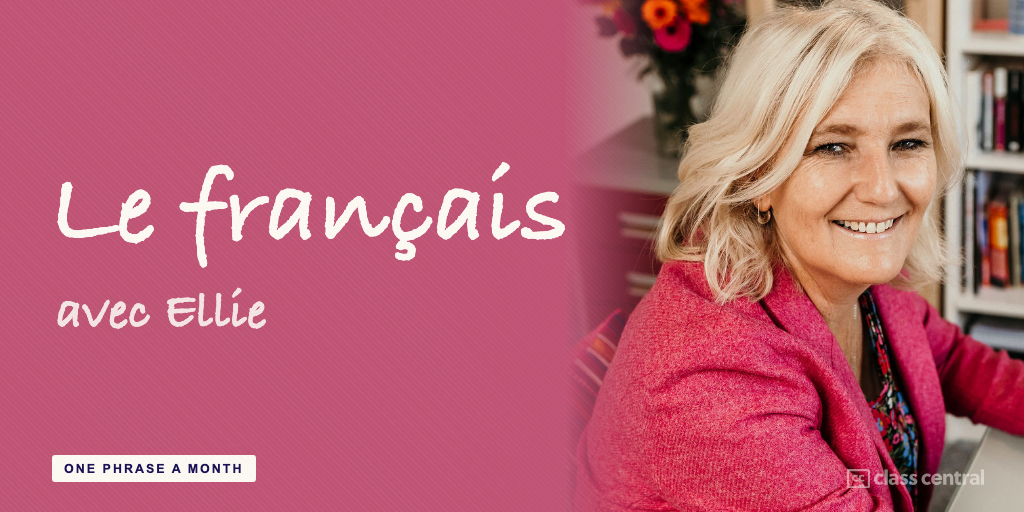
Ellie, The English Woman Who Became a French Master
There’s a reason why Ellie’s students stay with her for years!
You’ll come across her videos on the website, but I’d highly recommend meeting her in a live session because her love for French is uncanny.

“I wanted to do French at university, but didn’t have the grades. So I did economic history at the University of Sussex. The minute I graduated, I got the opportunity to go to France,” said Ellie. “I got offered a job as a humanitarian aid worker in a war zone with a French organization, and funnily enough that’s where I really learned French, because all the people around me couldn’t speak English.”
Ellie couldn’t leave French and vice versa. She became a wine buyer at Tesco, worked for a big Switzerland-based pharmaceutical company, worked with the government, then got into project management, logistics, and change management; basically all sorts of things.
Finally, she thought: what if teaching French was the real deal?
She started offering French lessons to adults at the secondary school near Cambridge, then gave private lessons, heading to students’ home or them coming to her. After six years of teaching offline, Ellie built a website, and officially started The French Room during the pandemic.
When you visit it the first time, you’ll see there’s a lot happening: libraries for vocabulary, grammar, live sessions, the movie and book club section, and more!
I was a Duolingo student and an Anki flashcard user, so I was used to the one-way, gamified, dopamine-hit learning. I hadn’t learned a skill parallelly. But a few days in, Ellie’s (eco)system made sense.
From One Phrase to Many, Many Words
Ellie’s teaching style is inspired by how she learned French; by talking to people who only spoke French. So the idea of teaching structured, step-by-step French didn’t sit right with her.
“When I went to France, I learned this expression, il faut que je m’en aille. It means ‘I’ve got to go’. But it’s grammatically complex,” said Ellie. “If you waited until you were grammatically certain of everything, you might be 100 before you start using it. I was using it in the first few weeks of being in France, so I thought, ‘Yeah, I’d like to bring that to people.’”

Ellie came across a linguist, Jacqueline Picoche, who said the best way to learn a language was through vocabulary; introduce words and use those to explain grammar, structures, etc..
Picoche said that 907 words are all you need to speak French in any situation. There are around 60,000 words in a French dictionary. In the most expansive English dictionary, there’s about 600,000. That doesn’t mean French people don’t express less than English-speaking people. They just reuse words many times.
Picoche spoke about le rendement (the efficiency) of each word; how much can you squeeze out of one word?
This led to Ellie teaching just one word/phrase, because that automatically leads to learning multiple words.
“Words don’t cohabitate by luck. They attract other words,” said Ellie. “For example, prendre (to take) will attract transaction words and transport words. Also faire (to do) is a replacement for pretty much every verb in French, that’s 12,000 words. Slowly, as you explore the word, you start creating systems of vocabulary and usage around it.”
The intent is not breadth, it’s depth. But the breadth follows. I often found myself translating my usual thoughts from English to French even when I wasn’t on the website. I’d look for words I couldn’t translate and note them down.
Non Linear Learning Is the Most Personal
Apart from live lessons and Ellie’s thrice-a-week short lessons on the word of the month, you’ll find libraries in The French Room.
When you learn one word, the libraries help you use it to its maximum potential. In fact, one of them, the Listening Library gives you tips to understand and process French. It gives you access to spoken native language; something many platforms and apps miss.
“I tell students to treat the Listening Library like a visit to France. Imagine that you’re actually going to France, you’re in a cafe, and you’re listening in, or you’re watching telly. If you’re interested in a word, find its meaning in the Vocabulary Library,” said Ellie. “Think: what can that word do for you? How far can you take it? If you don’t know how to make that word work in a specific scenario, go to the Grammar Library for help.”
But the libraries missed a major part: pronunciation. Take it from me, it’s the toughest bit (I still can’t pronounce the ‘r’)
“I realized that pronunciation is neglected. The voice, the demeanour, even the body language needs to be developed. It goes beyond getting the masculine-feminine right and focuses on the main issues students face, speaking and understanding. That’s where the pronunciation exercises came from.”
Every week, Ellie sends you three sentences that you need to record and send in. On Friday, she gives you directional feedback. She tells you which syllable you’ve nailed, which sounds need practice, and what you need to write in your Cahier: a part of the French Room that’s closest to being in school and one I’m still drawn to.

Cahier, means notebook, “something you make yourself and you build as you go” as The French Room describes it. Since Ellie has students from all backgrounds and learning levels in her live sessions, a Cahier becomes a personal record of learnings.
“Students can’t take in every word I say in the live session. So you bank what you want, but where? Vocab lists are low-effort and less conscious. So notepads,” said Ellie. “I wanted something that helped make connections, and was unfinished and messy. But students were tidy with them and showed them as this finished product. I told them it can’t be finished, because there’s no such thing as speaking a language perfectly. It’s a personal interpretation, it’s an expression. A word has emotional resonance, and you decide how important it is to you and how you’re going to live it.”
The Cahier personalizes your learning, activates your mind, and gives you the freedom to pick what you want from the language.
When Ellie sends her feedback about the pronunciations, she tells you how to update your Cahier. If one week, she asks you to add a word to the vocab list, the next, she’ll ask you to note down words that end in ‘ion’ because their gender is feminine.
Here’s what a Cahier page looked like when I was understanding faire.

The unstructured yet structured approach works because Ellie lets you work at your pace.
“Students say, ‘Oh, I’m behind, I’m overwhelmed, I haven’t been in a single library this week.’ I tell them, ‘You are where you are, concentrate on where you are at the moment,’” said Ellie. “I’ve had people who were highly dependent on me, so I always cap it to short videos and limited live lessons. And they’re not disengaging, they’re going away, they’re learning, they’re finding connections, and sharing them.”
In one month, I attended one live class, one book and movie club meeting, and sent in my pronunciations, and I know way more words than I thought I would. Plus, I’m more comfortable around French because I’ve heard it so much.
The internal overwhelm of not understanding the language, and being pressurized to answer has reduced.
The Genius: Introducing Friction
When Ellie sends the weekly speaking task, it has three untranslated sentences. It was unusual, not having the translation next to them. I would check it on Google. Then, if I’d spot that word again somewhere else and I’d forgotten the English meaning, off I’d go to Google again. Slowly, I started retaining the meanings to avoid taking the extra trip.
Research has proven this friction helps, but there’s another reason Ellie has it.
“It’s a French-first perspective. If people try to make sense of French sentences from an English perspective, they start sounding like robots”, said Ellie. “I’ve seen this happen. In France, when people speak French translated from English, the French person replies in English, because they think you can’t work with French. Students need to stop thinking that English is the first language and French, second. There are some crossover points, but English is English and French is French.”
This friction is the reason I came across words like l’aire, essayer, temps, and still remember them. It also made the process more active.
The second week onwards, I would guess the translations of my weekly sentences, and then cross-check on Google. Sometimes, Google would give a literal translation, but since one word plays differently in different scenarios, I had to infer the meaning myself.
Fun fact I learned: Essayer means to try. But I came across an Instagram post that shows how the word “essay” came from that word, because it also means to experiment. So an essay is actually a way to try out a thought!
Live Community Lessons; Because You Cannot Learn a Language Alone
The movie and book club session has to be my favorite lesson! We watched a scene from a French comedy movie, deciphered it (the other advanced speakers did, I just tried to keep up).
The most daunting part was the dialogue reading, where each of us read pages of dialogues!
The first few pages were rough for me. I regretted signing up for the session. Almost every pronunciation was wrong. I was so slow that every pause made me more anxious.
The others were intermediate speakers, but made me feel better about my non-French sounding French (‘Oh, I was worse’, ‘Don’t worry, we’ve all been there’).
By the end, I was a much better reader, and they were surprised with how far I’d come in just one session.

When the pandemic happened, Class Central hosted cohorts too. Since everyone was home, it became a third space for many.
David Joyner, Executive Director of Online Education & OMSCS in Georgia Tech’s College of Computing, wrote about this concept of third spaces in online learning.
“Lifetime learning and digital education shouldn’t be just about signing up for a self-paced, individualized module that feeds you content at the optimized rate. It should be about joining a community of learners with a shared interest and exploring that interest together, forming relationships along the way.” — David Joyner
He also said that to foster third-place gathering spots, it needs to draw students who want to be there, not who feel they need to be there. The French Room has exactly that.
I asked Ellie about why students join The French Room (since it’s more expensive than a Duolingo subscription).
“Because they love the language,” she said.
In retrospect, I might know more French words now, but I’m more open, experimenting, and excited about learning French because of the support I’ve gotten from Ellie and the other students.
As a classroom community, our capacity to generate excitement is deeply affected by our interest in one another, in hearing one another’s voices, in recognizing one another’s presence. – bell hooks
The French Room is For French Romantics
At Class Central, I study Duolingo’s users, its features, ads, etc. We analyze every number. The quality of learning sometimes takes a backseat. I’m not comparing Duolingo with The French Room, because we can’t deny how massive Duolingo is.
But The French Room is intimate. And that was refreshing.
We hear about AI “personalizing” learning, but there’s nothing more personalized than having your instructor spend 30 minutes understanding how much friction you’d like while learning the language. When I told Ellie I’d prefer the friction but I was also lost at times, she added a hint about every sentence in the speaking exercise without revealing the meaning (to get our tone right).
Apps like Duolingo also aim to “democratize” learning which translates to: it’s made for the masses. The French Room isn’t. It’s only for those who’d love the process of learning French more than the goal. In fact, the goal is to immerse in the language for as long as they can.
Most of Ellie’s students have stayed with her for more than five years.

One student, a woman who runs multiple businesses, still spends 60% of her time learning French. Another woman from Mexico learned French because she wanted to move to Canada. She wanted to know everything about the language. After four years with Ellie, she moved.
These experiences redefined my perspective on language learning. Can we really have short-term language goals? Are 15-minutes a day enough? Is maintaining a streak even the right motivator?
I was no longer skeptical about the “one phrase a month” thing. In fact, I’d find myself using the phrase when I was working or at home. I was experimenting. I was proactive.
This was a by-product of a quality teacher and a well-rounded curriculum. In language learning that’s hard to find, because the apps don’t teach you how to imbibe a culture.
When I want to learn a language, I want to fit in among native speakers. That involves understanding how they think, what they find humorous, why they use certain phrases, how they live.
You need space and practice to re-mould yourself, to be receptive to them. You sign up for being vulnerable. And you need someone who can manage those vulnerabilities: a guide, a mentor, and a space holder for that.
In my one month with Ellie, I might’ve learned just one phrase on paper, but I’ve also overcome the nervousness of speaking to a French speaker. I’ve learned how French accents differ based on cities, how typical phrases work, but mainly I’ve become patient with myself like Ellie and the other students were with me.
The French Room is all about falling in love with French. It is for the language romantics. So if you are one of them, tant qu’à faire…
P.S. The French Room is also available to download on iOS!
The post The Joies of Learning French from Ellie; One Word A Month appeared first on The Report by Class Central.