Source: AGU Advances
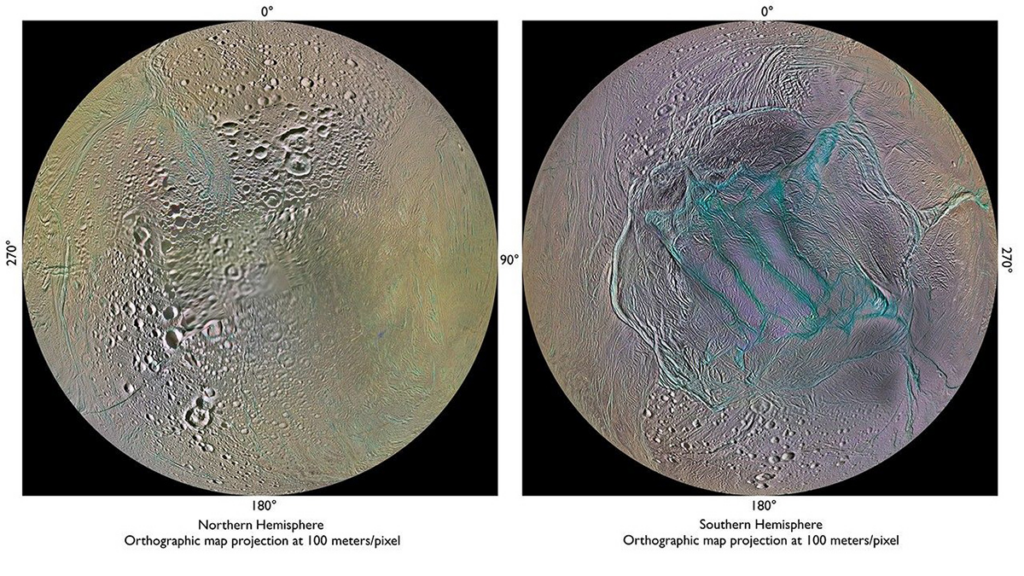
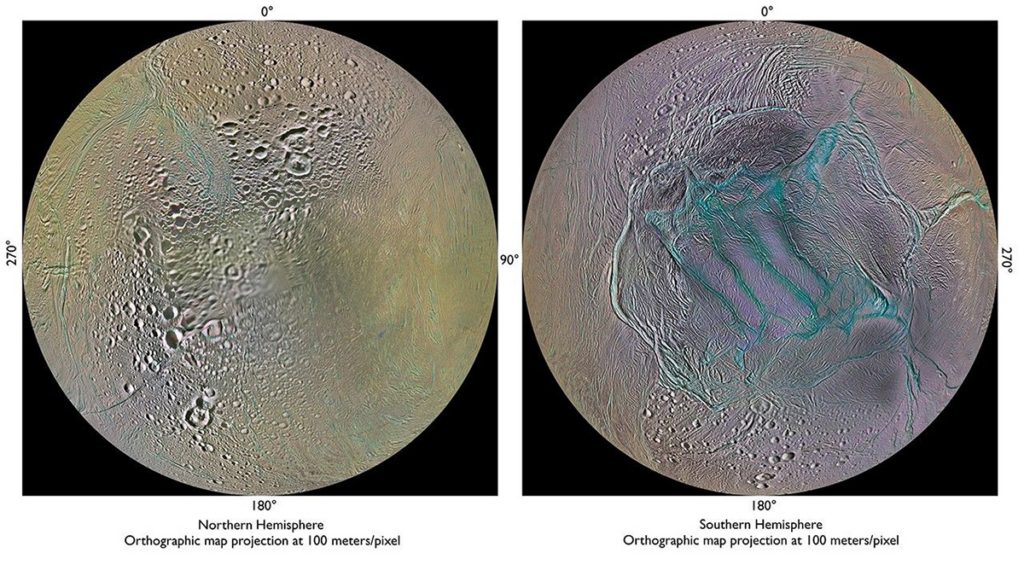
Saturn’s moon Enceladus sports a thick shell of ice surrounding a liquid water ocean. As though scraped by an enormous claw, four parallel cracks slash across its south pole. Each about 500 meters deep, 2 kilometers across, and 130 kilometers long, the fissures spew water vapor and other materials from the subsurface ocean directly into space. But the origin of these “tiger stripes” is mysterious.
Most prior research has explored the possibility that Enceladus’s tiger stripes were created by processes primarily involving the ice shell itself, such as tectonic fracturing and cooling. Now, Abdulah et al. show that waves in the ocean beneath the ice could play a deciding role in their formation.
The researchers took inspiration from ocean waves on Earth, which can propagate from the seafloor to the surface, focus to a point, break, and dissipate. Using mathematical analysis and computational simulations, the research team investigated how waves in Enceladus’s subsurface ocean might interact with the inner surface of the ice shell. They incorporated a key feature of the moon: Because of its irregular orbit around Saturn, the moon’s entire ice shell wobbles relative to its ocean.
In the new picture of tiger stripe formation, one initial fissure already existed in the ice shell. As the shell wobbled, the motion of the fissure’s uneven underside topography against the liquid ocean below excited waves, which traveled tens of kilometers through the ocean down to the seafloor. The waves then ricocheted back up and broke against an adjacent part of the ice shell, imparting energy as heat that began to melt the ice from beneath.
The analysis suggests that this melting could kick-start a process that would eventually carve out additional parallel fissures about 35 kilometers apart from each other—matching the observed spacing of Enceladus’s existing tiger stripes.
If this proposed mechanism is correct, it would set constraints that reveal additional characteristics of the subsurface ocean, including how its density changes with depth. Additional modeling and a possible future mission to Enceladus could help refine and test the mechanism and its implications. (AGU Advances, https://doi.org/10.1029/2026AV002539, 2026)
—Sarah Stanley, Science Writer

Citation: Stanley, S. (2026), Did ocean motion carve Enceladus’s tiger stripes?, Eos, 107, https://doi.org/10.1029/2026EO260272. Published on 26 August 2026.
Text © 2026. AGU. CC BY-NC-ND 3.0
Except where otherwise noted, images are subject to copyright. Any reuse without express permission from the copyright owner is prohibited.