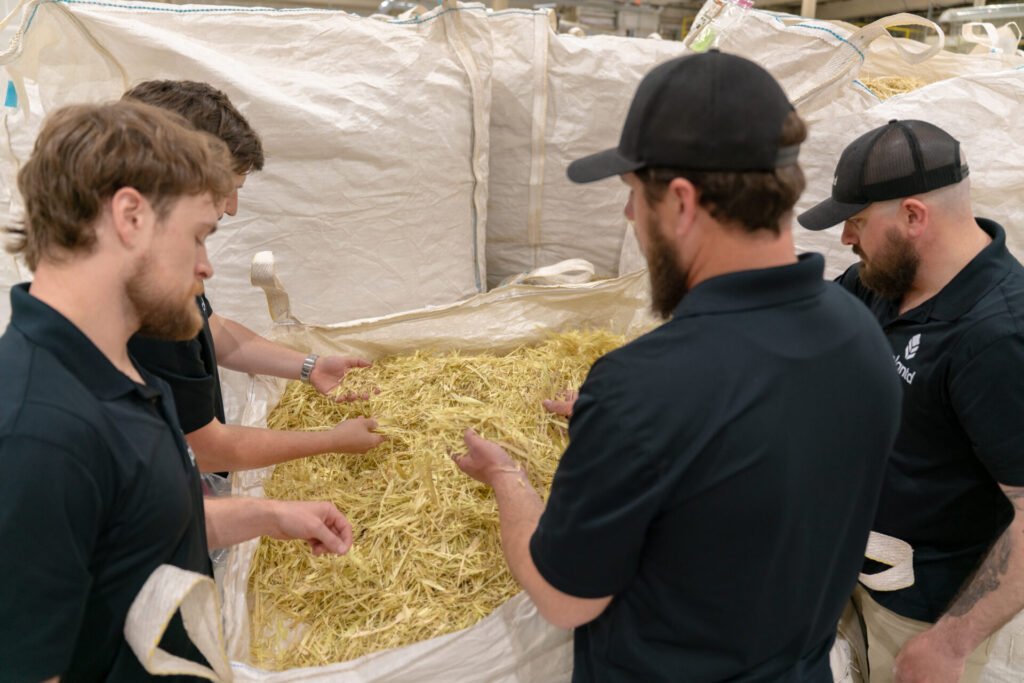
Not long ago, Plantd grappled with $13,000 in waste-removal costs each month thanks to leftover biomass from its construction panel manufacturing. But rather than simply absorb those costs, cofounder and CEO Nathan Silvernail took something of a left turn and landed on agriculture as the key to the problem. Specifically, he discovered the promise of biochar, which farmers have used as a soil amendment for thousands of years.
The result: Plantd, which is best known for its construction panels made from grass, launched a biochar product line this week it now sells to the agricultural industry. Farmers can use it as a soil amendment to reduce fertilizer usage and improve composition, and Silvernail says the new product line provides another substantial revenue stream for the North Carolina-based company.
The biochar line also brings the company a step closer to achieving a fully closed-loop manufacturing process.
Grass roots
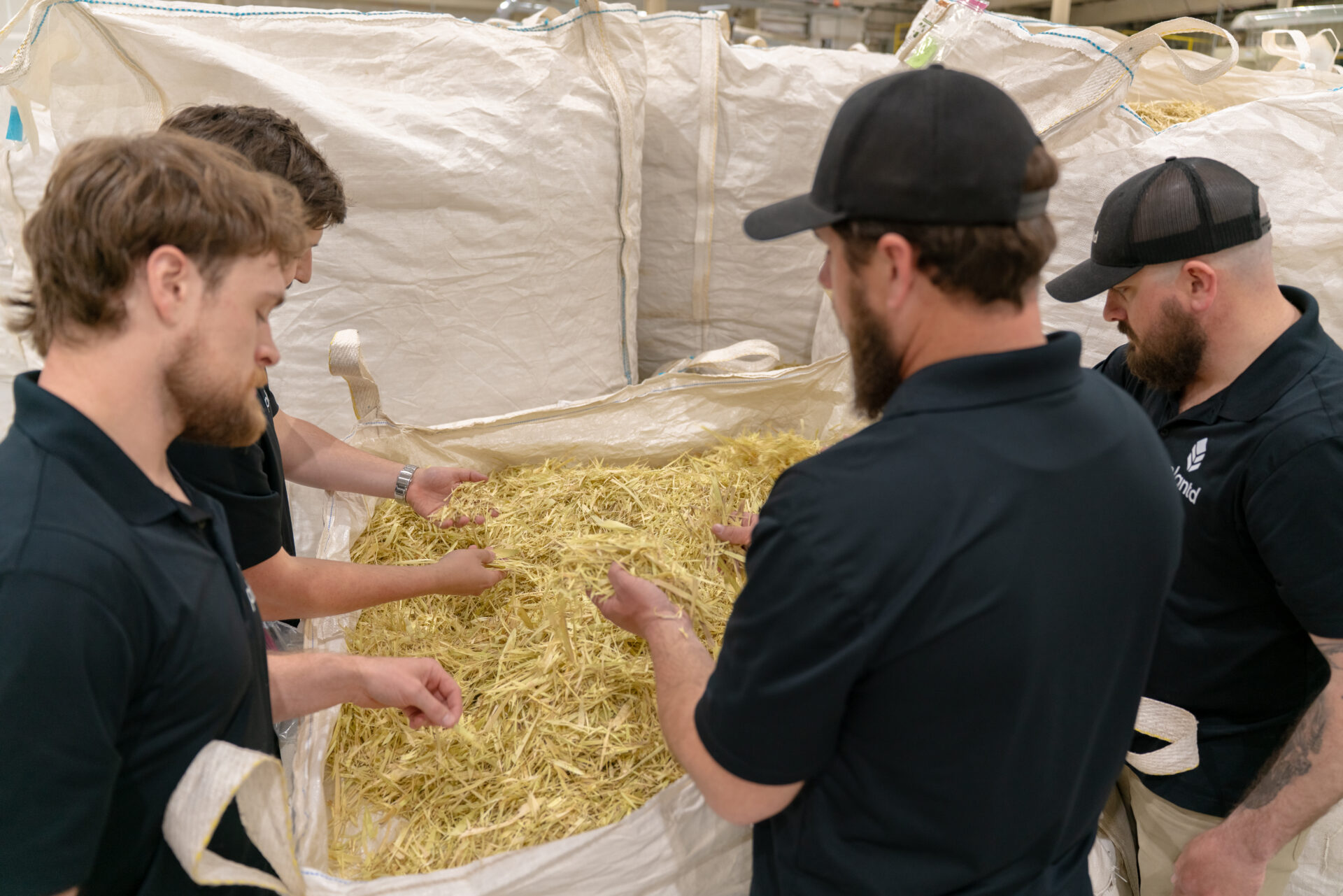
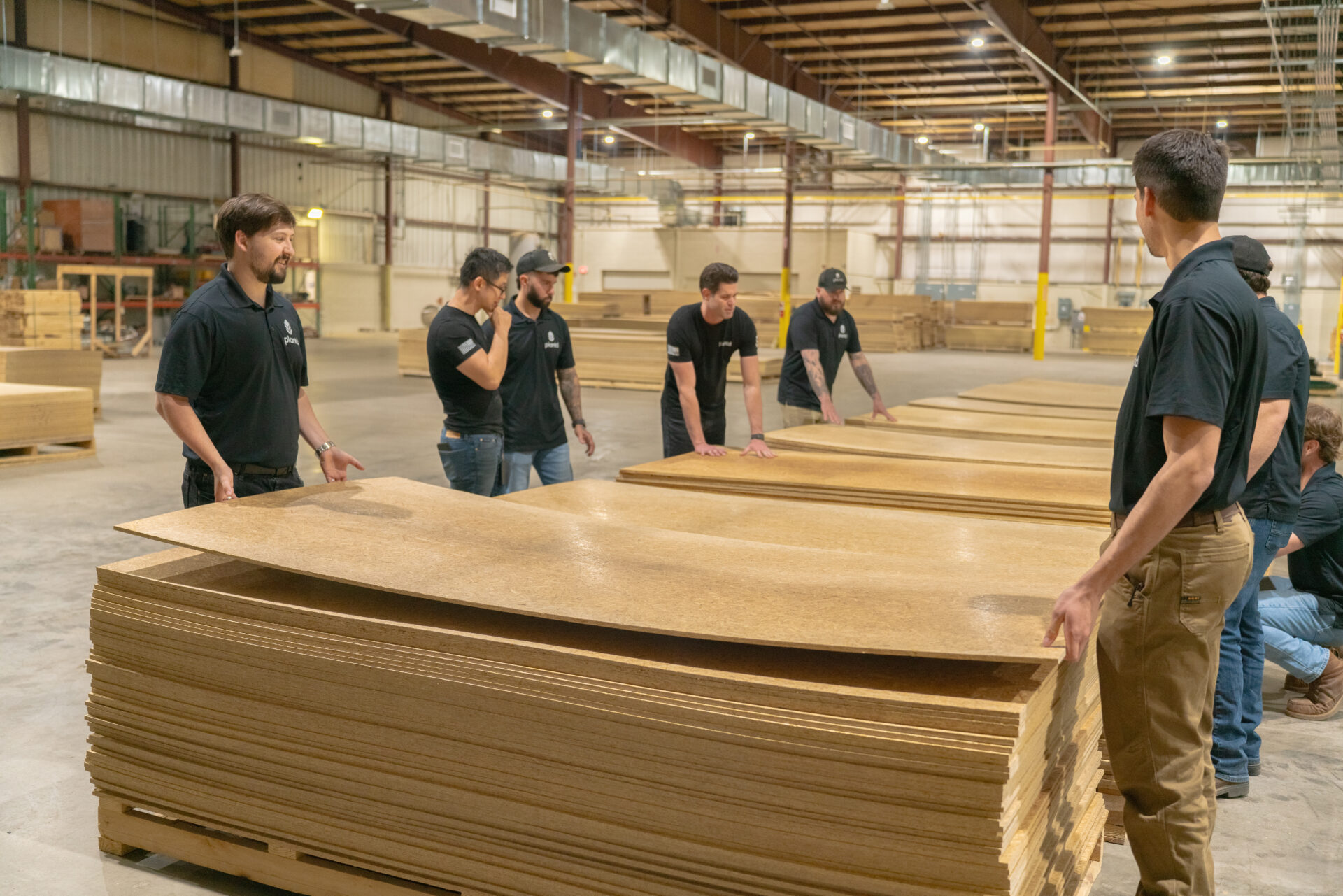
Plantd’s main businesses is developing building materials with a hearty, fast-growing perennial grass as source material. (While the company does not publicly disclose the specific species, photos suggest a cane grass.) Instead of the standard wood strands and synthetic adhesives known in construction, the company extracts fibers from this grass and compresses them into structural panels it markets as a “drop-in” replacement for OSB board.
Silvernail spent several years at SpaceX as an engineer, and says he applied learnings from that period to the development of Plantd.
“I’ve spent a lot of time building rockets and spacecraft, and one of the biggest things that you have to solve for is mass. Any additional kilogram of weight when you’re trying to get to orbit is incredibly expensive, so you’re always minimizing that.”
The same ethos applies to building a company elsewhere, he says. This is especially true if the goal is to make it sustainability-focused from the start.
“Oftentimes we solve capitalistically, but we’re not actually solving for sustainability. I’m a believer that if you solve for sustainability and efficiency from the get-go, all of the cost efficiencies come with it.”
For example, Plantd’s grass crops use land more efficiently than forestry, he says, as relying on trees normally requires huge swaths of land that are only ready for harvest every 15 years.
“You don’t get that much biomass from one acre of land, so you’re spread out, which means your supply chain just to get the biomass to your manufacturing facility is very large, which is very costly, and costly in emissions.”
By contrast, Plantd operates monoculture plantations for its grass, for which harvests occur nine months after planting. Its manufacturing facility is situated on the plantation, cutting more logistics costs.
“That basically gives us a 15x land advantage over any timber,” says Silvernail.
From waste to ‘top-of-the-line’ fertilizer
Silvernail suggests the addition of a biochar is the next logical step in achieving a closed-loop manufacturing process for its construction panels.
The initial idea was to cut the aforementioned monthly waste bill by turning the biomass leftover from panel production into biochar.
“We were producing so much [of its construction panels], our waste numbers were high,” says Silvernail. In an effort to turn that liability into revenue, Silvernail used a benchtop-scale bioreactor to produce some biochar and sent it out for testing.
“We realized from the test results that it was basically premium,” he notes. “This was pretty much top-of-the-line fertilizer.”
Biochar is a solid, carbon-rich material made by heating biomass—usually organic waste, plants, and forestry byproducts—to extreme temperatures in the near or total absence of oxygen. The process converts some of the CO2 present in the biomass into durable carbon that resists environmental degradation.
Farmers have employed biochar in the field for at least 2,000 years. In modern times, it’s known for helping farmers reduce overall fertilizer use, and to add carbon to the soil.
Plantd markets its biochar product as a soil amendment for farms that can also rejuvenate damaged soils and possibly even sequester enough carbon to warrant a carbon credit strategy down the line, says Silvernail.
The company claims its biochar is also a more consistent, superior product to many biochar products available right now.
“Not all biochar performs the same in the field,” notes Plantd director of agriculture Dr. Janel Ohletz. “Our high silica content biochar has been shown to improve crop disease resistance and shows promise for delivering stronger agricultural performance than wood-based biochar.”
She adds that Pland’s biochar also delivers better water retention, improves soil structure, naturally raises soil pH, and offers long-term carbon storage.
The company is currently working with agricultural solutions provider Qualterra on the biomass processing. Through that relationship, Plantd has also established an initial customer base for the soil amendment product.
A zero-waste manufacturing model
In future, however, not all of Plantd’s biochar product will go on fields. At least part of it will become energy for the company in its own manufacturing operations.
Currently, Plantd’s all-electric machine for making construction panels runs off grid power. While plans are in place to move this to solar and wind power in future, Silivernail says the gasification process of the biomass into biochar is another possible energy source for operations.
This in turn would bring Plantd a step closer to its vision of a completely closed-loop manufacturing system laid out by Silvernail: “We grow the plants. We put them through our process. We use electricity for that. [The waste] goes in through this carbon process, then puts more electricity, more heat back into the system, which drops our initial costs down and makes the initial product.”
“This is what a real zero-waste manufacturing model looks like, where every part of the process becomes a product.”
The post Exclusive: Plantd converts a construction waste problem into revenue with new biochar line appeared first on AgFunderNews.