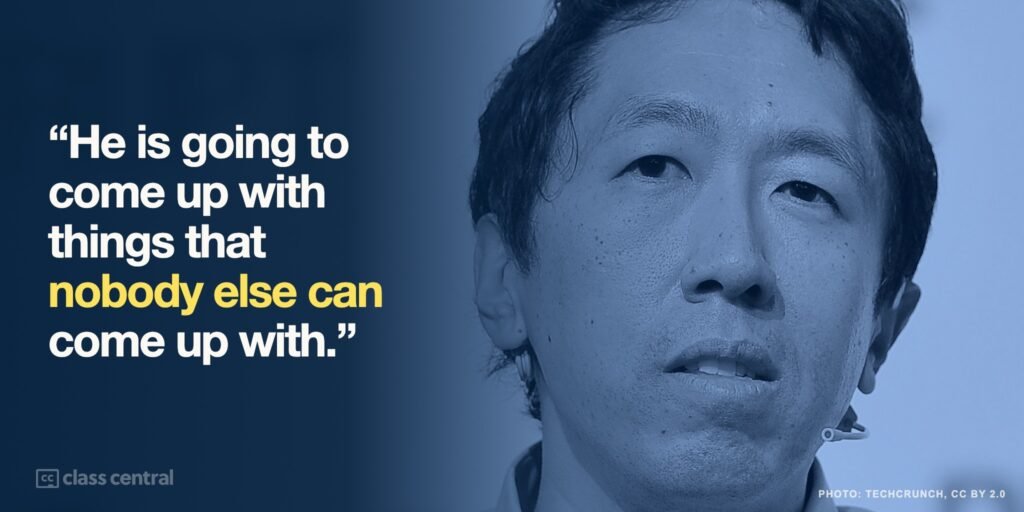

“Andrew is literally the only person that both Sam Altman and Dario Amodei have worked for. He is going to come up with things that nobody else can come up with.”
“We don’t know exactly what those inventions and innovations will look like yet, but I’m highly confident that he is uniquely positioned to come up with things that we wouldn’t have come up with on our own.”
That’s Greg Hart, Coursera’s CEO, on the July 29 earnings call, the first one since the Udemy merger, explaining why Coursera put $100 million into a company that doesn’t have a product yet.
To recap: LearnVector was founded by Andrew Ng, Coursera’s co-founder and the current chairman of its board. It was announced one day before the earnings call, and the arrangement doesn’t add up for me. Coursera provides the content, the distribution, and the money, and gets a third of the company in return.
LearnVector’s website itself felt very vibe-coded. In my experience, companies share a lot more with investors on an earnings call. Outside of using agentic AI for some sort of one-to-one learning platform built on Coursera and Udemy’s content, there isn’t much there.
One thing I did learn is that Coursera is building what Hart called a “new AI-native unified platform,” and expects to roll it out “over the first half of next year.”
Andrew Ng joined the call and gave prepared remarks. The wording was close to what LearnVector’s website already said. After that, he didn’t say anything else.

Here are some of the questions analysts asked about LearnVector:
- Why not buy back stock instead?
- What is the commercial arrangement between the two companies?
- Is this a conflict of interest, and why can’t Coursera build this itself?
Ng answered none of them. Coursera’s CEO Greg Hart and CFO Mike Foley took the questions.
The answers mostly came down to how good Andrew Ng is, and how much Coursera believes in him. There wasn’t much about what he’s actually going to build.
Will LearnVector Use Coursera’s Course Content?
One question stood out to me. An analyst asked whether LearnVector would train AI on Coursera’s content.
In his opening remarks, Andrew Ng talked about how learners want something they can trust, and how Coursera and Udemy have that trusted content. So the plan is to use the content in some way.
At first the answer looks like a no. Here is Greg Hart:
“They are not trained on the course content. Obviously, that’s the IP of our partners. No, there is no training that is done on the course content other than the specific AI features that we have within each individual course.”
I read it a few times. LearnVector hasn’t built anything yet, so there is nothing to train in the first place. Hart is telling us what is true today, not what happens once there is a product. Maybe I am reading too much into it.
What Coursera Is Allowed to Do With Partner Content
There is another question here. LearnVector is a separate company. Do Coursera’s agreements with its partners even allow it to share their content with an outside company?
Coursera filed its agreement with DeepLearning.AI, Andrew Ng’s other company, as an exhibit to its IPO paperwork. Deals with a company’s own chairman are related party transactions, and they get disclosed. It’s the same reason we know that DeepLearning.AI has crossed $100 million in sales on Coursera.
It’s the only one of these contracts anyone can read, so I went through it. Here is the license grant, in Section 3.1(a):
“Partner grants to Coursera a nonexclusive, sub-licensable, worldwide license to copy, distribute, modify, create derivative works based on, publicly perform, publicly display, and otherwise use Partner Course Content on Coursera Properties and for reasonable marketing purposes.”
“Sub-licensable” means Coursera can pass those rights on. So handing content to another company is allowed. But only for use on “Coursera Properties,” which the contract defines like this:
“Coursera’s properties (e.g., the Coursera website, mobile apps, and APIs; collectively, the ‘Coursera Properties’)”
Mobile apps are in there, which is why Coursera can build something like Ollie, the app it launched in June, out of partner courses. So are APIs.
There’s already a precedent. In October 2025, Coursera became one of the first apps inside ChatGPT, putting Coursera videos into ChatGPT conversations.

But that might fall under marketing purposes, which the contract does allow. The one contract we can see doesn’t make it clear how Coursera’s content could be used inside LearnVector.
Either way, none of it says anything about what the people who made the courses get out of it.
Class Central has written about this before. Both companies are allergic to paying the people who make the courses. Coursera started charging its partners a 15% platform fee last year. Udemy cut its instructors’ share of revenue and promised payouts wouldn’t fall, and I checked, and they fell anyway.
If I were a content creator on these platforms, I wouldn’t have a clear picture of how my content is going to be used, or how I will be paid for it.
Coursera can’t answer that yet either. Asked how the two companies will actually work together, Hart said:
“We’re working on a commercial relationship, but the high level approach is basically leverage the innovations that LearnVector comes up with to improve the platform on Coursera, and to deliver more personalized adaptive learning.”
And asked where LearnVector’s products would end up:
“As they are developed, they’ll be available on the unified platform. Some of them may be available on one or both of the independent platforms as well. We haven’t certainly gotten that far until we understand what some of the products might be.”
I’ve been reading these calls for years, and they usually give you more than the press release does. This one didn’t. Coursera hasn’t said what LearnVector will build, or how the arrangement will work.
Between them, Coursera and Udemy bring in about $1.5 billion a year. The content creators behind that were not part of the conversation.
For now, the strategy is that Andrew Ng will figure it out.
The post Coursera’s $100 Million Thesis: Andrew Ng Will Think of Something appeared first on The Report by Class Central.