
From the Cool Cat Teacher Blog by Vicki Davis
Subscribe to the 10 Minute Teacher Podcast and Cool Cat Teacher Talk anywhere you listen to podcasts.
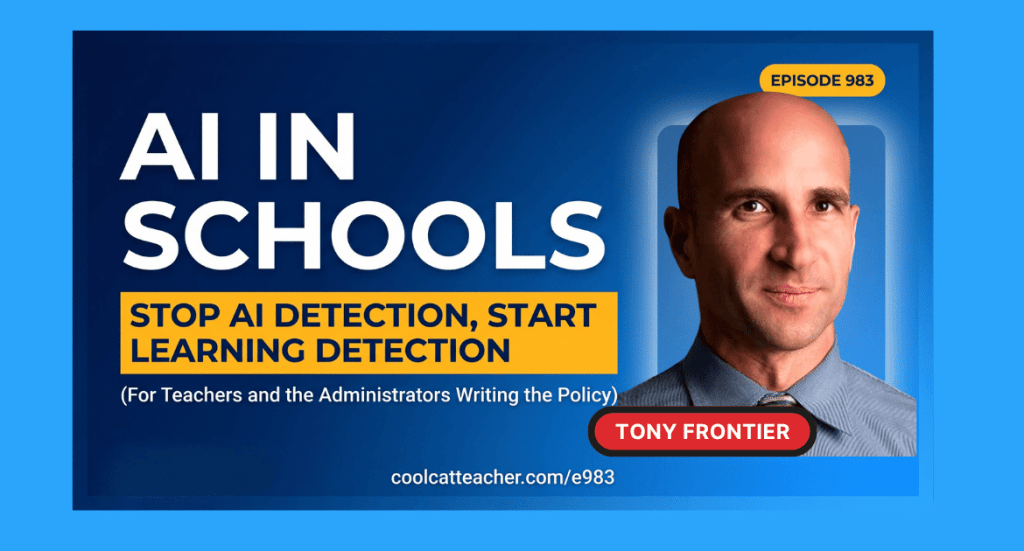
AI with intention. AI with integrity. Is it possible? Tony Frontier, author of AI with Intention, is talking about how we value learning in the age of AI. He shares the language we can use to evaluate what we’re doing, how we’re talking about AI, and how we’re measuring learning, and ultimately, why education needs to change more than ever.
I also open this show with some highlights from the Report of MIT’s Ad Hoc Committee on AI Use in Teaching, Learning, and Research Training and what it means for learning, and they use a term I think we should all be discussing: cognitive surrender. We cannot let our kids cognitively surrender and let AI do the work for them. They also talk about helping students understand that their learning, integrity, and judgment are the product of college, not the grades. So many challenges we have now, but this week has been about sharing the conversations and thought leaders to help you improve the AI conversation in your school. I hope this Thursday helps you be a thought leader in your school!
Listen to my conversation with Dr. Tony Frontier — or watch it on YouTube, or read the full transcript at the bottom of this page.
SPONSORED: Experience AI, a free program co-developed by the Raspberry Pi Foundation and Google DeepMind, sponsored this episode. All opinions are my own and those of the guest.
Experience AI is a free AI literacy program with ready to teach lessons for ages 8 to 16. The lessons are written for teachers of all subjects including: science, math, social studies, English, and art and some don’t even need a computer to use. Support your students to become critical thinkers and better understand AI technologies today. Explore the free resources at Experience AI.
Listen to the Show

Watch this video on YouTube.Subscribe to the Cool Cat Teacher Channel on YouTube
If the next voice is, I must not be very good at this, I must not be very smart — that’s a kid who is going to stop trying. And that’s where we lose kids… That’s a kid who has confused learning with compliance. And we did that to that kid.
Dr. Tony Frontier, Director of the AI Center for Effective Teaching and Learning
The AI Policy Dr. Tony Frontier Says Actually Works
You can listen to the whole conversation in the player above or read the full transcript below. Here is the framework Tony walked through, piece by piece. He has been running focus groups in high schools around the country — urban, suburban, rural, public, private, parochial — and his first finding is the one that should worry us: you cannot tell one school’s transcript from another.
Kids are using AI tools. Typically, kids say they use it twenty-five to forty percent of the time for their schoolwork… And there’s a group of kids say they use it all the time. I’ve had kids say they haven’t read anything since they were a freshman. They just have AI summarize everything.
— Dr. Tony Frontier
The second finding is the one we can actually do something about. Students told him they are not getting instruction. “There’s some vague permission, there’s a lot of outright bans, but there’s very little focused, specific lessons. Here’s how, here’s why.”
The 3 Choices Schools Have Right Now
Tony frames three approaches schools are taking. He says, “if you have access to a search bar, you have access to an AI tool that can do pretty much all of your homework, kindergarten through PhD.” So there are three doors:
- Let kids figure it out on their own. “A lot of videos out there on TikTok about how to use AI to cheat.”
- Let the tech companies decide. Just let the kids do everything.
- Take the lead. “The kids are ahead of us right now and we have to get ahead of the kids.”
✏️✏️✏️
Part 1: Guidelines and Boundaries
Boundaries say what is off-limits. Guidelines describe what good looks like. Tony’s warning is that most schools write only the first kind and think they are done. Wow, are we giving kids guidelines? Are we modeling good uses?
Do you have any good uses of AI that you can model for your students tomorrow? Can you show them the chat and what you did? Can you show them how you figured out AI was wrong on something or why you made other choices than the AI did for the work. This is part of disclosure and transparency, but also modeling and giving guidelines.
Part 2: Define Effective, Ineffective, and Inappropriate Use
Sit down and define what these look like in your school. Sit down with paper and write one-sentence definitions for what this looks like. Tony’s point is that the definitions have to be specific enough to provide direction but general enough not to micromanage a teacher’s judgment or expire the moment a tool changes.
- Effective — aligned and intentional.
- Ineffective — “I used AI to complete my work, but I can’t explain the work that I completed.”
- Inappropriate — privacy violations, cheating, “things that are completely inappropriate.”
He notes there is a toolkit with worked examples published through the AI Center for Effective Teaching and Learning.
Part 3: The Core Commitments
This is the part that Tony says many schools skip entirely, but that is essential. Remember that whatever we ask of students, we model. I’ve included quotes from Tony for each of these, but listen to the show for the full context. (And remember his book AI with Intention: Principles and Action Steps for Teachers and School Leaders has many of these items.)
3 Commitments for Students:
- Integrity — “Can a student say I used AI tools in ways that are aligned to my teacher’s communicated expectations?”
- Transparency — “I document and report any tool or resource I use.”
- Explainability — the student “is always accountable to explain, justify, or further explain the work that they did.”
3 Commitments for Teachers
- Fidelity — is this aligned to stated priorities for teaching and learning? “I don’t mean everyone’s on page 263 of the teacher’s manual.”
- Transparency — “We need to model the transparency we expect from our kids.”
- Explainability — “If I used AI to create a slideshow or an assessment, I should be able to say, here’s why this specific academic language is here.”
Tony really implies these aren’t for “gotchability” but a framework for intentionality and admin support within the commitments.
Not because we’re looking to catch people doing the wrong thing… If I’m a teacher and I’m awake at two AM worried about something, and I know I used AI for something the day before, I want to know that I have administrative support.
— Dr. Tony Frontier
Make “Who Helped You With This?” a Normal Question
One point here is important to hear: “I’ve yet to hear a compelling reason why kindergarten through fifth-grade kids should be using LLMs.” He also talks about making transparency with who did the work part of what is done, to level the playing field as much as anything.
We should just make it normal starting in kindergarten. Who helped you with this? My mom helped me, or my older sibling helped me… Because if I don’t know what you can and can’t do independently, I can’t teach you.
— Dr. Tony Frontier
In my AP Computer Science Principles classroom, my students can use AI to write code. However, they must be prepared to explain every line of code, what it does, and how the code works. If they cannot, I reserve the right to have them remove the code to see if it still works. I care more about learning detection than AI detection. In fact, students who resisted AI in that course, in my opinion, did not do as well as those who used it wisely for learning support.
Cognitive surrender — Falling back on AI at the first hint of struggle, and getting the illusion of learning instead of the learning. This is not Tony’s phrase and it is not mine — it comes from the Report of MIT’s Ad Hoc Committee on AI Use in Teaching, Learning, and Research Training (August 25, 2026), which I read from at the top of this episode. MIT’s point is that giving in to that option cheats students out of the cognitive friction that actual learning requires.
Explainability — A student’s accountability to explain, justify, or further explain the work they turned in.
⚠️ Be careful with this one: in the AI industry, “explainability” means something else entirely — whether a human can understand why the model produced a given output. Tony is using it about the student, not the machine. Both meanings are legitimate; they are just not the same word doing the same job. Source: Dr. Tony Frontier, AI Center for Effective Teaching and Learning.
Agency / agentic learner — A learner who asks questions, seeks clarification, wants personal relevance, and can say “help me out here, I need that differently.”
⚠️ Same caution: “agentic AI” in the tech press means software acting on its own. Tony’s “agentic learner” is about the human doing the acting. As he puts it, our most agentic learners are our kindergartners. Source: AI Center for Effective Teaching and Learning.
Humanizer — A tool that rewrites AI-generated text so it will not trip an AI detector. There is no official definition for this one; it is student vocabulary. Tony’s finding is the part worth knowing: some students start using humanizers after being falsely accused — “I didn’t use AI, but once I got accused, now I run everything through a humanizer.”
These are new to my AI Vocabulary List — I’m adding them. Want to find out how many of these words you already know? Play Spy the AI, the free vocabulary game I vibe coded from that same list.
Stop Doing AI Detection. Start Doing Learning Detection.
As I said in the show, AI detection whack-a-mole, to me as a teacher, is pretty pointless. I have moved to at least two oral assessments every grading period. So I as told him: we shouldn’t be about AI detection; we should be about learning detection. He says the same thing in a similar way.
He said “Exactly” — and then told me the session he had just given is called Catch Them Learning. That is great!
Here is why the switch matters, in his words. It changes who carries the burden of proof. I think this table helps explain it.
| Chasing cheating | Building integrity |
|---|---|
| “Did the student actually do the work?” | “Does this work actually represent the student’s true knowledge and skills?” |
| “Now it’s on me to prove that you cheated.” | “Integrity is a shared responsibility between the student and the teacher.” |
| A policy about what we’ll do if we catch you | A policy about what we’ll both do to make the work real |
What a lot of people realize is their academic integrity policy — it’s really a what we’ll do if we catch you cheating policy. It’s really about what not to do.
— Dr. Tony Frontier
As he said earlier, students need to be modeled what to do with AI and not be given a list of things that you can’t do.
What To Watch Out For: Tony had some lines we need to read.
- The arms race you cannot win. (13:48) — “The technology arms race is always going to be one that the students can win. Simply because there are more of them than there are of us.”
- False accusations create the behavior. (13:48) — “I’ve had a few kids in a few different schools say, I didn’t use AI, but once I got accused, now I run everything through a humanizer.” As Tony puts it: “it’s like the teacher forced them into using AI.”
- Detectors catch the wrong students. (13:33) — my own line, and Tony confirmed it from his focus groups: the only kids who get caught using AI are the ones who don’t know how to use AI.
- Policies that try to put the genie back. (17:16) — see the Blockbuster section below.
Where We Lose Kids
I asked Tony a question that I, as a mom of a couple of dysgraphics, wonder: does it make it okay if you can pay to have a human writing coach, but not okay to turn AI into a writing coach? His answer started with IEPs and case-by-case judgment and he says that is important. But then, he makes a great point that speaks to equity.
When my kids came home from school, stuck on their schoolwork, they had a dad with a PhD and a mom with a master’s degree to help them. No one ever asked, right, did your parents help you with this? But we’re hyper-concerned now about, did I help you with this? We should have been asking those questions all along.
— Dr. Tony Frontier
Then he described the moment a student’s inner voice turns. What happens when a kid says “I’m stuck, I don’t get it?” But it can happen often by second or third grade, sometimes as early as the end of first, the next voice becomes “I must not be very smart.” That kid stops trying. And the only tool they can think to reach for is one that hands them the answer. This is not good. (It is the cognitive surrender that MIT talked about in their report and one we need to be watching out to prevent!)
Our Most Agentic Learners Are Kindergartners
Our students with the greatest level of agency in our schools, they’re our kindergartners. They come in, they ask questions, they want to know, they want to tell you. That’s how we want kids to interact with AI tools.
— Dr. Tony Frontier
And the skills turn out to be the same ones we already teach: “Asking questions, seeking clarification. If something isn’t working for your learning, can you stand up and say, help me out here? I need that differently.”
An Image to Help: The Blockbuster Boardroom
When Tony hears schools talk about ramping up policies to catch cheating, this is what it sounds like to him:
Some of the conversations that were probably happening at the Blockbuster video boardroom right around 2010. Where it was like, you know, if we just get this late fee thing right, everything’s gonna be fine. No — that was a transactional solution to a transformational challenge.
— Dr. Tony Frontier
The transformational challenge, he says, is that how people receive and consume entertainment had completely changed. It did not matter how hard Blockbuster chased the late fee policy. It was the wrong conversation.
And perhaps instead of the AI “whack-a-mole” detection impossibility (wrong conversation) we should instead be having a conversation about what truly makes education (the right convo to have, perhaps?)
Tony says: “We have an education model that’s built on 1890s technology. We’re gonna batch process kids, roll them down the conveyor belt” — same page, same pace, same time, because that is how you manufacture things. His argument is that these tools, used well, finally make it possible to stop.
Try This Tomorrow: The Quarter Sheet of Paper
When I told Tony this kind of conversation takes time, he agreed. Then he gave the single most usable thing in the episode. Students upload the assignment the night before. The next day, on a quarter sheet of paper:
- Here is an important word from last night’s homework. Write your definition of it.
- What was the main idea?
- What was your biggest takeaway from last night’s assignment?
No, you cannot grade a hundred and forty of those every day. That is not the point.
It’s not just turning it in. I want to know what you know. I want to know what you don’t know. I want to know what questions you have. It starts to shift the culture.
— Dr. Tony Frontier
I remember in 1991 I started teaching people how to use the internet. I remember people being scared. Others were angry. And I received criticism that I was somehow a bad person because I believed people needed to learn to use the Internet properly and civilize it. Internet used to be a proper noun. In 2016, we started using internet in lowercase. That is how much the internet became part of everything we do. Enough to no longer be a proper noun! It is no longer a question of whether we use the internet; it is how, when, and why. We need intentionality there, too.
The criticism that came with Web 2 stung a little less. But by now, I just move forward. AI is the most powerful technology we’ve ever encountered as a general populace, and it comes with far more responsibility.
This technology is literally different for everyone who uses it. Previously, if I logged in to an app, I might have a similar experience to yours. No more. A thousand tiny nuances from how we speak and type to what we ask can cause our experiences to be far different. The challenges with bringing student-facing and teacher-facing AI to schools are many, but it is here, and we have to move forward and have the conversations that matter. AI detection is just so not the convo to be having.
I hope that you’ll pick up Tony’s book and use what I’ve shared with you here to add to the conversations you’re having at your school.
Resources Mentioned in This Episode
- Report of MIT’s Ad Hoc Committee on AI Use in Teaching, Learning, and Research Training — released August 25, 2026. The report I read from at the top of the show, and the source of “cognitive surrender.” Read it yourself; do not use AI to summarize it.
- The AI Center Implementation Toolkit — the toolkit Tony references on air, with the worked examples of effective, ineffective, and inappropriate use. It includes a four-phase planning process plus the full set of guidelines, boundaries, and shared commitments.
- Guiding Principles and Action Steps — the free PDF for leadership teams and teacher teams, from the AI Center.
- AI with Intention: Principles and Action Steps for Teachers and School Leaders — Tony’s newest book, with a foreword by Jay McTighe. Also available from ASCD.
- Students’ Perceptions of AI in Seven High Schools: Moving from Avoidance and Deterrence to Responsible Engagement — Tony’s write-up of the focus-group work he describes in this episode. This is where the twenty-five-to-forty-percent finding comes from.
- The AI Center for Effective Teaching and Learning — Tony directs it. Also home to the AI2TPS teacher-perception survey and the student focus-group protocol, if you want to run this in your own school.
- Experience AI — this episode’s sponsor. Free AI literacy lessons from the Raspberry Pi Foundation and Google DeepMind.
About Dr. Tony Frontier

Dr. Tony Frontier was a teacher in Milwaukee Public Schools and a high school principal, K-12 curriculum director, and University Professor. He is currently the Director of the AI Center for Effective Teaching and Learning where he works with schools and districts to ensure AI tools are used in ways that support, rather than undermine, effective teaching and learning. He is author of 6 books and numerous articles. His most recent book, AI with Intention, Principles and Action Steps for Teachers and School Leaders with a foreword by Jay McTighe, and has been praised by John Hattie as “the best book I have read to introduce all to optimize the power of AI.”
Find Tony: AI Center for Effective Teaching and Learning · LinkedIn · ASCD
Other Shows for Teachers and Administrators Writing AI Policy
- Creativity and Art in an AI World — Susan M. Riley on why creativity is the defining skill of the AI era. This is the Monday show where we used the phrase “hard fun,” which MIT uses in this report too.
- How to Build Your Own Data Dashboard: No Coding Required — A.J. Juliani on building your own AI tools, de-identifying student data, and the one question to ask any vendor.
- AI With Intention: What Leaders Decide and Teachers Do — Tony as part of the AI and Edtech SuperSeries from ISTE 2026.
Disclosure of Material Connection: This is a sponsored episode and blog post. Experience AI has compensated me to share information about the Experience AI program. However, all opinions expressed are my own. I have personally reviewed these resources and only recommend tools I believe offer genuine value to classroom teachers. My endorsement is limited to the educational products and services discussed in this episode. I am disclosing this in accordance with the Federal Trade Commission’s 16 CFR, Part 255: “Guides Concerning the Use of Endorsements and Testimonials in Advertising.” The sponsor has no impact on the editorial content of this show.
Disclosure of Material Connection: This episode includes some affiliate links. This means that if you choose to buy I will be paid a commission on the affiliate program. However, this is at no additional cost to you. Regardless, I only recommend products or services I believe will be good for my readers and are from companies I can recommend. I am disclosing this in accordance with the Federal Trade Commission’s 16 CFR, Part 255: “Guides Concerning the Use of Endorsements and Testimonials in Advertising.” This company has no impact on the editorial content of the show.
The post AI in Schools: Stop AI Detection, Start Learning Detection appeared first on Cool Cat Teacher Blog by Vicki Davis @coolcatteacher helping educators be excellent every day. Meow!
If you’re seeing this on another site, they are “scraping” my feed and taking my content to present it to you so be aware of this.